
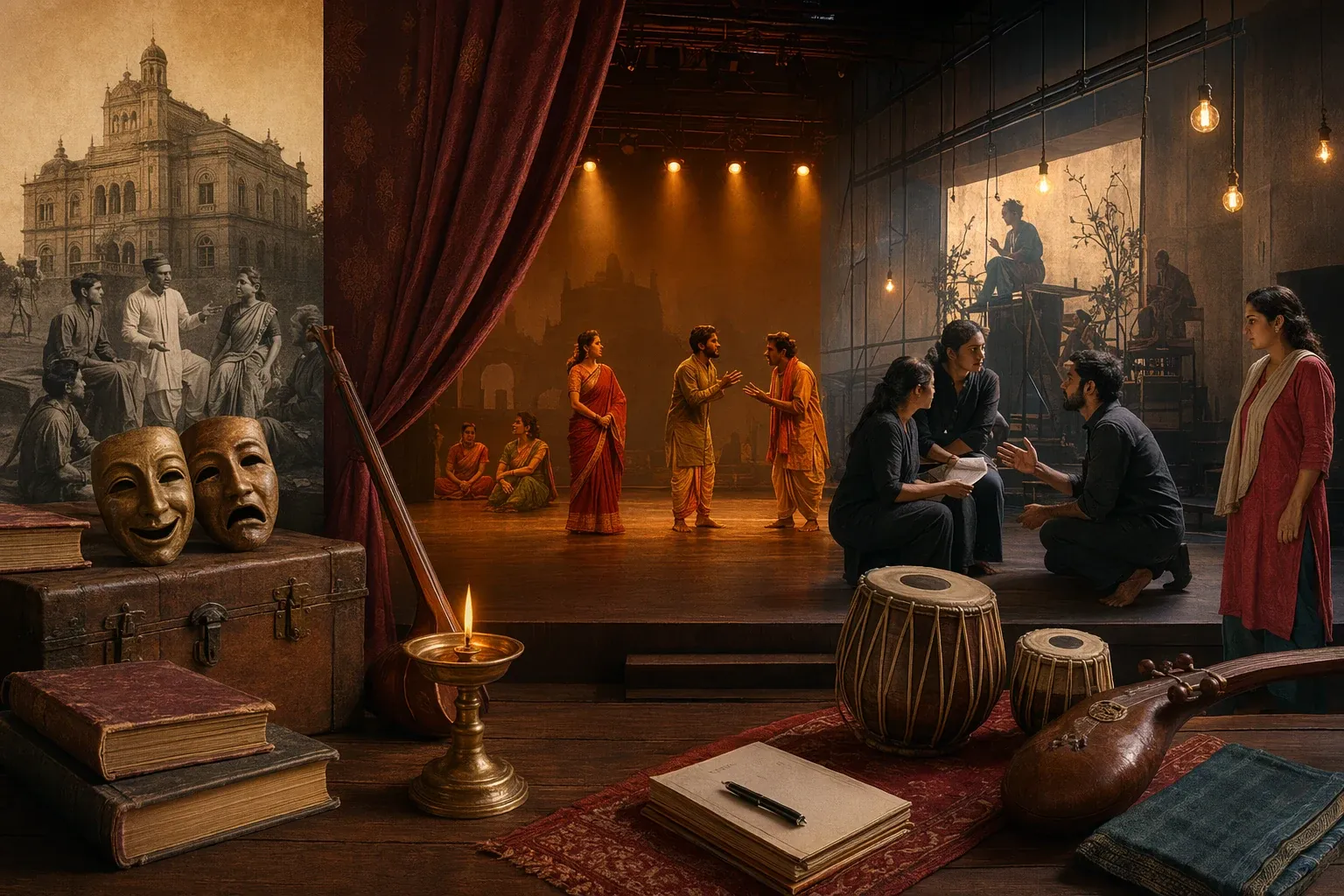
Modern Indian theatre is the theatre that developed as Indian performers, writers, directors, and audiences met new stage spaces, colonial institutions, printing, urban publics, social reform, nationalism, and global dramatic ideas. It did not replace older Sanskrit, folk, devotional, or community performance traditions. Instead, it created a new conversation: how can Indian stories speak on modern stages without losing Indian languages, memories, and social concerns?
To compare modern theatre with older and parallel performance worlds, read it alongside history of Indian theatre, types of Indian theatre, Indian theatre basics, Natya Shastra and Indian performing arts, and Indian classical music because modern stages often respond to classical theory, regional forms, music, public audiences and changing performance spaces.
The phrase “modern Indian theatre” usually points to the nineteenth and twentieth centuries, especially the growth of urban theatre, proscenium stages, ticketed audiences, regional-language playwriting, realism, political theatre, theatre education, and experimental forms after independence. It is a story of influence, adaptation, resistance, and creativity.
The proscenium changed the viewing habit
One important Western influence was the proscenium stage: a framed stage where the audience sits in front and watches a separated performance area. Older Indian forms often used courtyards, open grounds, temple theatres, processional spaces, or flexible audience arrangements. The proscenium created new habits of scenery, lighting, curtains, entrances, exits, realism, and ticketed public viewing.
This did not automatically make theatre better or worse. It simply changed the grammar. A drawing-room scene, a historical court, a prison, or a realistic family conflict could be staged with furniture and sets. At the same time, some performers felt boxed in by the frame and later searched for open-air, street, courtyard, and experimental spaces.
Western influence did not mean copying the West
Indian playwrights and directors used Western theatre in selective ways. They learned from Shakespeare, Ibsen, Brecht, Greek tragedy, realism, naturalism, modernism, and actor-training systems, but they did not merely imitate them. They placed these tools inside Indian languages, caste realities, gender questions, colonial anxieties, nationalist emotion, mythological memory, and regional histories.
For example, Shakespeare entered Parsi theatre, school and college performance, and professional companies in adapted forms. Realism helped playwrights examine family, society, hypocrisy, and reform. Brechtian ideas of distance and political theatre influenced some Indian groups, while Indian performance already had its own traditions of narration, song, direct address, and commentary.
Parsi theatre and popular urban performance
Parsi theatre became a major bridge between older storytelling and modern commercial performance. From the nineteenth century onward, Parsi companies toured widely and used painted scenery, music, melodrama, romance, comedy, historical subjects, mythological stories, and spectacular stage effects. They performed in Gujarati, Urdu, Hindi and other languages, influencing popular theatre and early Indian cinema.
A modern reader may think melodrama is unserious, but Parsi theatre built audience habits. It trained spectators to enjoy songs, emotional reversals, villains, heroes, comic relief, grand scenes, and recognisable moral conflict. Many features later became familiar in films too.
Theatre became a voice of reform and nationalism
During colonial rule, theatre was not only entertainment. Plays could comment on social reform, education, widowhood, caste, gender, poverty, colonial authority, and national feeling. In Bengal, Maharashtra, Karnataka, Hindi-speaking regions, Tamil areas, Kerala, Assam, Punjab and other regions, theatre became part of public debate. The stage was a place where society could see itself and sometimes feel uncomfortable.
The Indian People’s Theatre Association, formed in the 1940s, is an important example of people’s theatre linked with social and political awakening. IPTA artists used song, drama, street performance, and progressive cultural work to speak about famine, workers, peasants, freedom, and injustice. Whether one agrees with every ideology or not, IPTA showed that theatre could leave elite rooms and address public suffering directly.
After independence, institutions shaped training
After 1947, modern theatre needed training spaces, repertory work, translation, criticism, and national festivals. The National School of Drama, set up by Sangeet Natak Akademi in 1959, became one of the important institutions in this story. Under figures such as Ebrahim Alkazi, NSD developed disciplined actor training, design thinking, and serious staging of Indian and world drama.
Alkazi’s productions of plays such as Andha Yug, Ashadh Ka Ek Din, Tughlaq, and works from Shakespeare and Greek drama helped define modern Indian theatre practice for many students and audiences. His work also reminds us that modern Indian theatre was not only about writing; direction, scenography, actor training, repertory culture, and institutions mattered deeply.
Regional playwrights made modernity Indian
Modern Indian theatre becomes truly exciting when we look at regional-language writers. Mohan Rakesh in Hindi, Vijay Tendulkar in Marathi, Girish Karnad in Kannada, Badal Sircar in Bengali, Habib Tanvir in Hindi and Chhattisgarhi theatre contexts, Mahesh Elkunchwar in Marathi, and many others used theatre to ask sharp questions about power, identity, memory, gender, violence, and freedom.
Karnad used myth, history, and folklore in plays such as Tughlaq, Hayavadana, and Nagamandala to speak to modern anxieties. Tendulkar examined social violence and moral hypocrisy in works such as Ghashiram Kotwal and Sakharam Binder. Badal Sircar moved away from the proscenium into what he called Third Theatre, using simpler spaces and closer audience contact. Habib Tanvir drew from Chhattisgarhi performers and folk energy while making modern political and social theatre.
Modern theatre also questioned modern theatre
By the late twentieth century, many Indian theatre-makers were no longer satisfied with simply using Western realistic forms. They returned to folk performance, classical ideas, oral storytelling, masks, music, ritual movement, street theatre, and local bodies of knowledge. This was not a backward move. It was a creative search for forms that felt rooted and alive.
Street theatre, campus theatre, feminist theatre, Dalit theatre, regional repertories, children’s theatre, documentary performance, and experimental collectives all expanded the field. Modern Indian theatre became plural: a Marathi political play, a Manipuri physical theatre work, a Kannada mythic-modern play, a Bengali courtyard performance, a Hindi street play, and an English-language city production can all belong to the modern landscape.
A balanced way to understand it
Modern Indian theatre is not simply “Western influence in India.” That is too small. A better definition is: modern Indian theatre is the meeting point of Indian languages, older performance memories, colonial-era stage forms, social change, political urgency, modern education, and artistic experiment. It borrowed, argued, transformed, and invented.
For beginners, remember three shifts. First, the proscenium and urban public changed staging. Second, writers used theatre to discuss modern society, not only mythological story. Third, directors and groups kept searching for Indian performance energy beyond imported models. That search is still continuing.
Frequently asked questions
What is modern Indian theatre?
Modern Indian theatre is the theatre that grew through colonial-era stages, regional-language playwriting, social reform, nationalism, institutions, experimental groups, and twentieth-century Indian voices working with both Indian and global influences.
How did Western theatre influence Indian playwrights?
Western theatre influenced stage architecture, realism, scripted drama, Shakespeare adaptations, design, actor training, and modern dramatic structure. Indian artists adapted these ideas into Indian languages, histories, myths, social issues, and performance traditions.
Who are important names in modern Indian theatre?
Important names include Ebrahim Alkazi, Habib Tanvir, Girish Karnad, Vijay Tendulkar, Mohan Rakesh, Badal Sircar, B. V. Karanth, Safdar Hashmi, Mahesh Elkunchwar, and many regional actors, directors, designers, and groups.