
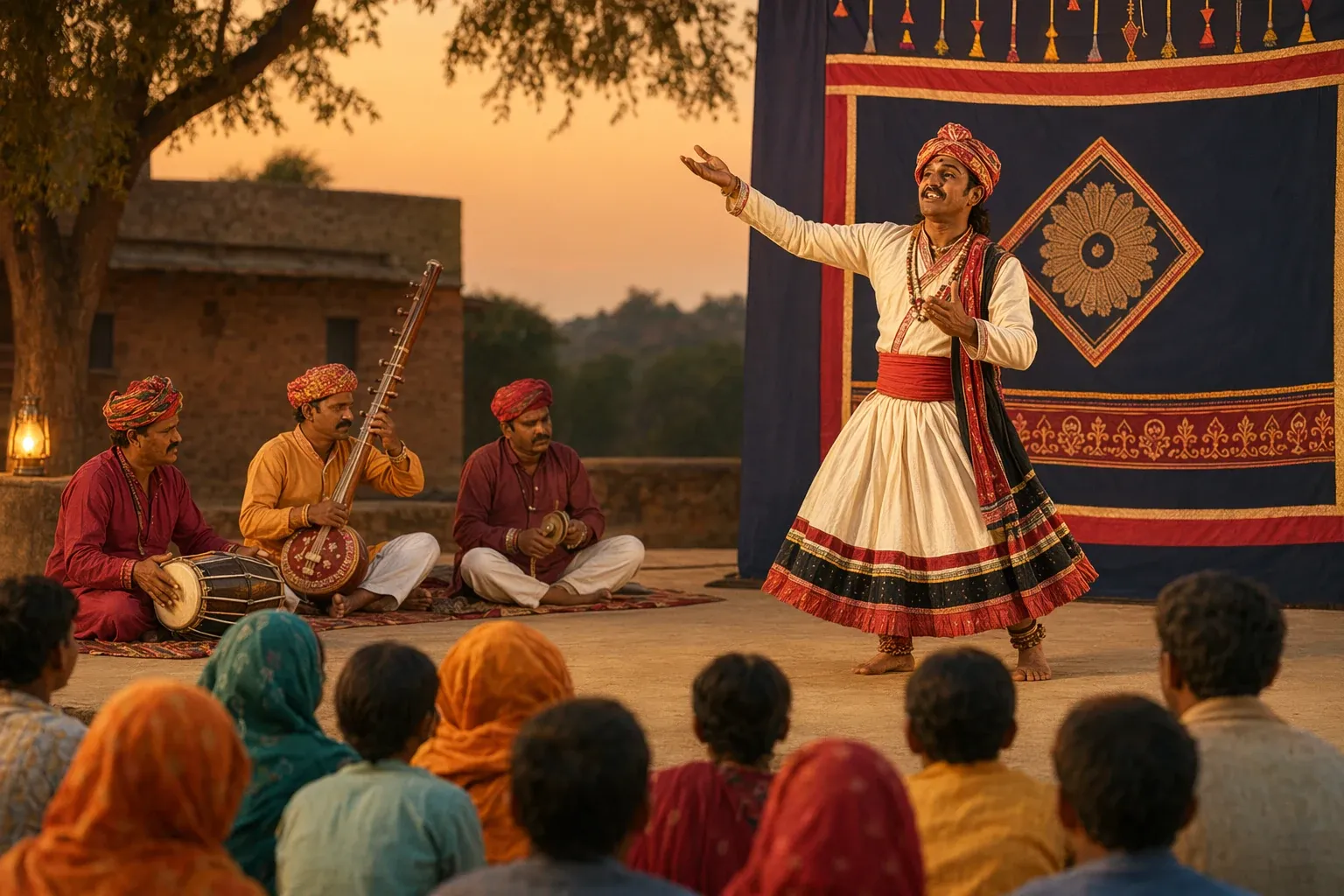
Indian folk theatre is community performance that grows out of local language, music, humour, memory, devotion, and everyday life. It is not only a play presented on a formal platform. It may happen in a village square, temple courtyard, fairground, festival route, open field, school space, or temporary mandap. The actors may sing, dance, joke, narrate, argue, wear masks, improvise with the audience, and move between sacred story and social comment in the same evening.
For a wider map of performance traditions, read this with Indian theatre basics, types of Indian theatre, Ramlila performance tradition, how a Ramlila performance is made, Indian puppetry, and Indian shadow puppetry because folk theatre often overlaps with epic storytelling, festival staging, puppetry, music and regional performance habits.
For a beginner, the simplest meaning is this: Indian folk theatre is theatre shaped by the people of a region. It uses familiar speech, local rhythms, popular stories, costumes, instruments, and performance habits so the audience feels, “This belongs to us.” That is why one form can be devotional, comic, educational, political, and entertaining all at once.
Local language gives the performance its heartbeat
Folk theatre usually speaks in the language or dialect of its audience. This matters because humour, teasing, blessings, village references, proverbs, and emotional moments become immediate. A scene from the Ramayana or Mahabharata may be ancient in story, but the performer can make it feel close by using local idioms, familiar tunes, and jokes that people recognise.
This local quality also means Indian folk theatre is not one uniform tradition. A performance in Rajasthan, Bengal, Maharashtra, Karnataka, Kerala, Odisha, Uttar Pradesh, Assam, or Tamil Nadu can look and sound completely different. The word “folk” should not make us imagine something simple or crude. Many forms require years of training, strong memory, musical command, physical stamina, and careful knowledge of community expectations.
Music, dance, and dialogue work together
In many folk theatre forms, the story is carried by song as much as speech. A singer may introduce characters, comment on the action, create emotional atmosphere, or help the audience follow a long episode. Drums, cymbals, harmonium, shehnai, flute, reed pipes, or regional instruments may guide entrances, fights, dances, comic scenes, and devotional moments.
Movement is equally important. Chhau, for example, is often described through martial movement, stylised animal gaits, masks in some regional styles, and performance during festivals such as Chaitra Parva. Ramlila brings epic scenes into a community festival setting, with dialogue, narration, song, costumes, lights, and audience participation. These examples show that folk theatre often refuses to separate drama, music, dance, ritual, and public gathering into neat boxes.
Stories can be sacred, playful, or sharp
Many folk theatre traditions use stories from the Ramayana, Mahabharata, Puranas, local deity traditions, saint lives, heroic legends, and village memory. But the performance is not limited to old stories. A clown, sutradhar, vidushak-like figure, singer, or comic pair may add social satire, current references, moral warnings, or playful criticism of greed, pride, hypocrisy, and misuse of power.
This is one reason folk theatre has been valuable for public communication. Before mass media reached every home, performance could spread religious stories, ethical lessons, news, reform ideas, and political feeling. During the twentieth century, groups linked with people’s theatre also used performance to speak about famine, labour, freedom, inequality, and social justice. The form can entertain, but it can also question society.
Costume, mask, and make-up make characters visible
A folk theatre audience may include children, elders, devotees, visitors, and people who have not read the text behind the story. Costume and make-up help everyone understand quickly. A crown may mark a king, a mask may mark a divine, heroic, animal, or demonic figure, a colourful skirt may create movement, and a comic costume may invite laughter before the first line is spoken.
Masks are especially powerful in traditions such as Chhau styles of Purulia and Seraikella, where the covered face shifts attention to body movement, rhythm, and silhouette. In other forms, the actor’s face remains visible and expressive. Either way, the outer design is not decoration alone. It helps create rasa, mood, role, and distance from ordinary life.
Regional forms every beginner should know
Ramlila is one of the most widely recognised community performance traditions, especially across northern India during Dussehra. UNESCO describes it as a performance of the Ramayana through scenes that include song, narration, recital, and dialogue, with important centres such as Ayodhya, Ramnagar, Varanasi, Vrindavan, Almora, Satna, and Madhubani. Some versions last days; the Ramnagar tradition can stretch across a month.
Other regional examples include Nautanki in north India, Tamasha in Maharashtra, Jatra in Bengal and Odisha, Yakshagana in Karnataka, Bhavai in Gujarat, Therukoothu in Tamil Nadu, Ankiya Naat in Assam, and Chhau across parts of eastern India. Each has its own performance grammar. Yakshagana is known for elaborate costume, music, dance, and night-long storytelling. Tamasha often carries song, dance, wit, and social humour. Jatra can be loud, mobile, emotional, and direct. Therukoothu brings Tamil street-theatre energy to epic and local stories.
Folk theatre is living culture, not museum culture
The most respectful way to understand Indian folk theatre is to see it as living work. Artists adapt to changing audiences, shorter festival slots, school shows, tourism, television influence, digital clips, and city stages. Some changes help survival; some reduce depth. A night-long village performance cannot be judged by the same expectations as a ten-minute social-media video.
There are also real challenges. Many performers face unstable income, reduced patronage, migration, fewer students, and competition from screens. UNESCO’s notes on forms such as Ramlila, Chhau, and Kutiyattam repeatedly remind us that audience change, funding, and transmission matter. Appreciation should include support for artists, not only nostalgia for tradition.
A simple way to remember it
Indian folk theatre is where story becomes public life. It gathers people, speaks in their language, uses their music, reflects their worries, honours their deities and heroes, and makes room for laughter. If classical theatre can feel like a carefully preserved grammar, folk theatre often feels like a lively conversation between tradition and the street. Both are important. Together they show how deeply performance is woven into Indian culture.
Frequently asked questions
What is Indian folk theatre?
Indian folk theatre is regional community theatre that uses local language, song, music, dance, humour, costume, and storytelling to perform epics, legends, devotional themes, social issues, and everyday life.
What are the major features of Indian folk theatre?
Major features include local speech, live music, audience interaction, flexible staging, regional costume, humour, improvisation, devotional or epic stories, social satire, festival settings, and strong community participation.
Is folk theatre the same as classical theatre?
No. The two overlap in stories and performance ideas, but classical theatre is usually linked with codified traditions and texts, while folk theatre is shaped more directly by regional community practice and popular performance habits.