
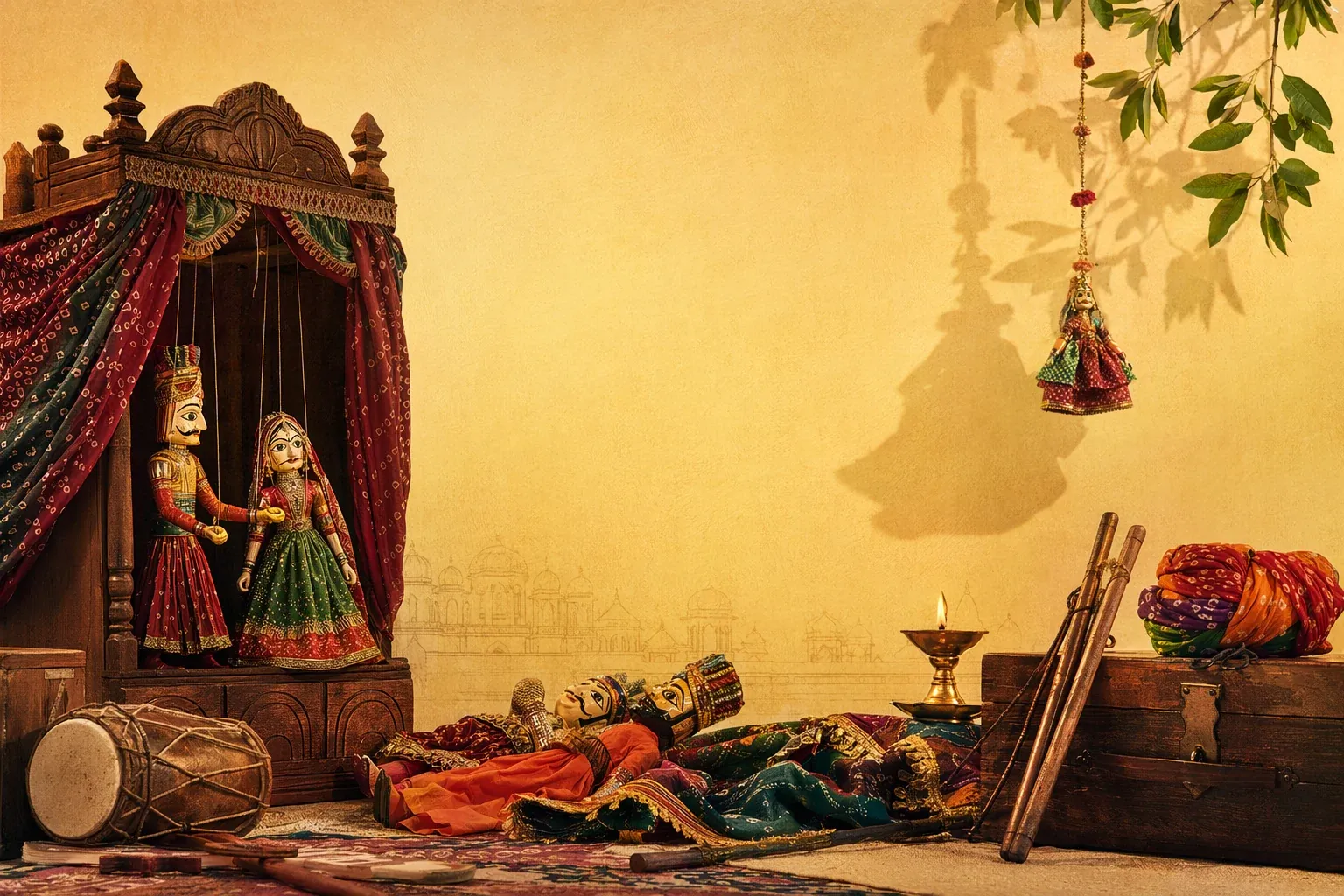
Indian puppetry is a form of theatre in which dolls, figures, shadows, music, spoken dialogue and live narration come together to tell a story. The puppet may be a small wooden figure in a bright Rajasthani skirt, a large leather shadow of Hanuman crossing the sea, a rod puppet dancing like a village performer, or a hand puppet dressed like a Kathakali character. What makes it Indian is not only the object in the puppeteer’s hand, but the whole performance world around it: the language, songs, costume style, local humour, epic episodes, ritual setting and community memory.
For a beginner, the simplest way to understand Indian puppetry is this: it is storytelling made visible through a controlled figure. The puppeteer gives the figure motion; singers and musicians give it mood; the narrator gives it meaning; the audience completes the moment by recognising a character, laughing at a joke, or remembering a moral. In many villages, a puppet performance was never just “children’s entertainment”. It could carry the Ramayana, the Mahabharata, Krishna stories, local legends, social advice, satire, news, devotion and community celebration.
Why puppetry became such a powerful storytelling form
Puppets can travel where a large theatre troupe cannot. A family or small group can pack figures, a cloth screen, lamps, drums and costumes, and perform in a courtyard, temple area, village square, school or fairground. This made puppetry especially useful in a country with many languages and regional styles. A puppet’s exaggerated face, large eyes, bright colours and clear movement can communicate even when the audience includes children or people who are listening from a distance.
Indian puppetry also solves a theatrical problem: how do you show gods, demons, kings, battles, forests, flying monkeys and magical weapons on a small stage? Puppets make the impossible practical. A leather shadow can grow huge against a lit screen. A wooden marionette can spin, bow, ride, dance or fight without needing a full human cast. A comic puppet can say things that might sound too sharp from a human performer. This freedom made puppetry a natural partner for mythological and folk storytelling.
The four main ways Indian puppets are moved
Indian puppet traditions are often grouped into four broad categories: string, shadow, rod and glove. These categories are helpful, but they are only the starting point. Each region has its own materials, stage habits, music and story choices.
String puppets, or marionettes, are moved from above by strings. Rajasthan’s Kathputli is the best-known example for many beginners. The puppets are usually wooden, brightly dressed and famous for their quick turns, royal costumes and folk-tale atmosphere. Odisha’s Kundhei and Karnataka’s Gombeyatta also belong to the string family, but their movement, music and visual style are different.
Shadow puppets are flat figures held between a lamp and a screen. Many are made of treated leather, cut into detailed shapes and painted so that light glows through them. Andhra Pradesh and Telangana’s Tholu Bommalata, Karnataka’s Togalu Gombeyatta, Kerala’s Tholpavakoothu and Odisha’s Ravanachhaya are important shadow traditions. When the lamp is lit and the puppets move, the audience sees a world of silhouettes, colour and rhythm rather than the puppeteer’s body.
Rod puppets are moved with rods attached to the body, head or hands. West Bengal’s Putul Nach is a famous rod-puppet tradition where large figures can appear almost like dancers. Odisha’s Kathi Kundhei Nacha and Bihar’s Yampuri are other examples. Rod puppets often have a strong stage presence because their size and direct control create bold gestures.
Glove puppets fit over the hand. The puppeteer’s fingers control the head and arms. Kerala’s Pavakathakali is a striking example: it adapts the look of Kathakali dance-drama into miniature hand puppets with elaborate faces and costumes. Odisha’s Sakhi Kundhei and Bengal’s Benir Putul show how small hand puppets can carry sharp dialogue, devotional stories or comic situations.
What stories do Indian puppets tell?
The Ramayana and the Mahabharata are central to many traditions because they offer dramatic characters and recognisable scenes: Rama’s exile, Sita’s abduction, Hanuman’s leap, the Kurukshetra war, Draupadi’s humiliation, Krishna’s counsel and many other episodes. Puranic stories, especially Krishna and Radha traditions, are also common. In Odisha, Krishna themes are important in several puppet forms. In Kerala’s Tholpavakoothu, Ramayana narration has a strong temple connection. In Rajasthan, Kathputli often brings together heroic legends, courtly scenes, local romance and comic interludes.
But Indian puppetry is not limited to sacred or epic subjects. Puppeteers have long used their art for social messages and everyday concerns: health, education, family conflict, village disputes, moral choices, local politics and humour. Because a puppet can be both serious and playful, it can speak to children, elders and mixed audiences without sounding like a lecture.
The craft behind the performance
A puppet begins as material: wood, cloth, leather, paint, bamboo, cotton, paper, metal wire, beads or thread. The maker has to think like a sculptor and a performer at the same time. A puppet’s head must be expressive, but not too heavy. Its arms must be visible from a distance. Its costume must suggest a king, queen, demon, clown, sage or animal quickly. In shadow puppetry, the cutwork matters because every hole and painted area changes the way light passes through the figure.
Music is equally important. Drums mark entrances and battles. Cymbals add energy. A harmonium, pakhawaj, mridangam, dholak or local instrument may support songs and dialogue, depending on the region. The puppeteer may also be a singer, narrator, comedian and voice actor. A single performer may shift from a king’s commanding tone to a clown’s squeaky voice in seconds.
Who performs Indian puppetry?
Many traditions have been carried by hereditary communities. The Bhat community is strongly associated with Rajasthani Kathputli. Shadow puppet troupes in Andhra, Karnataka and Kerala often passed skills through families. This does not mean the tradition is frozen. Modern puppeteers, theatre groups, educators and museums have adapted puppetry for schools, festivals, urban stages and cultural workshops. Still, hereditary artists remain vital because they hold performance memory that cannot be learned from a written script alone: timing, jokes, songs, repair skills, voice patterns and audience handling.
Why Indian puppetry matters today
Indian puppetry matters because it preserves regional imagination. It shows how a community visualises Rama, Ravana, Krishna, village heroes, queens, tricksters, birds, horses and demons. It also keeps local languages and musical habits alive. A puppet show is a small archive of costume, gesture, pronunciation, humour, caste and community history, religious practice and craft knowledge.
At the same time, puppetry faces real pressure. Television, cinema, mobile phones, migration, shrinking patronage and cheaper entertainment have reduced regular audiences in many places. Some artists now sell puppets as decorative craft because performance income is uncertain. That craft market can help families survive, but a puppet hanging on a wall is not the same as a puppet singing, arguing and dancing before an audience.
How to watch an Indian puppet show as a beginner
Do not worry if you do not understand every word. Watch how the puppet enters, how the music changes, how the audience reacts, and how the puppeteer uses stillness as well as motion. Notice the difference between a hero’s movement and a clown’s movement. In shadow puppetry, look at the screen like a moving painting. In string puppetry, watch the bounce, spin and rhythm. In rod puppetry, notice the big, confident gestures. In glove puppetry, notice how much expression can come from a small figure.
If you see a performance at a museum, festival or school, ask where the form comes from and what story is being performed. If puppets are being sold, ask whether the artist also performs. Buying directly from performers, attending shows, inviting troupes to schools and sharing accurate information are practical ways to support the tradition.
FAQs
Is Indian puppetry only for children?
No. Children enjoy the colour and movement, but many traditions were created for mixed village audiences and include epic narration, satire, devotion, music and social commentary.
What is the most famous Indian puppet form?
Rajasthan’s Kathputli is probably the best-known to general audiences, but India has many major forms, including Tholu Bommalata, Togalu Gombeyatta, Putul Nach, Pavakathakali and Bommalattam.
Are Indian puppets still performed today?
Yes, though the performance circuit is smaller than it once was. Traditional families, cultural institutions, theatre groups and educators continue to perform and teach puppetry.
What materials are Indian puppets made from?
Materials vary by form. Wood, cloth, leather, bamboo, paint, metal wire, cotton, paper and decorative fabric are common. Shadow puppets are often made from treated and painted leather.
What should I learn first?
Start with the four movement types: string, shadow, rod and glove. Then connect each type to a few regional examples. That gives you a clear map without flattening the diversity.