
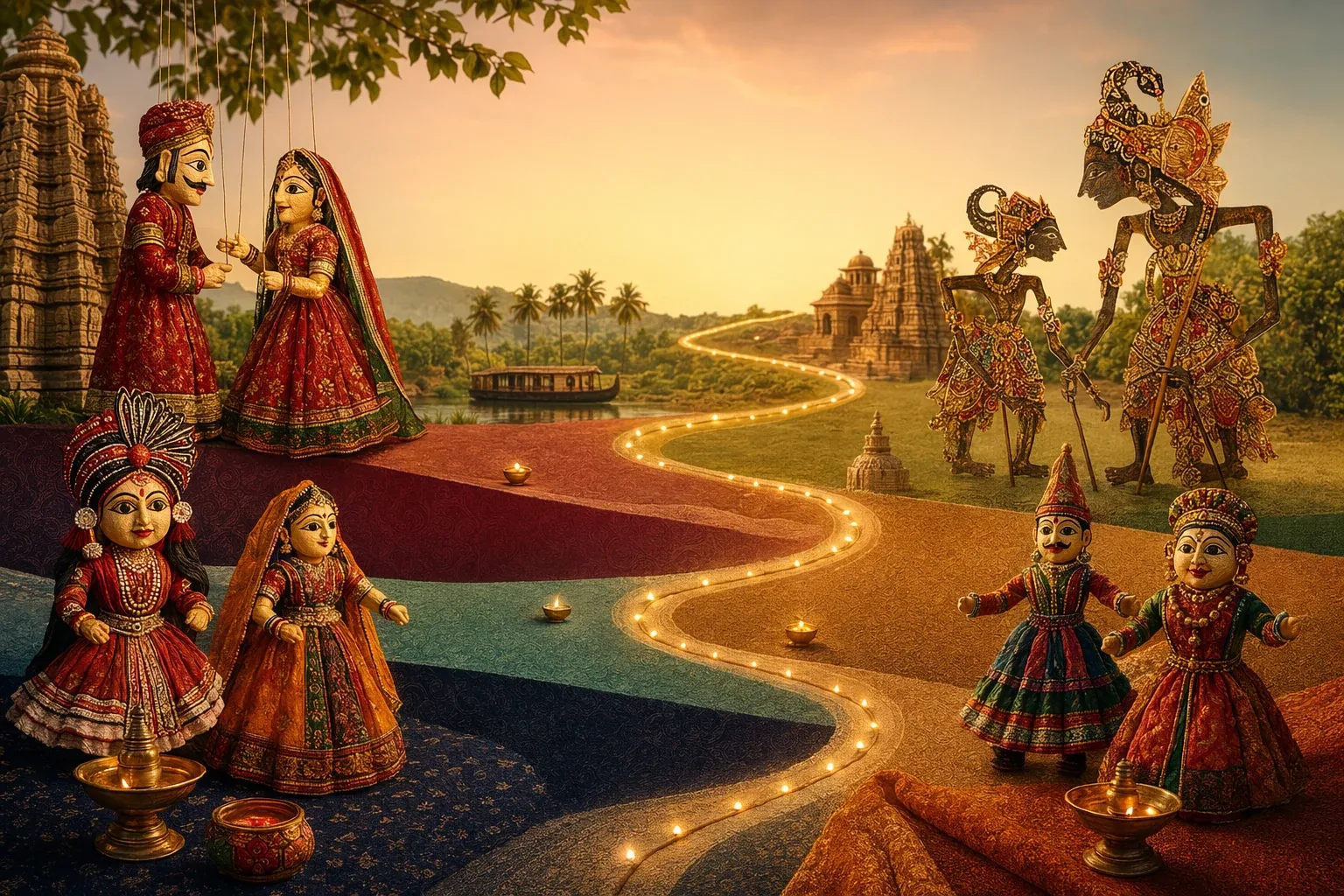
Indian puppetry is a travelling theatre of wood, leather, cloth, voice, music, and memory. A puppet may be a royal figure from Rajasthan, a translucent leather hero from Andhra Pradesh, a rod puppet from Bengal, a glove puppet from Kerala, or a large temple-linked figure from Tamil Nadu. Each style has its own name, language, music, story world, and performance technique. Learning the names is the first step toward seeing how varied the tradition really is.
Puppetry in India has never been only children’s entertainment. It has carried epics, local legends, satire, devotional stories, social messages, and community memory. The puppeteer may be a narrator, singer, musician, actor, craftsperson, and stage manager all at once. The puppet is small, but the performance world can be vast.
Kathputli of Rajasthan
Kathputli is one of the most widely recognised Indian puppet traditions. The name is often linked with wooden dolls, and the style is associated with Rajasthan. These string puppets are usually brightly dressed, with painted faces, dramatic eyes, and colourful costumes. A puppeteer manipulates them with strings while music and narration create a lively atmosphere.
Traditional Kathputli performances often include kings, queens, warriors, dancers, horses, and comic figures. The movement is swift and stylised. A dancer puppet may spin with surprising grace. The style has long been associated with itinerant performer communities who carried stories from place to place. Today Kathputli appears in fairs, cultural festivals, schools, tourist venues, and heritage programs, but its community roots deserve recognition.
Bommalattam of Tamil Nadu
Bommalattam, from Tamil Nadu, is a distinctive puppet tradition that may combine rod and string techniques. The puppets can be large and heavy compared with some other forms. Performances have drawn on stories from the Ramayana, Mahabharata, local legends, and devotional themes. The scale gives the figures a strong presence.
The word bommai means doll or puppet in Tamil contexts, and attam suggests dance or performance. Bommalattam therefore carries the idea of puppet dance. The puppeteer’s skill lies not only in movement but in sustaining narrative, voice, and rhythm. Like many regional forms, it has faced challenges from changing entertainment habits, but it remains an important part of Tamil performance heritage.
Tholu Bommalata of Andhra Pradesh and Telangana
Tholu Bommalata is a shadow puppet tradition associated with Andhra Pradesh and Telangana. The puppets are made from treated leather, cut into figures, painted with bright colours, and perforated so that light passes through beautifully. When placed against a screen with a lamp behind them, they become glowing silhouettes full of detail.
The name tholu refers to leather, while bommalata means puppet play. These performances often narrate episodes from the Ramayana and Mahabharata. The puppets can be large, with jointed limbs that allow expressive movement. Music, dialogue, humour, and dramatic battle scenes create an immersive experience. A shadow puppet is not merely a flat figure; it becomes alive through light.
Togalu Gombeyata of Karnataka
Togalu Gombeyata is Karnataka’s leather shadow puppet tradition. The term again points to leather dolls or figures. The puppets vary in size and may be associated with different performance contexts. Like other shadow traditions, they use a screen, light, narration, and music to create theatre from silhouettes.
One fascinating feature of Indian shadow puppetry is regional variation in puppet size, colour, articulation, and story emphasis. Togalu Gombeyata has its own visual character and performance history. It is part of a wider southern shadow theatre family, yet it should not be collapsed into a single generic label.
Putul Nach of Bengal
Putul Nach means puppet dance in Bengali. Bengal has rod puppet traditions where figures are manipulated using rods, often with the puppeteer standing behind or below a screen or platform. The puppets may be dressed in cloth costumes and used to tell mythological, social, or folk stories.
Rod puppetry gives a different movement quality from string puppetry. The figures can appear grounded and dramatic, with gestures controlled through rods. Putul Nach reflects Bengal’s strong storytelling culture, where song, narration, theatre, and visual craft often meet. For readers interested in Bengal’s stitched textile storytelling, Bhaktilipi’s guide to Indian embroidery types includes Kantha, another form where narrative and handwork meet.
Pavakathakali of Kerala
Pavakathakali is a glove puppet tradition from Kerala influenced by Kathakali themes and aesthetics. The puppets are worn on the hand, and the performance draws from the dramatic world of Kathakali: expressive faces, rich costumes, mythological stories, and stylised action. The scale is smaller than human theatre, but the visual inspiration is clear.
Glove puppetry allows direct, intimate movement. The puppeteer’s fingers become the puppet’s arms and head support. Pavakathakali shows how a major classical performance tradition can be reimagined in puppet form without losing its dramatic flavour.
Kundhei Nacha and other Odisha traditions
Odisha has puppet traditions such as Kundhei Nacha, a string puppet form. The word kundhei is associated with dolls. Performances may include mythological and folk themes, music, and stylised movement. Odisha’s wider artistic culture includes temple sculpture, Pattachitra painting, and performance traditions, so puppetry sits within a rich visual world.
Regional puppet names are often closely tied to local words for dolls, leather, dance, or play. This is why learning the local name matters. It preserves the connection between language and art.
Shadow, string, rod, and glove: the main types
Indian puppets are often grouped by manipulation method. String puppets hang and move through strings, as in Kathputli and Kundhei Nacha. Shadow puppets are held against a lit screen, as in Tholu Bommalata and Togalu Gombeyata. Rod puppets use rods for support and gesture, as in Putul Nach and some other regional forms. Glove puppets are worn on the hand, as in Pavakathakali.
These categories are useful, but they do not tell the whole story. Materials, music, language, community, story repertoire, and ritual context are equally important. Two shadow puppet traditions may both use leather, yet their figures, songs, and performance mood can differ greatly.
Where to see Indian puppetry
Today Indian puppetry can be seen at folk festivals, state cultural programs, museums, craft fairs, schools, heritage centres, and sometimes in village or temple-linked settings. Rajasthan’s Kathputli is often visible in tourist circuits, while shadow puppetry may appear in curated cultural festivals. Some contemporary puppeteers also create new stories about health, environment, education, and social change.
When watching, notice the whole performance, not just the puppet. Listen to the singer, the drum, the comic exchanges, the narrator’s timing, and the way the audience responds. Puppetry is a shared event. A still puppet in a display case is beautiful, but the art truly lives in motion.
Respecting the makers and performers
Many puppet traditions have struggled because patronage changed and younger audiences moved toward cinema, television, and digital media. Supporting puppetry means more than buying a decorative doll. It means attending performances, crediting communities, paying fairly, inviting artists to teach, and preserving performance knowledge along with objects.
The names Kathputli, Bommalattam, Tholu Bommalata, Togalu Gombeyata, Putul Nach, Pavakathakali, and Kundhei Nacha are not just labels. They are doorways into regional theatre worlds. Once you know them, Indian puppetry no longer appears as one craft. It becomes a map of moving stories shaped by hands, voices, light, and local memory.