
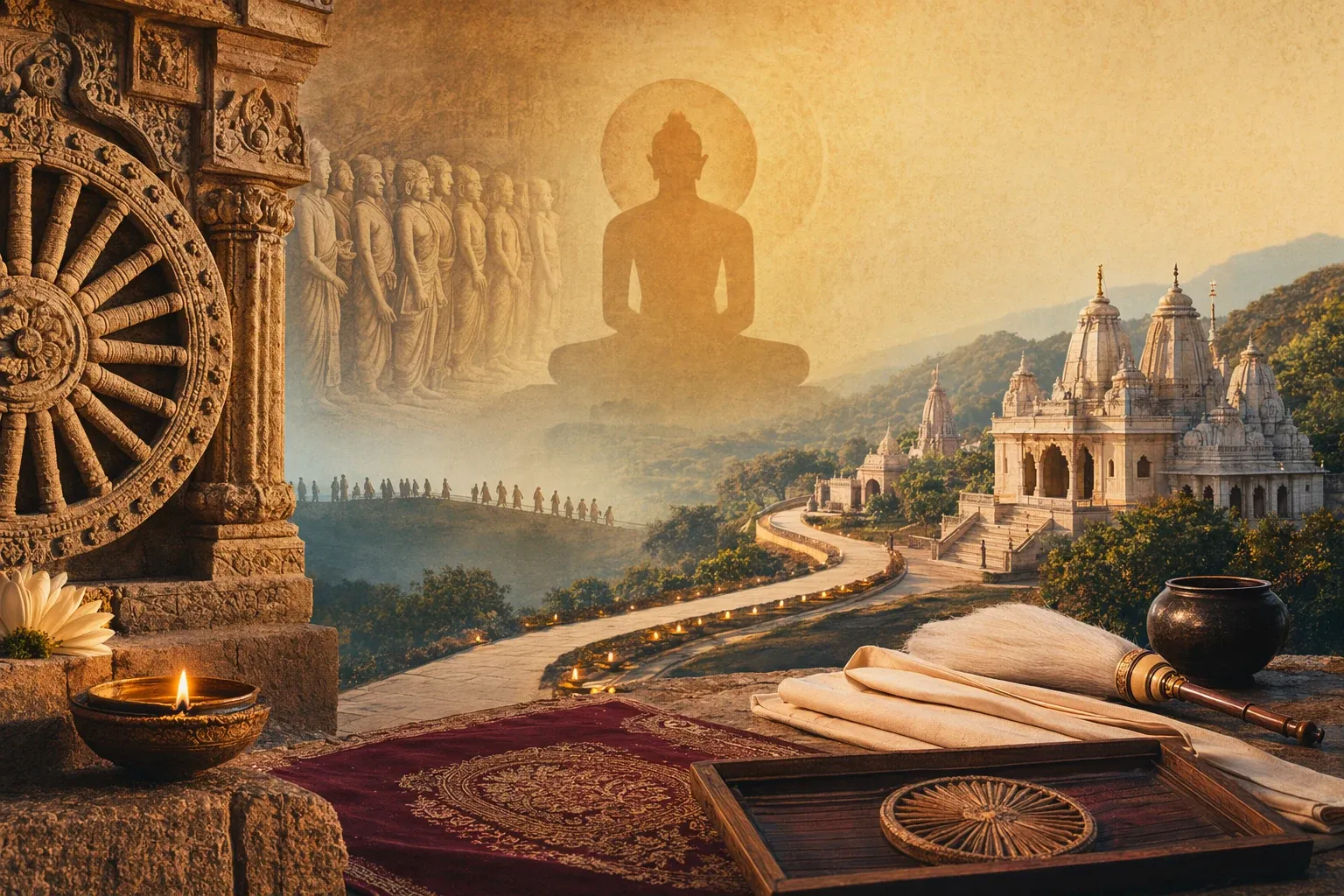
Jainism is rooted in ancient India, especially the spiritual world of north India where renouncers, teachers, kings, merchants, and seekers debated karma, rebirth, liberation, and disciplined living. For historical beginners, Mahavira’s life is usually placed around the 6th century BCE. For Jain tradition, the story is older because it remembers a long lineage of Tirthankaras before Mahavira.
So the best short answer is: Jainism became historically visible through Mahavira in ancient north India, but Jain tradition understands its path as much older than one historical moment.
Ancient India context
Mahavira lived in a time when many seekers questioned ritual, social duty, suffering, rebirth, and liberation. This wider world is often called the shramana context, where renouncers practised discipline, meditation, fasting, wandering, and philosophical debate. Buddhism also emerged in this broad environment, which is why Jainism and Buddhism are often studied together.
The region connected with Mahavira includes parts of present-day Bihar and surrounding areas. Ancient cities, republics, kingdoms, trade routes, and monastic communities helped religious ideas spread beyond one village or court.
Mahavira’s period
Mahavira is traditionally remembered as a prince who renounced worldly life, practised severe austerity, attained complete knowledge, and taught for many years. His community included monks, nuns, laymen, and laywomen. That fourfold community helped Jain practice become organized and durable.
Historical details can be debated, and dates in ancient Indian traditions are not always simple. But for a beginner, it is enough to place Mahavira in ancient north India around the same broad era as the Buddha, while remembering that Jain tradition looks beyond one date.
How Jainism spread
Jainism spread through teachers, monastic lineages, lay communities, merchant networks, royal and local patronage, pilgrimage centres, and temple culture. Jain monks and nuns carried teachings through travel and discipline, while lay communities supported temples, learning, food discipline, charity, and festivals.
Trade routes mattered because Jain lay communities often became active in towns and commercial centres. When families moved for livelihood, they carried food rules, worship practices, stories, manuscripts, and community institutions with them. Over time, Jainism became especially visible in western India, parts of south India, Rajasthan, Gujarat, Karnataka, Maharashtra, Madhya Pradesh, and elsewhere.
Jainism in western and southern India
Western India became strongly associated with Jain temples, pilgrimage, manuscript culture, and merchant communities. Gujarat and Rajasthan are especially important in public memory because of famous temple sites, art, community networks, and literary traditions.
South India also has a long Jain past. Karnataka, Tamil Nadu, and other regions preserve Jain inscriptions, images, caves, stories, and intellectual contributions. The famous Bahubali image at Shravanabelagola is one of the best-known examples of Jain heritage in the south.
Why the timeline is not one straight line
Religions do not spread like a simple arrow on a map. Communities rise, decline, migrate, receive patronage, lose patronage, adapt language, build temples, preserve texts, and interact with neighbours. Jainism’s spread happened through many small acts across centuries: teaching, travel, vows, donations, festivals, and family continuity.
That is also why Jainism is not only “ancient history”. It remains a living tradition today, with communities in India and across the world practising temple worship, fasting, charity, study, vegetarian ethics, and festival life.
A simple timeline for beginners
A beginner timeline can be remembered in three layers. First is the sacred memory of the Tirthankaras, beginning with Rishabhanatha in Jain tradition. Second is the historically visible age of Mahavira in ancient north India. Third is the long spread of Jain communities through monks, nuns, merchants, temples, pilgrimage centres, literature, and regional patronage.
Keeping these layers separate avoids confusion. Tradition answers the question of sacred memory; history studies evidence, dates, places, inscriptions, texts, and communities. A mature explanation can respect both without pretending they are identical.
Why Jainism survived across centuries
Jainism survived because it built strong habits of community life. Lay supporters fed and honoured ascetics, funded temples, preserved manuscripts, organized festivals, and taught children. Monks and nuns preserved discipline and learning. Families carried food rules, stories, pilgrimage memory, and ethical identity into new towns.
This combination of strict ideals and adaptable community institutions allowed Jainism to remain small compared with some traditions, yet highly influential. Its impact on non-violence, vegetarian culture, art, trade ethics, literature, and temple architecture is much larger than numbers alone suggest.
Important places in Jain memory
Many places became important because they were linked with Tirthankaras, ascetics, temple building, inscriptions, councils, pilgrimage, or community life. Bihar and nearby regions matter for Mahavira’s story. Gujarat and Rajasthan are famous for temple and merchant community history. Karnataka is remembered for major Jain monuments and the Bahubali tradition.
These places show that Jainism is not locked into one region. It moved through languages, kingdoms, trade routes, monasteries, and families. Each region added architecture, literature, art, and local memory while preserving the larger Jain concern with non-violence and liberation.
For a school answer, keep it simple: connect Mahavira with ancient north India, mention the longer Tirthankara memory, and explain that Jainism spread through disciplined communities rather than conquest. That gives enough history without flattening the tradition into one date.
What beginners should remember
The historical comparison with Buddhism is common; readers can also explore public remembrance around Mahavir Jayanti and Buddha Purnima for a modern cultural bridge.
Jainism is historically linked with Mahavira and ancient north India, but Jain tradition remembers a much longer Tirthankara lineage. It spread through monks, nuns, lay supporters, merchants, temples, pilgrimage, and regional communities. A careful answer should respect both history and tradition instead of forcing everything into one date or one place.