
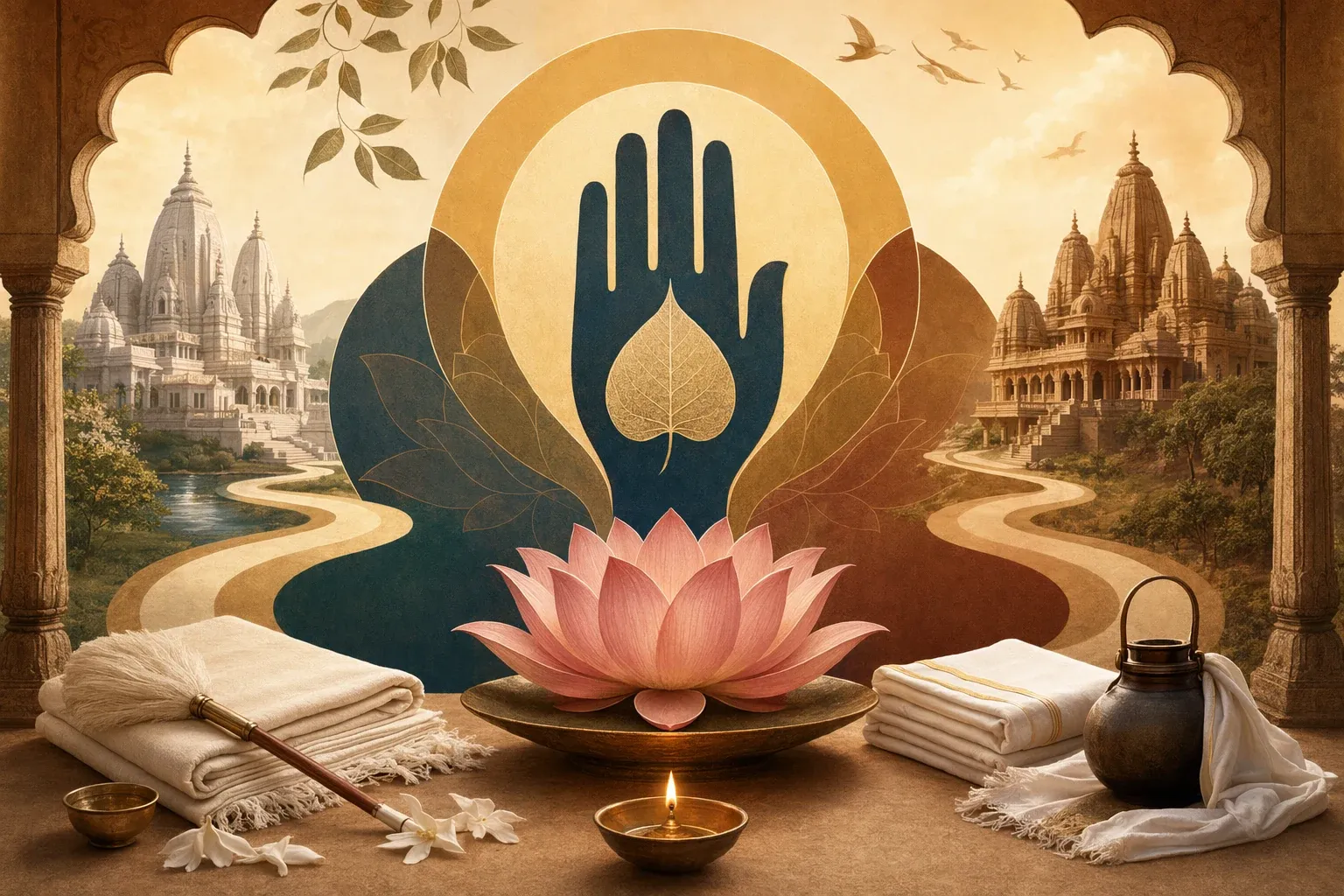
Digambara and Svetambara are two major Jain traditions. They share the broad Jain foundations of ahimsa, self-discipline, karma, liberation, reverence for the Tirthankaras, and respect for renunciation. Their visible differences developed over time through monastic practice, scripture, clothing, regional history, and community life.
A respectful explanation should avoid two mistakes. The first is pretending there are no differences. The second is turning the differences into jokes, stereotypes, or a competition. Jain traditions are living communities, not labels for casual arguments.
The simple meaning of the names
Digambara is often explained as “sky-clad”. In the strict monastic ideal, it points to complete renunciation, including giving up clothing for certain male ascetics. Svetambara means “white-clad”, referring to the white clothing associated with its monks and nuns. These words are important, but they should be handled with maturity, not sensationalism.
For a broader foundation before the sect comparison, read our Jainism beginner guide. The shared Jain worldview matters more than memorising differences alone.
Shared Jain foundations
Both traditions honour the Tirthankaras and place great importance on liberation from karmic bondage. Ahimsa, or non-violence, is central. So are truthfulness, restraint, non-possessiveness, discipline, and careful conduct. Lay followers may live family and professional lives, while monastics follow much stricter vows.
This shared foundation is why it is misleading to describe Digambara and Svetambara as completely separate religions. They are Jain traditions with differences in interpretation, practice, monastic discipline, and textual history.
Monks, nuns, and lay communities
The most visible difference often discussed is monastic clothing and renunciation. Digambara monastic ideals emphasise radical non-possession for certain ascetics. Svetambara monastics wear white robes. Both traditions include serious spiritual discipline, study, meditation, fasting, and community teaching.
Lay communities also matter. Most Jains are not monks or nuns; they are householders who support temples, teachers, charities, fasting practices, festivals, education, and community life. A sect explanation that ignores lay devotion misses a large part of Jain reality.
Scriptures and historical memory
Digambara and Svetambara traditions differ in how they understand the preservation and authority of certain texts. These differences are connected with long historical developments, councils, transmission, and monastic lineages. Beginners do not need to master every detail immediately, but they should know that the divide is not only about clothing.
Textual history is delicate. Different traditions remember preservation, loss, commentary, and authority in their own ways. A fair explanation says “the traditions differ” without mocking either side.
Images and temple practice
In temples and devotional art, beginners may notice differences in how Tirthankara images are represented, decorated, or worshipped. Some images may be unclothed and austere; others may be clothed or ornamented according to tradition. These visual differences are not random decoration. They express different theological and monastic ideals.
Local practice can also vary by region, temple, lineage, and community. It is wise to learn from the specific temple or tradition you are visiting instead of assuming one rule explains every Jain space.
Avoid caste and wealth stereotypes
A common mistake is to reduce Jain identity to business, wealth, region, caste, or food habits. That is unfair and shallow. Jain communities are diverse across language, region, profession, education, migration history, and practice level. Sect identity should not be used to stereotype people.
It is fine to ask cultural questions, but ask them respectfully. “What does this practice mean?” is better than “Why are they like that?” Curiosity becomes learning when it is paired with humility.
How to remember the difference
For a first memory cue, remember this: Digambara is associated with the sky-clad ideal of radical renunciation, while Svetambara is associated with white-clad monastic practice. Then add the deeper layers: scriptures, images, monastic rules, regional history, and lay community life.
What beginners should remember
Digambara and Svetambara are major Jain traditions with shared foundations and meaningful differences. The best beginner approach is simple: respect both, avoid stereotypes, learn the shared Jain values first, and then study the differences in clothing, scriptures, images, monastic discipline, and community practice with care.
Language and region
Jain communities live across many regions and languages, including Gujarati, Hindi, Marathi, Kannada, Tamil, Rajasthani, and others. Sect identity, local custom, temple style, food discipline, festivals, and family practice can interact in complex ways. That is why one city’s Jain life may not look exactly like another city’s Jain life.
For beginners, this is a helpful reminder: do not learn Jainism only through labels. Listen to how communities describe themselves, notice the shared values, and then study the sect differences with patience.
Respectful comparison matters
Religious comparisons can easily become rude when they focus only on visible difference. A better comparison explains meaning. Clothing, image style, scripture, monastic discipline, and lay practice all point toward serious questions about renunciation, purity, knowledge, and liberation. When explained this way, Digambara and Svetambara differences become a doorway into understanding Jain depth, not a source of casual mockery.
This is especially important for younger readers. They should learn that Indian traditions can have internal diversity without losing dignity. Difference does not automatically mean division in a negative sense; it can also show how communities preserve memory and discipline across time.
How to speak about it politely
When discussing Digambara and Svetambara traditions, use neutral language. Say “this tradition teaches” or “this practice is associated with” rather than making jokes about clothing, region, or community. If you are unsure, admit that you are learning. Respectful words are especially important because Jain vows and monastic discipline are not lifestyle trivia; they represent serious spiritual commitments.
A good beginner summary is therefore simple: both traditions are Jain, both value liberation and non-violence, and their differences should be understood through history, discipline, scripture, image practice, and community life. That approach keeps the explanation clear without making it careless.