Om is most strongly associated with Hindu sacred sound, but it also appears in some Buddhist and Jain contexts. That does not mean every tradition uses it in the same way. A symbol can travel across Indian religious worlds while still carrying different meanings, rituals, and emotional weight in each community.
This guide keeps the comparison simple and respectful. It explains why Om matters so deeply in Hindu practice, where it can appear in Buddhist and Jain settings, and why beginners should avoid turning shared symbols into careless “all religions are the same” statements.
The short answer
Om, also written Aum, is a sacred syllable and sound-symbol. In Hindu traditions it is linked with mantra, meditation, the Vedas, the Upanishads, the presence of Brahman, and the beginning of many prayers. For a focused introduction, read our guide to Om and Aum in Hinduism.
In Buddhist and Jain contexts, Om may appear in mantras, temple art, manuscripts, or cultural designs, especially where Indian religious language and Sanskritic sound are part of the tradition. But its role is not always identical to its Hindu role. Context decides meaning.
Why symbols overlap in India
Indian religious traditions grew near each other for many centuries. Teachers debated, kings patronised more than one path, artists reused familiar visual languages, and pilgrims moved between sacred regions. Because of this, words such as dharma, karma, moksha, yoga, mantra, and ahimsa can appear across traditions while meaning different things in context.
The same is true for symbols. A lotus, wheel, swastika, trishul, kalasha, conch, or sacred sound may not belong to only one story. To understand this wider visual world, our Hindu symbols beginner guide is a useful companion, even when the comparison reaches beyond Hinduism.
Om in Hindu traditions
In Hinduism, Om is not just decoration. It is treated as a sacred sound connected with creation, consciousness, prayer, and spiritual attention. Many mantras begin with Om. Many people write or place the symbol in puja rooms, notebooks, temples, jewellery, digital greetings, and devotional art.
Different Hindu schools explain Om differently. Some connect it with the waking, dreaming, deep sleep, and silent states of consciousness. Some connect it with Brahman, the ultimate reality. Others use it as a reverent opening sound before prayer. The common point is that Om is sacred, not a random aesthetic mark.
Om in Buddhist contexts
Buddhist traditions are diverse. In many early Buddhist settings, Om is not central in the way it is for Hindu mantra practice. But in later Sanskrit, Mahayana, and especially Vajrayana contexts, Om appears in well-known mantras and ritual language. The famous mantra “Om mani padme hum” is one example many people recognise.
Here, Om functions inside a Buddhist mantra world, not as a copy-paste of Hindu theology. The same sound can sit inside a different philosophical frame. That is why beginners should ask: which Buddhist tradition, which mantra, which teacher, and what meaning is being given there?
Om in Jain contexts
Jainism also has its own symbol system, including the Jain emblem, the hand of ahimsa, the swastika in Jain meaning, the three dots, the siddhashila form, and sacred syllables. Om can appear in Jain devotional or mantra contexts, often understood through reverence toward the five supreme beings remembered in Jain practice.
For a broader foundation, read our Jainism beginner guide. Jain use of a shared Indian symbol should not be flattened into Hindu meaning or Buddhist meaning. Jain tradition has its own path of soul, karma, vows, non-violence, and liberation.
Common mistakes to avoid
One mistake is saying Om is “only” one thing in every place. Another mistake is saying that because Om appears in more than one tradition, all those traditions teach the same philosophy. Both shortcuts are misleading. Shared vocabulary does not erase real difference.
A third mistake is using sacred symbols as casual branding without learning the meaning. For many devotees, Om belongs in clean, intentional, respectful settings. It can feel disrespectful when printed on footwear, bathroom objects, alcohol branding, or joke merchandise.
Respectful use today
If you do not belong to a tradition but appreciate the symbol, start with humility. Learn the meaning, avoid mocking it, avoid mixing sacred symbols randomly, and do not claim ownership over a community’s practice. In art or education, it helps to say which tradition’s meaning you are discussing.
What beginners should remember
Om is deeply Hindu in its most famous and foundational use, but it also appears in some Buddhist and Jain contexts. The right answer is not “only one religion forever” or “all meanings are the same”. The better answer is contextual respect: know where the symbol is being used, learn the tradition’s explanation, and treat sacred signs carefully.
How to read online symbol charts
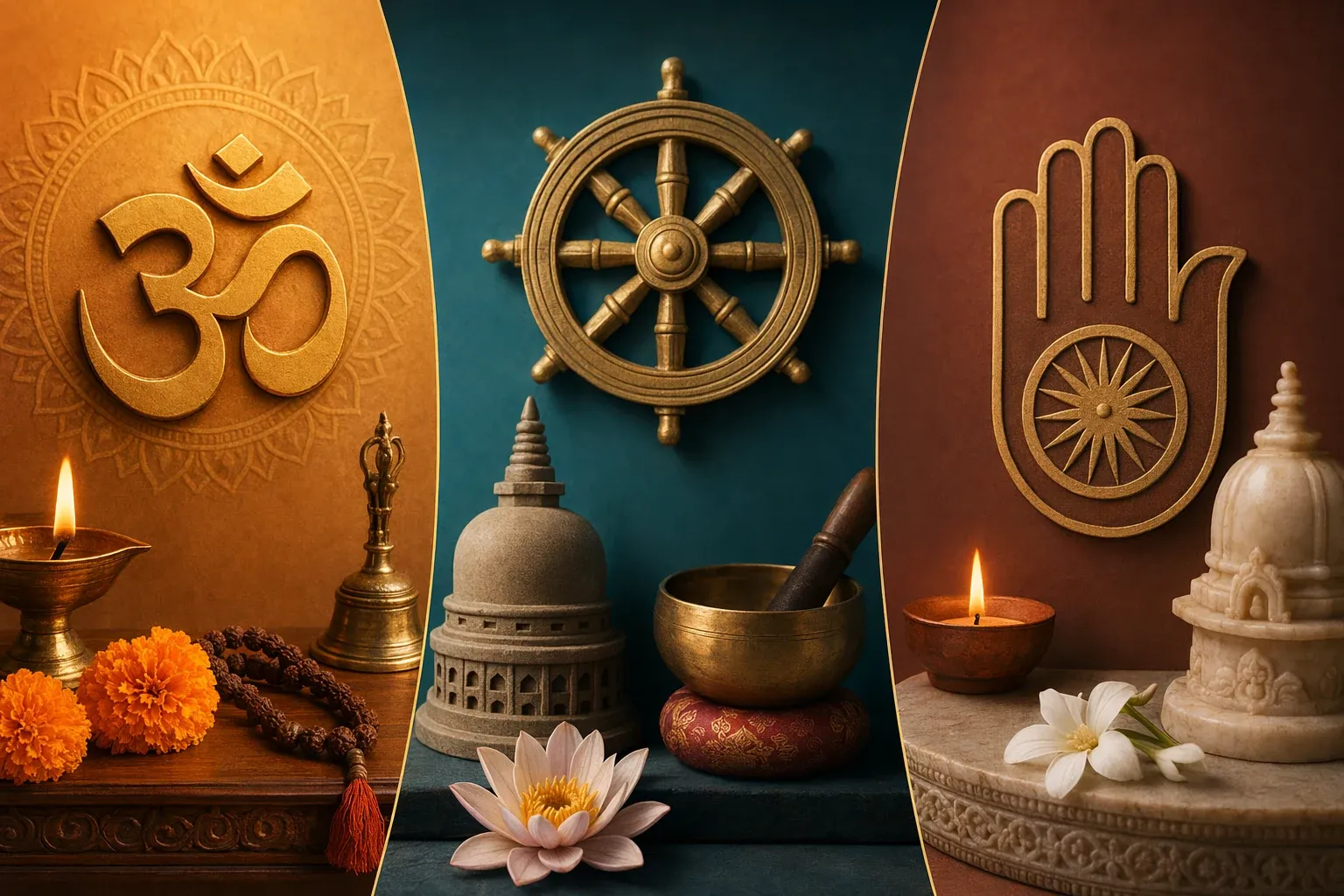
Online charts often place Hindu, Buddhist, and Jain symbols side by side. They can be useful as a first visual clue, but they are not enough for real understanding. A chart may show Om, a wheel, a lotus, a hand symbol, or a swastika without explaining the ritual setting, language, or community meaning behind it.
When you see such a chart, slow down. Ask whether the symbol is being explained from a Hindu, Buddhist, Jain, academic, artistic, or social-media point of view. A respectful learner does not stop at the picture; they checks the tradition and the context.
A careful comparison table in words
In Hindu practice, Om is often a sacred opening sound and a pointer toward ultimate reality, prayer, mantra, and inner attention. In Buddhist contexts, Om may appear inside specific mantras and ritual traditions, especially in Sanskrit and Vajrayana settings. In Jain contexts, Om may connect with reverence toward liberated beings and the Jain path of purification.
These descriptions are deliberately careful. They leave room for community variation and do not pretend that one paragraph can replace a teacher, scripture, or living practice. The point is to compare without flattening.
Why respectful language matters
Symbols can be emotional because they live inside worship, family memory, festivals, meditation, and identity. A casual joke may look harmless to the person making it but feel painful to someone for whom the symbol is sacred. Respectful language costs very little and protects trust.
For Bhaktilipi readers, the best habit is simple: learn before using, credit the tradition, and avoid turning sacred signs into empty aesthetics. That makes cultural curiosity warmer, deeper, and safer for everyone.
Related reading
For broader context on Bhaktilipi, continue with Hindu Symbols in Tattoos, Jewellery, and Clothing: A Respectful Beginner Guide and Jain Symbols, Temples, and Pilgrimage: A Simple Guide for First-Time Visitors.