
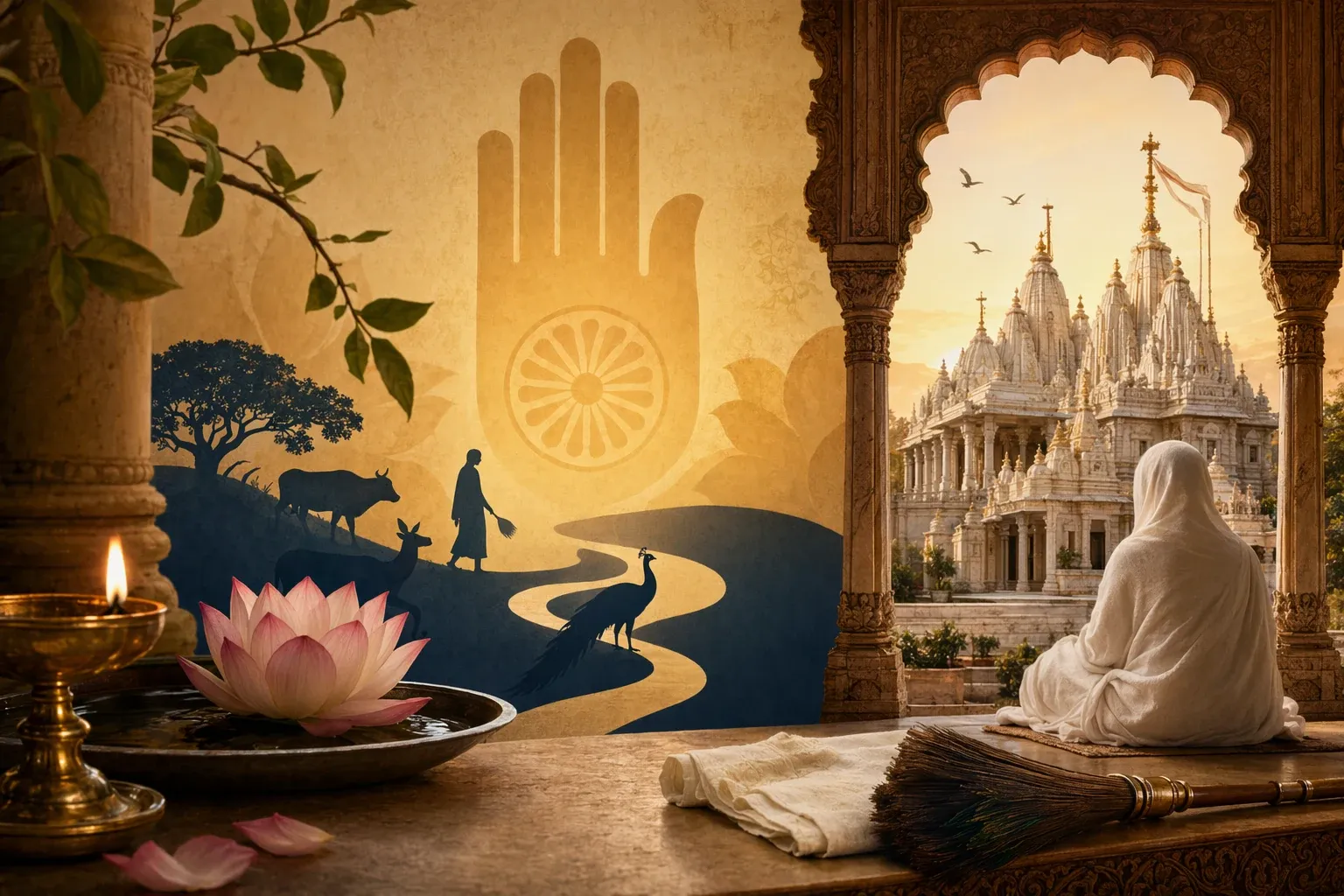
Jainism is sometimes described as a small religion, but that phrase can mislead. It is true that Jains form a small share of India's population and an even smaller share of the global population. It is also true that Jain ideas, communities, temples, food ethics, literature, business networks, and philanthropy have had an influence far beyond their numbers.
To understand Jainism today, we need to separate three questions. Where is Jainism practiced? Why are Jain numbers comparatively small? And why does Jainism still matter so much in Indian life? The answers show a tradition that is numerically small, historically deep, and very much alive.
Where is Jainism practiced today?
Jainism is practiced most visibly in India, the land where the tradition began and where the great majority of Jains still live. Within India, Jain communities are especially associated with western and central regions, including Maharashtra, Gujarat, Rajasthan, Madhya Pradesh, and Karnataka. Major urban centers such as Mumbai, Ahmedabad, Pune, Jaipur, Indore, Bengaluru, and Delhi have active Jain temples, associations, schools, charities, and business communities.
The 2011 Census of India recorded Jains at about 0.4 percent of the national population. That percentage sounds tiny, but it still represents millions of people. Pew Research Center, using Indian census benchmarks and survey work, likewise notes that Jains are India's smallest major religious group and are concentrated especially in the West, with Maharashtra standing out as a major center.
Jain communities also live outside India, especially in East Africa, the United Kingdom, North America, the Gulf, Southeast Asia, and Australia. Migration has carried Jain temple life, food practices, youth education, and festival observances into diaspora settings. In many overseas cities, Jain centers teach children about ahimsa, karma, Tirthankaras, Pratikraman, Paryushan, and vegetarian ethics in English alongside Indian languages.
Why does Jainism seem less popular than Buddhism or Hinduism?
Jainism can seem less visible because it did not become a large missionary world religion in the same way Buddhism did, and it did not become the majority tradition of India in the way Hindu traditions did. Jain communities historically emphasized disciplined practice, monastic authority, lay support, ethical restraint, and continuity through family and community networks. That created a strong tradition, but not always a large one.
Another reason is that Jain practice can be demanding. The ideal of ahimsa is taken very seriously, extending to diet, occupation, speech, travel, monastic conduct, and everyday habits. The highest Jain ideals of renunciation and non-possession are difficult for ordinary people to follow fully. Lay Jains adapt these ideals to household life, but the tradition still asks for unusual moral seriousness.
Visibility is also shaped by labels. Many people in India know Jain food habits, Jain temples, Jain business families, or famous pilgrimage sites without knowing much about Jain philosophy. Some Jain ideas, especially non-violence and vegetarianism, have entered wider Indian culture so deeply that their Jain contribution is not always recognized separately.
Did Jainism decline in India?
The word decline needs care. Jainism did not disappear, and it is not a relic. It remains a living tradition with monks, nuns, lay communities, festivals, libraries, schools, pilgrimage routes, and new temples. Still, Jainism's share of the population is small, and historically it did not spread as widely as some other Indian traditions.
Several factors help explain this. Jainism grew in ancient India alongside Buddhism and Brahmanical traditions, receiving support from merchants, urban communities, and some rulers. Over time, political patronage shifted; regional kingdoms rose and fell; devotional Hindu movements gained strength; Buddhism spread outside India in powerful ways; and Jain communities became more concentrated in particular regions and social networks.
Jain monastic discipline also affected expansion. Traditional Jain monks and nuns follow strict rules of non-violence, movement, food, and possession. Such discipline gives the tradition moral depth, but it does not always support rapid geographic spread. Lay communities played a major role in sustaining Jainism through commerce, temple-building, manuscript preservation, and philanthropy.
So it is better to say Jainism became regionally concentrated and demographically small, not that it simply declined into irrelevance. Its history is one of adaptation and endurance.
Population size is not the same as influence
A small community can shape a civilization if its practices are disciplined, visible, and widely admired. Jain influence is especially clear in the Indian moral vocabulary of ahimsa. Non-violence is not only a Jain idea, but Jainism gave it exceptional philosophical detail and daily discipline. Jain attention to harm helped strengthen vegetarian habits, animal compassion, and careful thinking about the consequences of ordinary actions.
Jain influence is also visible in temple architecture and pilgrimage. Sites such as Palitana, Shatrunjaya, Ranakpur, Dilwara, Shravanabelagola, Girnar, and Shankheshwar are not just religious landmarks. They are part of India's artistic, architectural, and regional memory. Marble carving, temple patronage, pilgrimage economies, and sacred geography all carry Jain contributions.
Literature and learning form another part of the legacy. Jain monks, nuns, and scholars preserved texts, wrote commentaries, contributed to Prakrit, Sanskrit, Kannada, Tamil, Gujarati, Rajasthani, and other literary cultures, and maintained manuscript libraries. Many Jain communities have valued education because scriptural study, debate, accounting, trade, and philanthropy all require literacy and discipline.
Jains in business, service, and philanthropy
Many Jain communities became associated with trade, finance, gems, textiles, manufacturing, and professional life. This was not accidental. Jain ethics discouraged occupations involving direct violence, while urban trade allowed laypeople to support families, temples, monks, nuns, community kitchens, animal shelters, schools, and hospitals. Over generations, this produced strong networks of trust, thrift, education, and charity.
Of course, not every Jain is wealthy, and Jain identity should not be reduced to business success. But philanthropy is a visible part of Jain public life. Community trusts support temples, student hostels, medical aid, drought relief, cow and animal shelters, food distribution, and educational institutions. The ideal behind such giving is not merely social prestige; it is connected to compassion, restraint, and the wish to reduce suffering.
Why is Jainism not more widely understood?
One reason is education. Many school summaries of Indian religion give far more space to Hinduism and Buddhism than to Jainism. Another reason is that Jains are often socially integrated into wider Indian linguistic and regional cultures. A Gujarati Jain, Rajasthani Jain, Tamil Jain, or Kannada Jain may share language, dress, cuisine, and local customs with non-Jain neighbors, making Jain distinctiveness less obvious to outsiders.
There is also a tendency to measure religions by political power or population size. Jainism asks to be measured differently: by ethical discipline, continuity, restraint, scholarship, and the ability to keep a demanding path alive without becoming a majority.
Will Jainism end?
There is no serious reason to speak as if Jainism is about to end. Like every tradition, it faces challenges: urban life, smaller families, migration, language change, youth education, debates over ritual, and the difficulty of practicing restraint in a consumer economy. But Jainism has already survived dramatic historical changes for more than two millennia.
Its future will depend on how well communities teach meaning, not only identity. Children and new learners need to know why ahimsa matters, why forgiveness is practiced, why food choices are ethical, why monks and nuns live as they do, and how Jain ideas can speak to ecology, animal welfare, non-violent communication, and mindful consumption today.
Which country has the most Jains?
India has by far the largest Jain population. Jain diaspora communities are important and active, but they are much smaller than the Jain population in India. Outside India, communities are often organized through temples, cultural associations, youth camps, and festival gatherings.
Why did Jainism remain small in India?
Jainism remained small for several overlapping reasons: demanding ethical ideals, strict monastic discipline, limited missionary expansion compared with Buddhism, changing patterns of royal support, and strong concentration in particular merchant, urban, and regional communities. Small, however, does not mean weak or unimportant.
What is Jainism's biggest influence today?
Its biggest influence is the disciplined ideal of ahimsa: minimizing harm in thought, speech, food, work, and social life. This ideal continues to shape vegetarian practice, animal compassion, forgiveness rituals, charitable service, and wider Indian conversations about non-violence.
Jainism today is best understood as a living minority tradition with an outsized moral and cultural presence. Its numbers are small, but its questions are large: How much harm do my habits cause? How can desire be restrained? How can wealth serve compassion? How can forgiveness repair community? Those questions keep Jainism relevant not only for Jains, but for anyone trying to live more carefully.