Samskara is one of those Sanskrit words that becomes smaller if we force it into one English word. In Hinduism and Indian philosophy, it can mean refinement, a shaping impression, or a life-cycle rite that marks an important turn in life. The connecting idea is formation: something is being prepared, polished, marked, or made ready.
That is why the same word appears in very different conversations. A family may speak about samskaras such as naming, first food, initiation, marriage, or funeral rites. A yoga teacher may speak about samskaras as inner impressions that influence habit and personality. A parent may use the related Hindi word sanskar to mean good values and upbringing. These uses are not identical, but they all point toward how human life is shaped.
What does samskara literally mean?
The Sanskrit saṃskāra is often explained through meanings such as preparing, putting together, refining, making complete, or perfecting. Older dictionaries and scholarly summaries show that the word is context-driven: it can refer to an act of preparation, a purifying or sanctifying ceremony, or an impression left in the mind.
A simple beginner translation is “a formative refinement.” That phrase is not as neat as one word, but it keeps the two main shades together. Samskara is not only a ritual performed outside the person. It is also something that can leave a mark inside the person: a memory, tendency, value, discipline, or pattern of response.
Samskara as a Hindu rite of passage
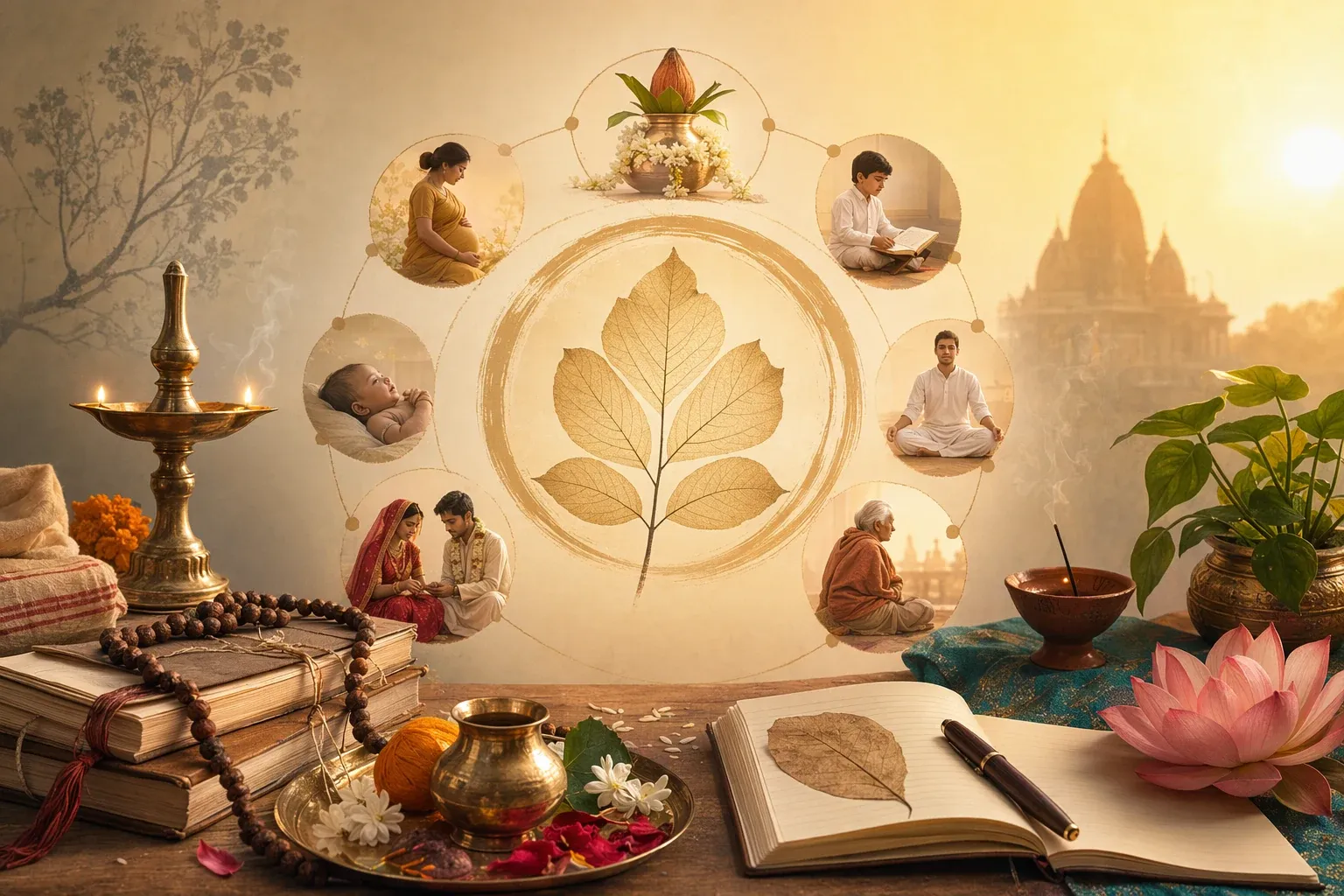
In Hindu life-cycle tradition, samskaras are rites that mark meaningful moments from before birth to death. Many people know the expression shodasha samskaras, the sixteen samskaras, though different texts, regions, and families count or perform them differently. The best-known examples include nāmakaraṇa, the naming ceremony; annaprāśana, a child’s first formal feeding of solid food; upanayana, initiation into study in many traditional settings; vivāha, marriage; and antyeṣṭi, the final rites.
These ceremonies do more than announce a social event. They place an individual moment inside a sacred and family context. A birth is welcomed with blessings, a child is named within community memory, learning is treated as a responsibility, marriage is entered with vows, and death is handled with reverence. The rite says: this moment matters, and it should be approached with care.
It is also important not to present one list as the only Hindu practice. Families may follow regional custom, sectarian tradition, local priestly practice, or simplified modern forms. Some rites are widely known, some are rarely performed, and some are adapted to the realities of contemporary life. The deeper point is that Hindu culture often treats life transitions as occasions for prayer, responsibility, and refinement.
Samskara as a mental impression
In yoga and Indian philosophy, samskara often means a subtle impression left by thought, action, intention, or experience. Repeated actions do not simply disappear. They leave traces in memory and character. Over time those traces can become tendencies: the ease with which we become angry, the habit of speaking kindly, the urge to avoid difficult work, or the calm that comes from regular prayer or meditation.
This use of samskara helps explain why character is not formed in one dramatic moment. It is shaped by repetition. If someone repeatedly practices patience, that patience can become more natural. If someone repeatedly feeds envy or harsh speech, those reactions may become easier too. In this sense, samskaras are not always mystical or remote; they are visible in everyday habit.
Yoga discussions often connect samskaras with the mind’s patterns. Old impressions can influence how we interpret a situation before we have fully thought about it. A student who has often been mocked may expect criticism even from a kind teacher. A person raised with generosity may instinctively notice where help is needed. Samskara is a way to speak about these inner grooves without reducing a human being to a machine.
How the two meanings are connected
The ritual meaning and the psychological meaning are related by the idea of shaping. A rite of passage shapes a public moment: it gives structure, blessing, and shared memory to a change in life. A mental impression shapes an inner pattern: it gives direction to future thought, feeling, and action. In both cases, samskara is about formation.
Think of a musical instrument. Before music can be played well, the instrument is tuned; after practice, the musician also carries impressions of rhythm, posture, and feeling. Hindu rites can be like tuning moments in a life. Daily choices can be like practice that leaves inner patterns. Neither image is complete by itself, but together they show why one Sanskrit word can travel between ritual, philosophy, yoga, and family life.
Everyday examples of samskara
A child who touches elders’ feet may first do it because the family teaches the gesture. Over time, the action can carry a value: gratitude for those who came before. A student who begins study with a small prayer may learn that knowledge is not only for marks or status, but also for humility and service. A person who apologizes quickly after making a mistake may slowly form the impression that ego is less important than repairing harm.
There are also difficult samskaras. Someone may have a habit of comparing themselves with others, speaking defensively, or giving up before trying. Hindu and yoga traditions do not usually treat such patterns as a permanent sentence. They can be noticed, weakened, and replaced through better action, self-study, devotion, meditation, ethical discipline, and supportive company.
This is why samskara is a hopeful idea. It accepts that the past shapes us, but it does not say we are trapped by the past. What has been impressed can be worked with. New impressions can be formed. A life can be refined.
Samskara, sanskar, and daily values
In many Indian languages, people use sanskar or sanskaar in everyday speech to mean values, manners, or moral upbringing. When someone says a child has “good sanskar,” they usually mean the child has learned respect, kindness, discipline, gratitude, and a sense of right conduct. This is a living cultural use, not a technical philosophy lesson.
Still, it echoes the older idea. Values are not learned only by being told once. They are absorbed through example, repetition, stories, festivals, family practices, and the way adults respond to success and failure. A home, school, temple, or community can become a place where helpful samskaras are planted.
Common misunderstandings
- Samskara is not only “ritual.” In Hindu culture it can mean a rite of passage, but in philosophy it can also mean an inner impression.
- Samskara is not only “habit.” Habit is a useful modern comparison, but samskara can include deeper memory, tendency, intention, and spiritual formation.
- The sixteen samskaras are not practiced identically everywhere. Lists and customs vary, and many families follow adapted forms.
- A negative samskara is not destiny. Traditions of yoga, devotion, and ethical living emphasize conscious practice and transformation.
Samskara in one simple sentence
Samskara means a refining formation: in Hindu life it may be a sacred rite that marks a life transition, and in yoga or philosophy it may be an inner impression that shapes future thought and action.
FAQs about samskara
What does samskaras mean?
Samskaras are formative refinements or impressions. In Hindu practice, the word often refers to life-cycle rites such as naming, first food, initiation, marriage, and final rites. In yoga and philosophy, it often means impressions left in the mind by repeated thoughts, intentions, and actions.
What is the concept of samskara?
The concept is that life is shaped by meaningful acts and repeated impressions. Outer ceremonies can mark and sanctify major transitions, while inner patterns can shape memory, habit, character, and spiritual growth.
What exactly is a samskara?
A samskara can be a specific rite of passage or a subtle mental impression, depending on context. The shared idea is that something is being prepared, refined, or imprinted in a way that affects life afterward.
What is the meaning of samskara in Hinduism?
In Hinduism, samskara commonly means a sacred rite that refines and marks a person’s journey through life. The same word is also used in Hindu philosophical discussions for mental impressions that influence conduct and experience.
Is samskara the same as karma?
No. Karma usually means action and its moral or spiritual consequence. Samskara refers to the impression or tendency formed by actions and experiences. The two ideas are related because actions can leave impressions, and those impressions can influence future actions.