Samskara is a beautiful but sometimes confusing word. In Hindu tradition it can refer to rites of passage that mark important moments in life. In yoga and philosophy it can also mean impressions or patterns that shape the mind. This guide focuses on the life-rite meaning: the ceremonies that help a family recognise birth, naming, first learning, sacred study, marriage, and other turning points.
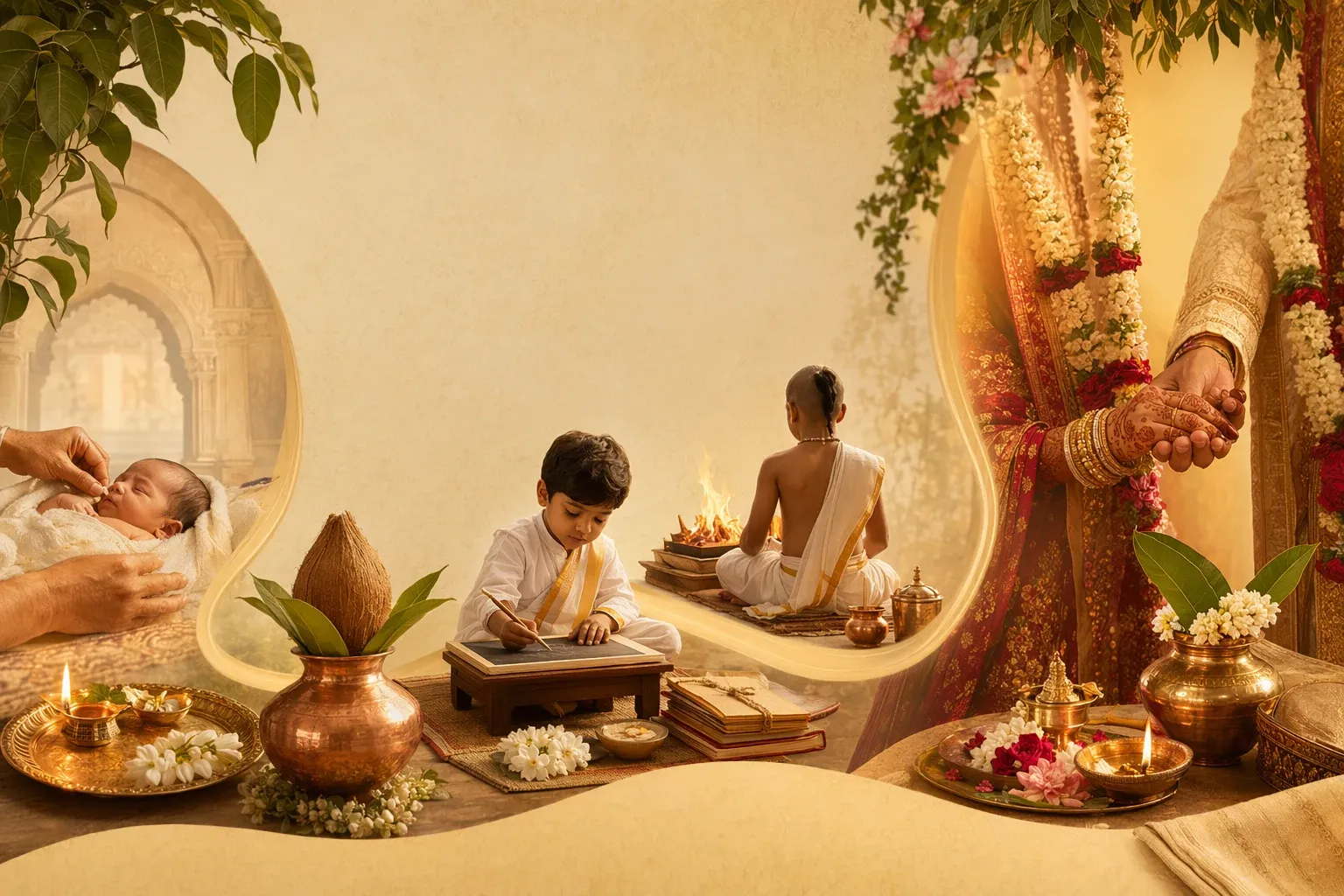
People often ask, “Which samskara is for birth, education, and marriage?” The short answer is that there is not one single samskara for all three. Birth, education, and marriage are connected with different rites. Jatakarma is associated with birth. Namakarana is associated with naming. Vidyarambha or Aksharabhyasa is associated with beginning education in many regional traditions. Upanayana is associated with entry into formal sacred learning in several traditional contexts. Vivaha is the marriage samskara. Together, these rites show how Hindu culture has understood life as a journey shaped by family, duty, learning, and responsibility.
What a samskara does
A samskara is not just a social event. It is a way of saying that a life moment matters. Birth is not treated only as a biological fact. Naming is not treated only as paperwork. Education is not treated only as school admission. Marriage is not treated only as a private agreement. Each moment is given meaning through prayer, family participation, blessings, and memory.
The number and details of samskaras vary across texts, regions, communities, and families. Many lists speak of sixteen major samskaras, but real practice has never been identical everywhere. Some ceremonies are widely remembered; others are rare or performed in simplified ways. A beginner should learn the main idea without assuming every Hindu family follows the same list in the same manner.
For a wider introduction, Bhaktilipi has a simple guide to what samskara means in Hinduism and another article on samskara in yoga. Those two meanings are different but related by the idea of shaping: one shapes life through rites, the other shapes the mind through impressions.
Birth: Jatakarma and the welcome into life
Jatakarma is commonly associated with birth. The word points to a rite performed around the birth of a child, traditionally welcoming the newborn and marking the beginning of embodied life. Different families and traditions may remember the details differently, but the emotional meaning is easy to understand: a child is received with reverence, blessing, and hope.
In many modern families, the exact traditional form may not be performed, or it may be simplified. That does not make the cultural idea meaningless. The deeper point is that birth brings responsibility. Parents, grandparents, and elders are not only happy; they are also entrusted with care, values, language, protection, and love. Jatakarma reminds the family that a child enters not just a house but a lineage of memory.
Naming: Namakarana and identity
Namakarana is the naming samskara. Names in Indian traditions often carry meanings connected with deities, virtues, nature, ancestors, family memory, or auspicious sounds. A name is not treated as a random label. It can become a daily blessing, a reminder of belonging, or a bridge to a story.
This does not mean every name must be heavy or formal. Families choose names in many ways today. Some prefer Sanskrit names, some regional names, some names connected with grandparents, and some modern names with cultural roots. Namakarana shows why the act of naming has long been respected: it gives the child a recognised place in family and society.
Education: Vidyarambha and Upanayana
Education-related samskaras need careful explanation because different terms appear in different contexts. Vidyarambha, also called Aksharabhyasa in some regions, marks the beginning of learning or writing. A child may be guided to write letters, invoke Saraswati or Ganesha, or begin formal learning with blessings. The heart of the rite is simple: knowledge is sacred, and learning should begin with humility.
Upanayana is another important education-related samskara in many traditional lists. It is often connected with the beginning of Vedic study and the relationship between student and teacher. In historical practice it has been shaped by community rules, gender expectations, region, and changing social realities. A responsible beginner guide should not pretend that the same form applied equally to everyone in every period.
The useful takeaway is that education was not viewed only as career preparation. Learning was linked with discipline, memory, speech, conduct, and responsibility. Whether a family performs a formal rite today or simply begins school with prayer and blessings, the older idea still speaks clearly: learning should be approached with respect.
Marriage: Vivaha and household responsibility
Vivaha is the marriage samskara. It marks the beginning of household life and shared duties. Hindu wedding customs vary widely across regions, languages, castes, communities, and family traditions, but the broad meaning is the same: marriage is treated as a serious partnership witnessed by family, sacred fire, vows, and blessings.
In many ceremonies, Agni is present as witness. The couple may take vows, walk around the fire, receive blessings from elders, and enter a new phase of life together. The emphasis is not only romance. It includes dharma, mutual support, family responsibility, hospitality, continuity, and ethical living.
Vivaha also connects to the idea of grihastha, the householder life. In the broader Hindu view, household life is not spiritually inferior. It supports family, society, ritual, service, charity, and the next generation. Marriage therefore becomes a doorway into responsibility, not just a celebration.
Why these rites matter today
Modern families may perform these samskaras fully, partly, symbolically, or not at all. Some may live outside India, some may belong to interregional families, and some may choose simplified ceremonies. The purpose of learning about samskaras is not to judge families. It is to understand how Hindu culture has honoured turning points in life.
These rites also help young readers see that tradition is not only about festivals and temples. It enters ordinary life: a child’s name, first letters, student discipline, marriage vows, family blessings, and the responsibilities that come with growing up. Samskaras give language to these transitions.
Simple takeaway
Birth, education, and marriage are not covered by one single samskara. Jatakarma welcomes birth. Namakarana gives a child a name. Vidyarambha or Aksharabhyasa marks the beginning of learning in many traditions. Upanayana is linked with formal sacred study in several traditional contexts. Vivaha marks marriage and entry into household responsibilities.
The larger message is that life should not pass by unnoticed. Important transitions deserve attention, gratitude, and guidance. That is why samskaras remain meaningful even when their exact forms change from family to family.