
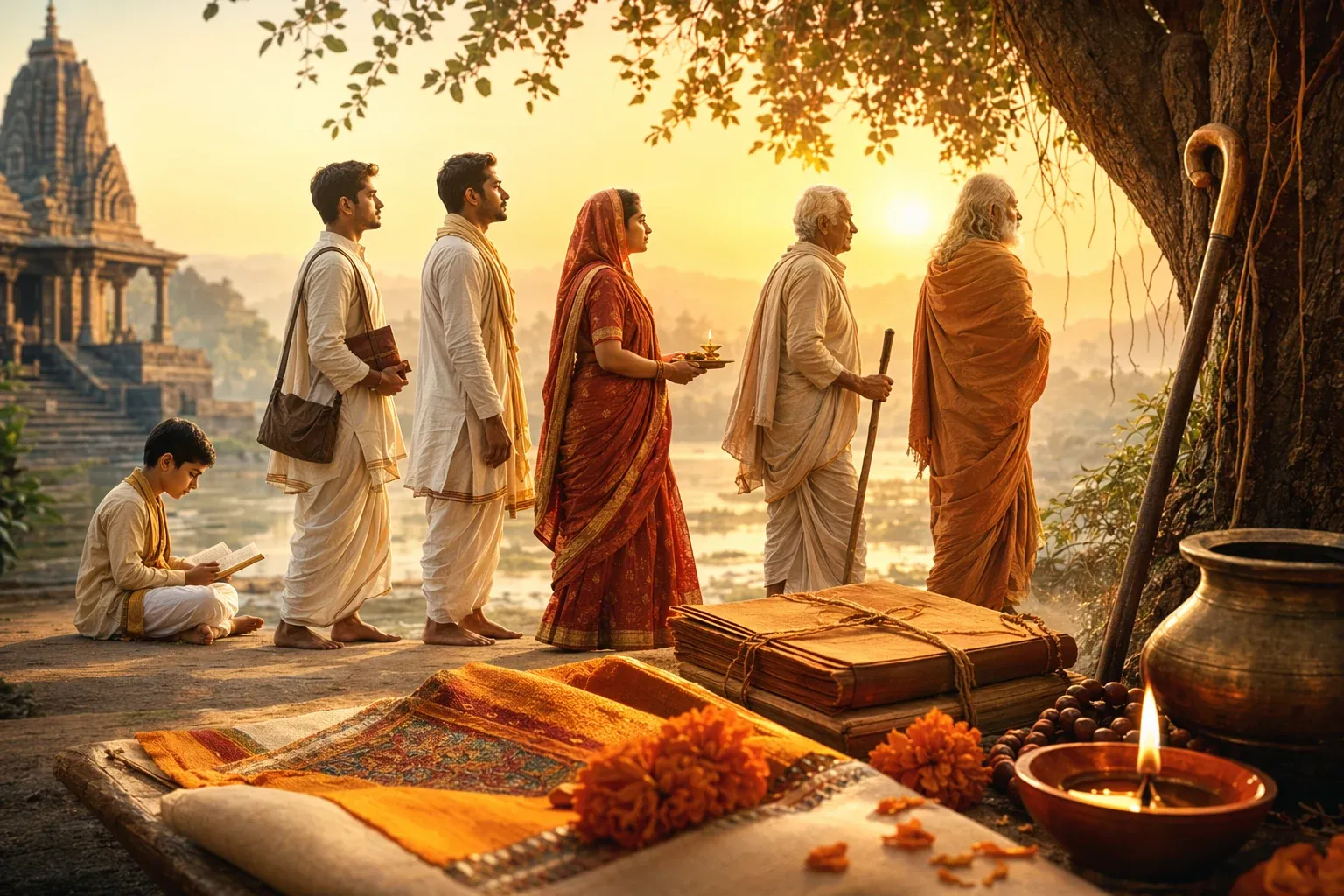
The Ashrama system is a traditional Hindu way of thinking about a human life as a journey with changing responsibilities. In simple terms, it divides life into four broad parts: student life, household life, retirement or withdrawal, and renunciation. These are called Brahmacharya, Grihastha, Vanaprastha, and Sannyasa.
The idea is not that every person in every period followed the model exactly. It is better understood as a cultural and philosophical framework. It helped people imagine how education, work, family, service, reflection, and spiritual freedom could fit into one lifetime. For beginners, the most important point is this: Ashrama does not only mean a spiritual retreat or a place where people live with a teacher. In this context, it means a life phase or way of living.
The basic meaning of Ashrama
The Sanskrit word ashrama can suggest a disciplined dwelling, a place of effort, or a mode of life shaped by a particular purpose. In the life-stage system, each ashrama has a different focus. A child or young student learns discipline and knowledge. An adult householder supports family and society. An older person gradually loosens attachment to status and possessions. A renunciant turns most fully toward liberation.
This model appears in Dharma literature and later Hindu discussions of social and spiritual life. It is linked with the wider idea that human life should not be ruled by one goal alone. Learning, livelihood, pleasure, duty, service, and spiritual insight all need balance. The Ashrama system offered one way to picture that balance across time.
Brahmacharya: the learning phase
Brahmacharya is usually explained as the student phase. The focus is study, discipline, memory, respect for the teacher, and training of body and mind. In older settings, this could involve living with a guru and learning sacred texts, language, conduct, and practical duties.
For modern readers, the deeper meaning is not limited to ancient schooling. Brahmacharya points to the value of preparation. Before a person takes on large responsibilities, they need habits of attention, self-control, humility, and curiosity. A culture that honors learning is saying that freedom without formation can become careless.
Grihastha: the household phase
Grihastha means the householder life. This is the phase of marriage, family, earning, hospitality, social duty, and contribution. In many Hindu texts, the householder is not treated as spiritually inferior. In fact, the householder supports many others: children, elders, guests, teachers, renunciants, and community institutions.
This is why Grihastha is often called central to the social order. It recognizes that spiritual and ethical life do not happen only in forests, monasteries, or temples. Feeding people, raising children, earning honestly, caring for parents, keeping promises, and supporting learning can also be sacred responsibilities. The household becomes a place where dharma is tested in ordinary decisions.
Vanaprastha: gradual withdrawal
Vanaprastha is often translated as the forest-dweller phase, but beginners should not imagine that every older person literally moved into a forest. The broader idea is gradual withdrawal. After fulfilling major family and social duties, a person begins to step back from ambition, possession, and control.
This phase asks a gentle question: what should a person do when the work of building a household is largely complete? The answer is not despair or idleness. It is reflection, guidance, simplicity, pilgrimage, study, and preparation for deeper detachment. In a modern setting, Vanaprastha can inspire elders to share wisdom without clinging to authority.
Sannyasa: renunciation and freedom
Sannyasa is the renunciant phase. Its ideal is a life turned toward moksha, or liberation. A sannyasi gives up ordinary social markers and seeks truth beyond ego, wealth, and family identity. This is the most radical part of the model because it says that human life is not complete if it never asks what lies beyond possession and status.
At the same time, Sannyasa should not be romanticized. Renunciation requires maturity, discipline, and guidance. It is not simply escape from difficulty. In Hindu thought, true renunciation is not laziness or bitterness; it is a serious turning away from selfish attachment.
Why the four phases were connected
The four ashramas make sense together. Student life prepares the person. Household life contributes to the world. Withdrawal loosens the grip of ego. Renunciation points toward spiritual freedom. The model therefore gives shape to both social duty and inner growth.
It also prevents one phase from pretending to be the whole of life. A student should not be forced to carry every adult burden too early. A householder should not forget reflection. An elder should not measure worth only by control. A seeker should not use spirituality as an excuse to avoid compassion. Each phase has dignity, but each also has limits.
Connection with dharma and the four aims of life
The Ashrama system is often discussed with the Purusharthas, the four aims of human life: dharma, artha, kama, and moksha. Dharma means ethical order and duty. Artha means material support and prosperity. Kama means desire, beauty, affection, and enjoyment. Moksha means liberation.
A balanced life needs wise attention to all four, though not in the same way at every age. Student life emphasizes formation and dharma. Householder life gives a responsible place to artha and kama under dharma. Later life turns more strongly toward detachment and moksha. This connection helps explain why the system is more than a social timetable. It is also a map of values. For a simple introduction to dharma, see Bhaktilipi’s guide to dharma.
Common misunderstandings
One misunderstanding is that the Ashrama system is the same as living in an ashram. A modern ashram may be a spiritual community, retreat, or teaching center. The life-stage idea is different. It describes phases of life, not just a physical place.
Another misunderstanding is that the system was a perfect historical reality for everyone. Social class, gender, region, family situation, economic hardship, and local custom shaped how people lived. Many people would not have experienced the model in a neat four-part form. That does not make the idea meaningless; it means we should read it as an influential ideal, not as a photograph of every life in ancient India.
A third misunderstanding is that renunciation makes family life unimportant. The model actually gives great importance to the householder, because society depends on care, food, work, and generosity. Spiritual aspiration and worldly responsibility are presented as connected, not always opposed.
Is the Ashrama system relevant today?
Modern life does not follow the old pattern exactly. People study at different ages, marry or do not marry, change careers, care for parents while raising children, and search for meaning in many ways. Still, the Ashrama system remains useful as a reflective tool. It reminds us that life has seasons. A healthy society should make room for learning, responsible work, care, rest, mentoring, and spiritual questioning.
Its best modern value may be its resistance to one-dimensional success. It tells a student that discipline matters. It tells an adult that earning should be joined with duty. It tells an elder that wisdom matters more than control. It tells every person that freedom is deeper than accumulation. Read in this way, the Ashrama system becomes a thoughtful guide to balance rather than a rigid rulebook.