
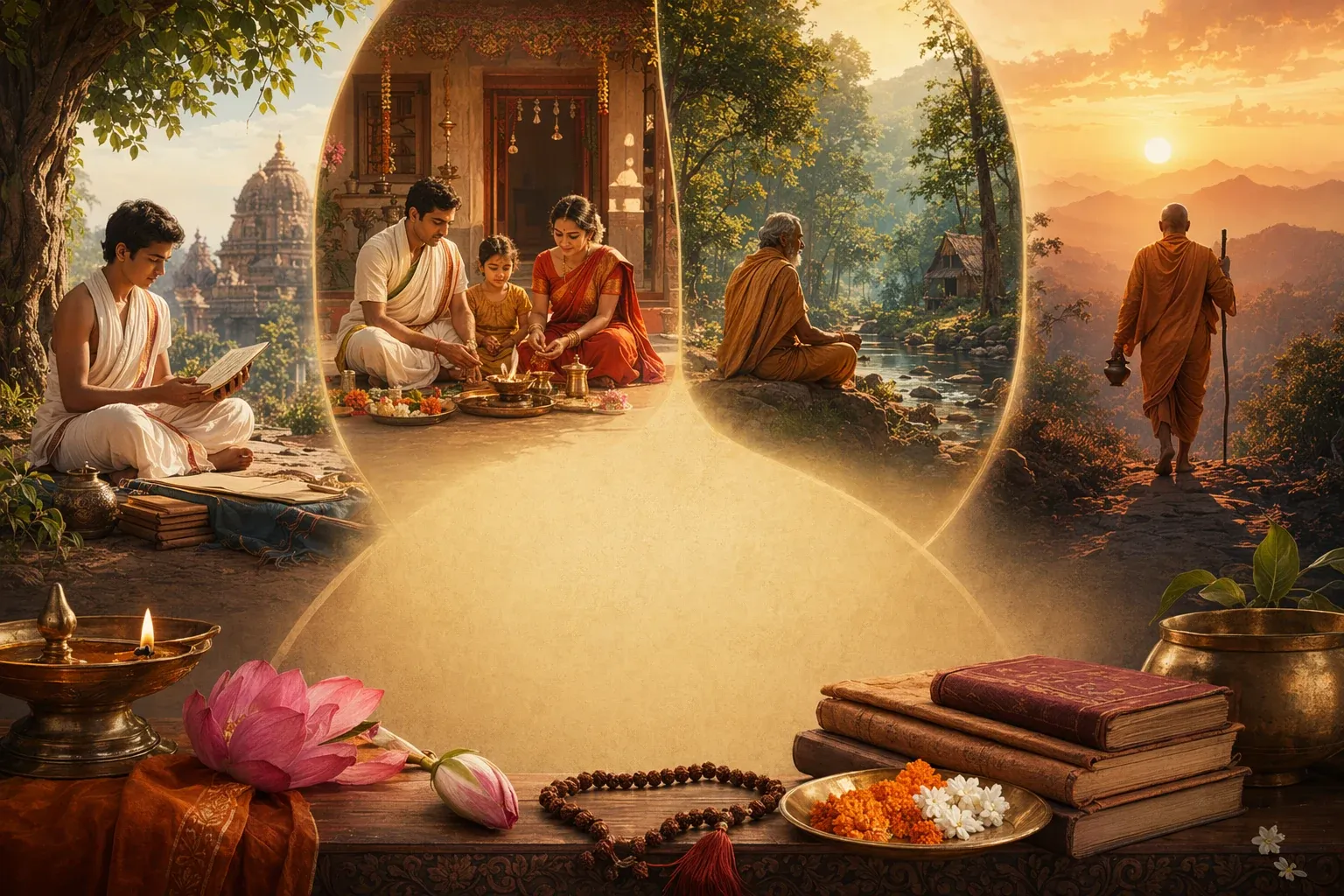
The ashrama system is a traditional Hindu way of thinking about a well-shaped human life. It does not describe life as a race to finish, or as a single fixed identity. Instead, it imagines life as a gradual training of the mind, family, responsibilities, and inner freedom. The four ashramas are brahmacharya, grihastha, vanaprastha, and sannyasa. In simple terms, they point to learning, household life, withdrawal from heavy duties, and spiritual renunciation.
This guide explains the four ashramas in beginner-friendly language. If you first want the broader meaning and purpose, see What Is the Ashrama System?. Here, the focus is on how the four parts fit together and why the model still appears in discussions of Hindu culture, ethics, and personal growth.
What the ashrama system is trying to do
The ashrama system begins with a practical observation: different parts of life ask different things from us. A young student needs discipline and guidance. A householder must care for relationships, livelihood, guests, and society. An older adult may slowly step back from daily ambition and become a source of counsel. A renouncer gives full attention to liberation and truth.
This does not mean every person in history followed the pattern perfectly. Texts, families, regions, and social realities varied. The value of the model is that it gives a moral map. It says that education, work, family, service, reflection, and spiritual freedom all have a place. It also reminds us that no single role should dominate the whole of life.
Brahmacharya: the learning phase
Brahmacharya is usually described as the student period. The word is often connected with disciplined conduct, self-control, study, and living in a way that supports learning. In traditional descriptions, a student studies with a teacher, learns sacred knowledge, develops humility, and forms habits that prepare the person for adult responsibility.
The deeper idea is not only school education. Brahmacharya asks: can the mind be trained before it is given power, money, and social duties? A person who learns restraint early is better prepared to use freedom wisely later. That is why this ashrama is linked with listening, memorizing, serving the teacher, rising above distraction, and respecting knowledge.
For modern readers, brahmacharya can be understood as the discipline behind any serious education. It may include formal study, learning a craft, spiritual reading, ethical training, or the quiet effort to build character before chasing status.
Grihastha: the householder phase
Grihastha is the householder life. It includes marriage for many people, raising children for some, earning honestly, hosting guests, supporting elders, and contributing to community life. Hindu texts often give this ashrama great importance because householders sustain society. They produce food, wealth, charity, ritual support, and care for people in other life paths.
This phase is not treated as spiritually inferior. In fact, it is where many values become real. Patience, generosity, truthfulness, and duty are tested in daily relationships. A person may speak beautifully about compassion, but family life and social duty reveal whether that compassion has become a habit.
Grihastha also connects strongly with dharma. The householder must balance personal desire, family needs, social responsibility, and moral limits. That balance is not always easy, which is why this ashrama is seen as demanding as well as meaningful.
Vanaprastha: the reflective phase
Vanaprastha is traditionally described as a gradual withdrawal toward the forest. The phrase should not be read only as physically moving into trees. It points to a shift in attention. After years of active responsibility, a person slowly loosens the grip of ambition and becomes more reflective.
In this phase, one may hand over responsibilities, reduce possessions, mentor younger people, study, travel for pilgrimage, and spend more time in contemplation. The person is not rejecting society in anger. Rather, the energy once spent on building and managing turns toward wisdom.
Vanaprastha is important because it gives aging a meaningful role. It says later life can be more than decline. It can be a period of clarity, simplification, and generous guidance.
Sannyasa: the renouncing phase
Sannyasa is the path of renunciation. A sannyasi seeks liberation with single-minded seriousness. The person gives up ordinary claims of property, status, and social identity in order to live for truth. Traditional images of sannyasa include wandering, meditation, teaching, silence, and freedom from attachment.
Not everyone entered sannyasa, and Hindu traditions have understood renunciation in many ways. Still, the idea has a powerful message: the final aim of life is not only success, comfort, or reputation. The deepest question is whether the self can become free from ignorance, ego, and clinging.
How the four ashramas work together
The four ashramas are best understood as a rhythm. Brahmacharya prepares the mind. Grihastha tests values through responsibility. Vanaprastha turns experience into wisdom. Sannyasa points toward spiritual freedom. Together, they prevent two common mistakes: treating youth as meaningless preparation, or treating worldly success as the whole purpose of life.
The model also teaches balance. Learning without service can become pride. Family duty without reflection can become exhaustion. Reflection without compassion can become escape. Renunciation without maturity can become performance. The ashrama system tries to place each pursuit in a larger order.
A simple takeaway
For beginners, the ashrama system is a life map, not a rigid timetable. Its four parts name the movement from training to responsibility, from responsibility to reflection, and from reflection to freedom. Whether read historically, spiritually, or ethically, it asks a useful question: what kind of life helps a person grow in knowledge, duty, love, and inner release?