
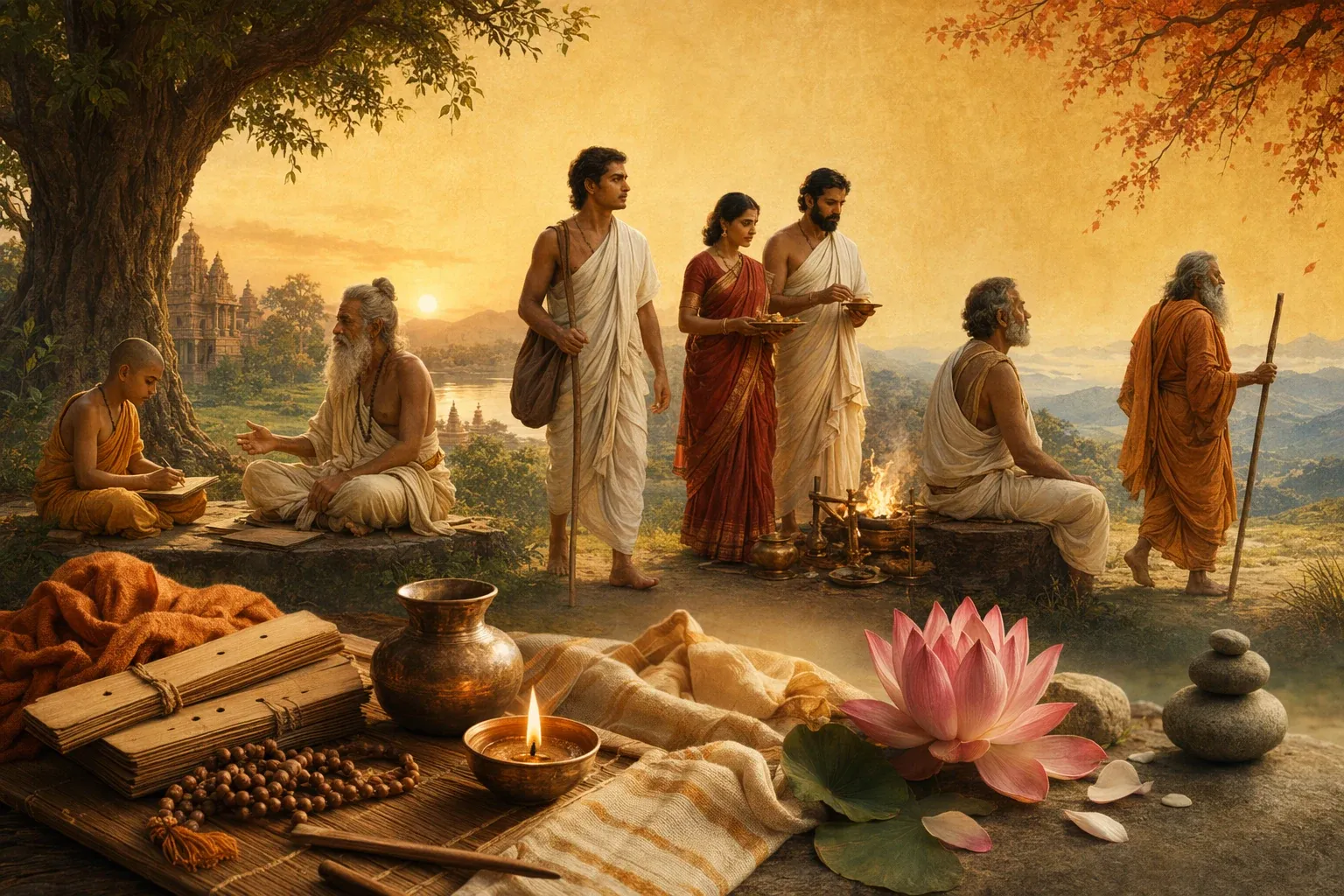
The ashrama system is often explained as a Hindu model of life divided into brahmacharya, grihastha, vanaprastha, and sannyasa. When people ask about the ashrama system in the Vedic period and ancient India, they are usually asking two related questions. Did ancient Indians really live according to this pattern? And what did the model mean in the world of Vedic learning, ritual, family duty, and renunciation?
The careful answer is that the ashrama idea developed over time. Early Vedic society placed strong emphasis on household ritual, lineage, learning, and social obligation. Later texts gave more explicit shape to the fourfold life model. So the ashrama system should not be imagined as one rule that appeared fully formed everywhere at once. It is better understood as a developing framework that organized important ideals in ancient Indian thought.
The background: Vedic life and disciplined learning
Vedic culture valued learning that was preserved through careful oral transmission. Students were expected to listen, memorize, repeat, and serve with attention. This background helps explain the importance of brahmacharya, the disciplined student life. Knowledge was not treated as casual information. It required character, restraint, respect for the teacher, and control over speech and behavior.
In this world, education was also connected with sacred sound, ritual responsibility, and moral formation. A student was being prepared not only to know words, but to carry a tradition responsibly. That is why brahmacharya became more than childhood education. It became a symbol of training the whole person.
The householder as the center of ancient society
Ancient Indian life depended heavily on the householder. The grihastha maintained the family, supported ritual fires, produced wealth, offered hospitality, and gave assistance to students, renouncers, guests, and the vulnerable. Because of this, many texts describe the householder path as the support of the others.
This can surprise modern readers who assume spiritual life must mean leaving the world. In the ancient Indian view, household life could be deeply religious. Feeding a guest, earning honestly, raising children, supporting teachers, and performing duties were all part of dharma. The householder was not outside sacred life; the household was one of its main places.
How withdrawal and renunciation entered the picture
Alongside household ideals, ancient India also produced powerful traditions of forest life, meditation, and renunciation. Some people sought truth beyond ritual prosperity and social identity. The Upanishadic atmosphere, with its questions about the self, ultimate reality, and liberation, helped give prestige to inward searching.
Vanaprastha and sannyasa reflect this movement. Vanaprastha marks gradual withdrawal from heavy household duty. Sannyasa represents a more complete renunciation. These paths show that ancient Indian thought did not reduce life to social success. It also made room for the search for moksha, freedom from ignorance and bondage.
Was the system a strict historical timetable?
It is tempting to read the four ashramas as if every ancient person moved neatly through them. History was more complex. Different regions, communities, texts, and family conditions shaped actual practice. Some people emphasized household duty. Some renounced early. Some never formally entered later paths. Many women, working communities, and local traditions do not fit neatly into textbook summaries.
Still, the framework mattered because it expressed ideals. It told society that learning, family responsibility, gradual detachment, and spiritual freedom were all worthy. It also created a language for discussing what a person owes to the self, the family, the community, and ultimate truth.
Ashrama and the four goals of life
The ashrama system is closely related to the purusharthas: dharma, artha, kama, and moksha. Ancient Indian thought did not see all goals as identical. Artha includes material security and power. Kama includes pleasure and emotional fulfillment. Dharma gives moral order. Moksha points to liberation. The ashrama model helps arrange these goals across the arc of life.
A student gives priority to discipline and learning. A householder engages more actively with livelihood, relationship, and social duty. A person entering withdrawal reduces attachment to achievement. A renouncer places liberation at the center. This is not a rejection of life, but a way of giving each aim its proper place.
Why the ancient model still matters
The ashrama system in ancient India gives us a window into how a civilization thought about time, maturity, and responsibility. It shows that life was not only measured by age, wealth, or power. A complete life required education, ethical action, social contribution, reflection, and spiritual insight.
For a beginner-friendly overview of the core idea, read What Is the Ashrama System?. The historical view adds another layer: the system was not just a private spiritual plan. It was tied to education, ritual, family structure, social support, and the search for liberation.
A balanced conclusion
In the Vedic and ancient Indian setting, the ashrama system was both an ideal and a mirror of changing religious thought. It honored the student, the householder, the elder seeker, and the renouncer. It grew from a culture that valued sacred learning and household duty, while also making space for deep inward freedom. Its lasting importance lies in that balance: worldly responsibility is respected, but it is not the final horizon of human life.
Reading ancient ideals with care
A careful reader should also remember that ancient Indian sources often present ideals. They tell us what learned traditions valued, not every detail of how every village or household functioned. This distinction matters. The ashrama system can be respected without turning it into a flat picture of the past.
For students, the best approach is to describe both sides. On one side, the model reveals a serious attempt to connect education, family duty, social support, and spiritual freedom. On the other side, actual life was shaped by class, region, gender, occupation, and local custom. When both sides are kept together, the ashrama system becomes more interesting. It is not a museum label. It is a living clue to how ancient Indian thinkers imagined a complete human journey.