
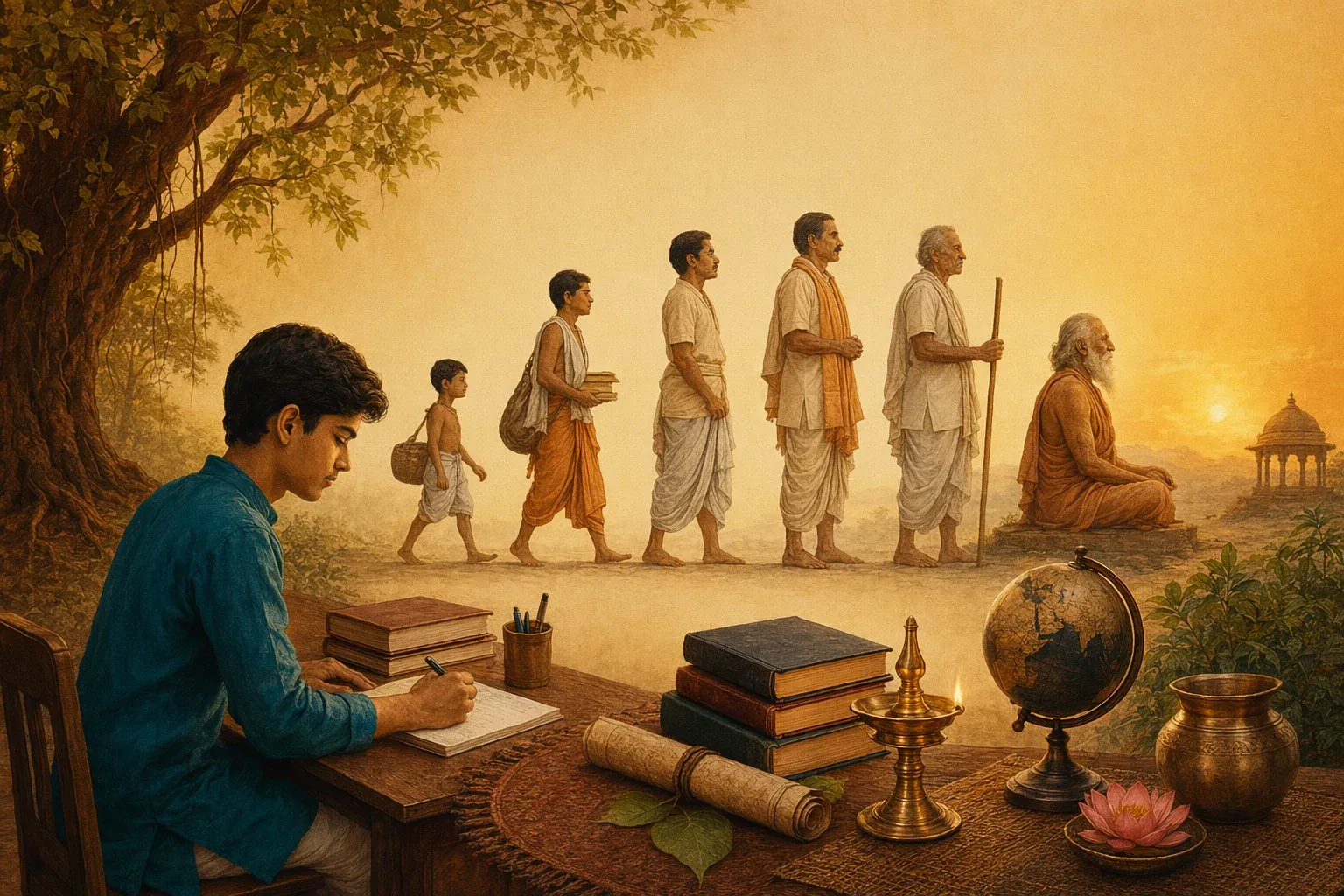
In sociology, the ashrama system can be understood as a cultural model that organizes life into meaningful roles and responsibilities. It is usually explained through four ashramas: brahmacharya, grihastha, vanaprastha, and sannyasa. These represent student life, householder life, gradual withdrawal, and renunciation.
A sociological explanation does not look only at personal spirituality. It asks how the system shaped social expectations, family life, education, authority, aging, and values. In that sense, the ashrama system is both a religious idea and a social framework.
What sociology notices about the ashrama system
Sociology studies patterns in society. When it looks at the ashrama system, it notices that the model gives different duties to different parts of life. A student is expected to learn discipline. A householder is expected to support family and society. An elder is expected to reduce active control and offer wisdom. A renouncer is expected to seek liberation beyond ordinary social identity.
This creates a structure of roles. It tells people what kind of behavior is valued at different points in life. It also connects individual growth with social order. A person is not imagined as isolated; each life path has meaning in relation to family, teachers, guests, dependents, and seekers.
Brahmacharya as social training
Brahmacharya, the student life, can be read sociologically as a period of socialization. Socialization means learning the values, habits, language, discipline, and expectations of a community. In traditional settings, the student learned not only texts but also respect, restraint, service, and obedience to a teacher.
This helped preserve cultural knowledge across generations. Oral learning, ritual practice, and ethical behavior required discipline. The student role therefore protected continuity. It trained young people to enter adult society with shared values.
Grihastha and the stability of society
Grihastha, the householder life, is central from a sociological point of view. Householders maintain families, produce and distribute resources, raise children, care for elders, host guests, and support religious and social institutions. Without householders, the other ashramas could not easily survive.
This is why grihastha is often described as a support structure. It connects private family life with public social order. Marriage, kinship, inheritance, livelihood, charity, and ritual duties all come together in this ashrama.
The householder also practices dharma through everyday conduct. Sociology would describe this as the moral regulation of social life: rules and values that help relationships remain stable and meaningful.
Vanaprastha and the role of elders
Vanaprastha is useful for understanding aging in society. Instead of treating older adults only as retired or dependent, the model gives them a new role. They become guides, advisors, and seekers. Their task is to step back from heavy control while sharing experience.
This can reduce conflict between generations. Younger adults receive space to lead, while elders continue to offer wisdom. Of course, real families may not always work so smoothly. But as a cultural ideal, vanaprastha gives aging dignity and purpose.
Sannyasa and life beyond social status
Sannyasa is especially interesting sociologically because it points beyond ordinary roles. A renouncer gives up many markers of social identity: property, family position, status, and ambition. This creates a respected place for people who choose spiritual freedom over social success.
At the same time, sannyasa challenges society. It reminds people that wealth, power, and family identity are not the final meaning of life. A society that honors renunciation makes room for values beyond production and consumption.
Social order and personal growth
The ashrama system links personal development with social stability. It encourages students to learn, adults to provide, elders to guide, and renouncers to seek truth. Each role has duties that support the whole.
This is why the system can be studied as a form of social organization. It distributes responsibilities across age, maturity, and spiritual aspiration. It also creates expectations about when to focus on education, family, withdrawal, and liberation.
A critical sociological view
A good sociology answer should also be critical. The ashrama system was an ideal, not always an exact description of every person’s life. Gender, caste, region, occupation, poverty, and local customs shaped who could follow which path. Many textbook summaries simplify this complexity.
So students should avoid writing as if all ancient Indians lived the same way. It is better to say that the ashrama system expressed influential ideals about life roles, even though actual practice varied widely.
Relevance for modern sociology students
For modern students, the ashrama system is useful because it shows how religion, family, education, economy, and aging can be connected in one cultural model. It also helps compare traditional and modern societies. Modern life often separates school, career, retirement, and spirituality. The ashrama system links them through duty and meaning.
For the basic religious explanation, see What Is the Ashrama System?. For sociology, remember the main point: the ashrama system is not only about private belief. It is a map of social roles, moral expectations, and the movement from learning to responsibility, then toward wisdom and freedom.
How to write about it in exams
For an exam or assignment, avoid only listing the four names. Explain what social function each part performs. Brahmacharya socializes the young through education and discipline. Grihastha supports family, economy, and social continuity. Vanaprastha gives elders a respected advisory role. Sannyasa creates a place for renunciation and values beyond social status.
Then add a balanced note that the model was idealized and not practiced uniformly by everyone. This makes the answer stronger because sociology is interested in both norms and real life. The ashrama system is therefore best described as an influential cultural framework for organizing duties, authority, aging, and spiritual aspiration within Hindu society.