If you grew up around Indian stories, festivals, or the Bhagavad Gita, you have probably heard the word Dharma. It sounds big. Serious. Maybe even a little confusing.
But at its heart, Dharma is a very practical idea.
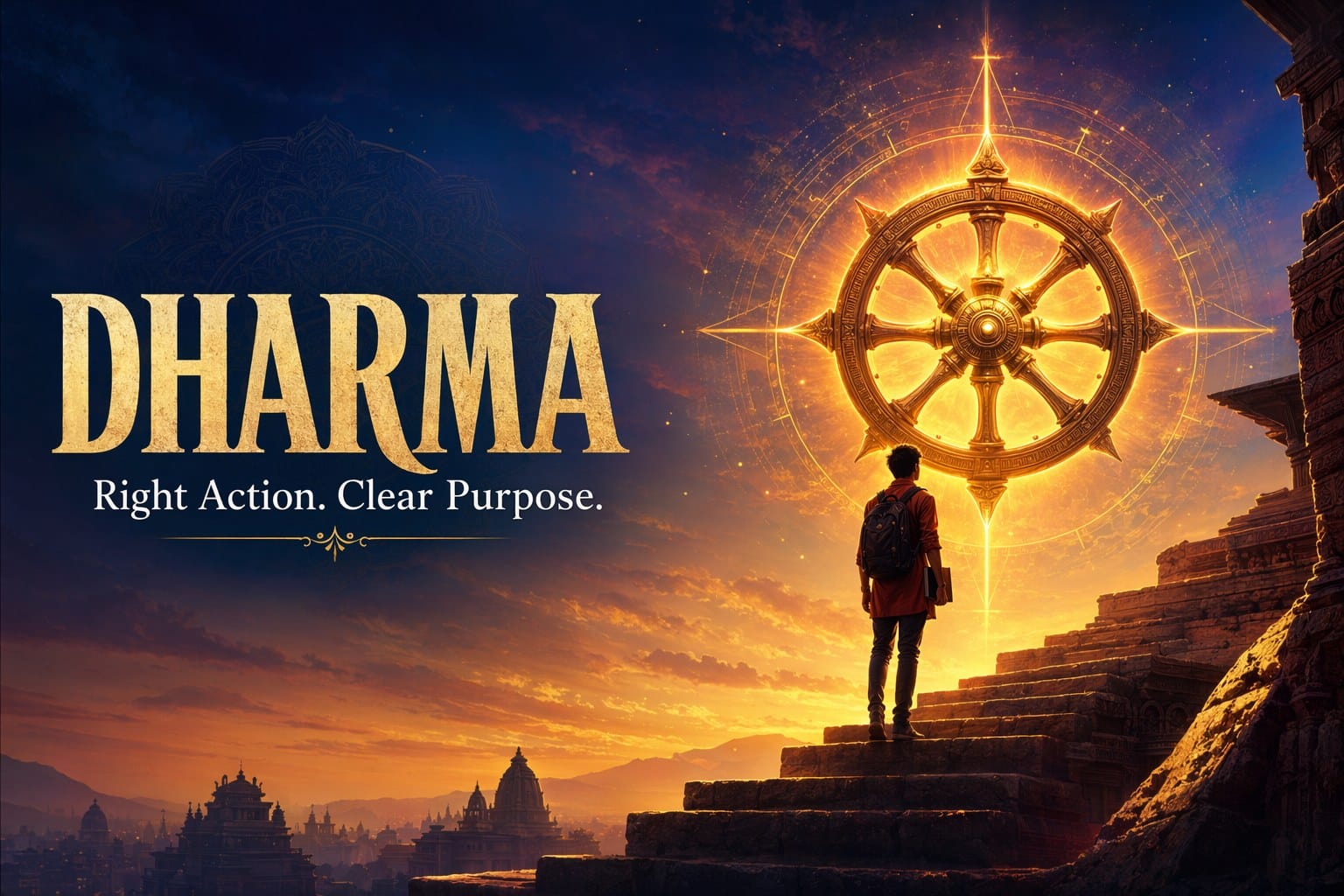
Dharma means the right way to live and act — the action, duty, value, or responsibility that helps uphold life, truth, and harmony.
It is not just “religion”. It is closer to a life compass.
The simple meaning of Dharma
The Sanskrit root behind Dharma is often explained as something that means to uphold, support, or sustain. So Dharma is that which holds things together.
Think of it like this:
- fire’s dharma is to give heat and light
- water’s dharma is to flow and nourish
- a teacher’s dharma is to guide students honestly
- a student’s dharma is to learn with sincerity
- a leader’s dharma is to protect and serve people, not exploit them
Dharma asks: What is the right thing to do here, according to truth, responsibility, and the welfare of others?
Dharma is not just one rulebook
One reason Dharma feels difficult to translate is that it changes with context.
Being truthful is Dharma. But so is being compassionate. Being brave is Dharma. But so is being patient. Taking care of your family can be Dharma. Standing up against injustice can also be Dharma.
That is why Dharma is less like a traffic signal and more like a compass. A signal says only “stop” or “go”. A compass helps you find direction even when the road is complicated.
Dharma and Karma: how are they connected?
A simple way to remember it:
Dharma is the right direction. Karma is the action you take.
Karma literally relates to action. Dharma helps decide whether that action is responsible, truthful, and aligned with a higher purpose.
The Bhagavad Gita gives one of the most famous teachings on Karma Yoga:
“You have a right to perform your prescribed duties, but you are not entitled to the fruits of your actions…” — Bhagavad Gita 2.47
In simple words: do the work that is yours to do, do it well, but do not become a prisoner of the result.
That does not mean results do not matter. It means your peace and integrity should not depend only on applause, likes, marks, money, or victory.
What is Svadharma?
Svadharma means one’s own Dharma — your own duty, path, or responsibility.
The Gita says it is better to follow one’s own duty, even imperfectly, than to copy another person’s duty perfectly.
This is powerful for modern life.
A student should not blindly copy someone else’s career just because it looks glamorous. A creator should not copy trends that feel empty. A leader should not imitate power if their real duty is service.
Svadharma asks: What is truly mine to do? What responsibility has life placed in front of me?
Everyday examples of Dharma
Dharma is not only for saints, kings, or warriors in epics. It appears in ordinary choices.
1. Dharma for students
Studying sincerely, respecting teachers, asking honest questions, avoiding cheating, and using knowledge for good.
2. Dharma for creators
Making content that informs instead of misleads. Respecting sources. Not spreading fake history just because it gets views.
3. Dharma for friends
Telling the truth kindly. Supporting a friend when they are struggling. Not encouraging harmful behavior just to look “loyal”.
4. Dharma for professionals
Doing work honestly, keeping promises, not exploiting people, and taking responsibility when mistakes happen.
5. Dharma for citizens
Following fair laws, protecting shared spaces, voting thoughtfully, and caring about society beyond personal comfort.
Sanatan Dharma: why “eternal”?
Sanatan Dharma is often translated as eternal Dharma. The word points toward values and truths that are not limited to one trend, one century, or one mood.
Values like truthfulness, compassion, self-control, patience, generosity, and respect for life do not become outdated. Their expression may change with time, but their importance remains.
A young person today may live with smartphones, AI, exams, memes, and career pressure. But the need for truth, discipline, courage, and kindness is still the same.
That is why Dharma still matters.
Why Dharma matters today
Modern life gives us endless options. But options without direction can become confusion.
Dharma helps us ask better questions:
- Is this action honest?
- Is it useful or just attention-seeking?
- Am I doing this from responsibility or ego?
- Who gets helped or harmed by this choice?
- Is this aligned with the person I want to become?
Dharma does not make life automatically easy. Sometimes the Dharmic choice is the harder choice. But it gives life meaning.
A simple Bhaktilipi takeaway
Dharma is not just something to read about. It is something to practice.
When your action is truthful, responsible, compassionate, and aligned with your purpose, you are walking closer to Dharma.
And when your Karma aligns with Dharma, even ordinary work becomes meaningful.
FAQs
What is Dharma in simple words?
Dharma is the right way to live and act. It means duty, responsibility, moral conduct, and the principle that supports harmony in life.
Is Dharma the same as religion?
Not exactly. Dharma can include religious duty, but it is wider than religion. It also means ethics, responsibility, right conduct, and the order that supports life.
What is the difference between Dharma and Karma?
Dharma is the right direction or duty. Karma is action. Dharma guides what kind of Karma we should perform.
What is Svadharma?
Svadharma means one’s own duty or path. It is the responsibility that fits one’s nature, role, situation, and stage of life.
How can students follow Dharma today?
Students can follow Dharma by learning sincerely, avoiding cheating, respecting knowledge, helping others, and choosing goals that match their values rather than blindly copying trends.