
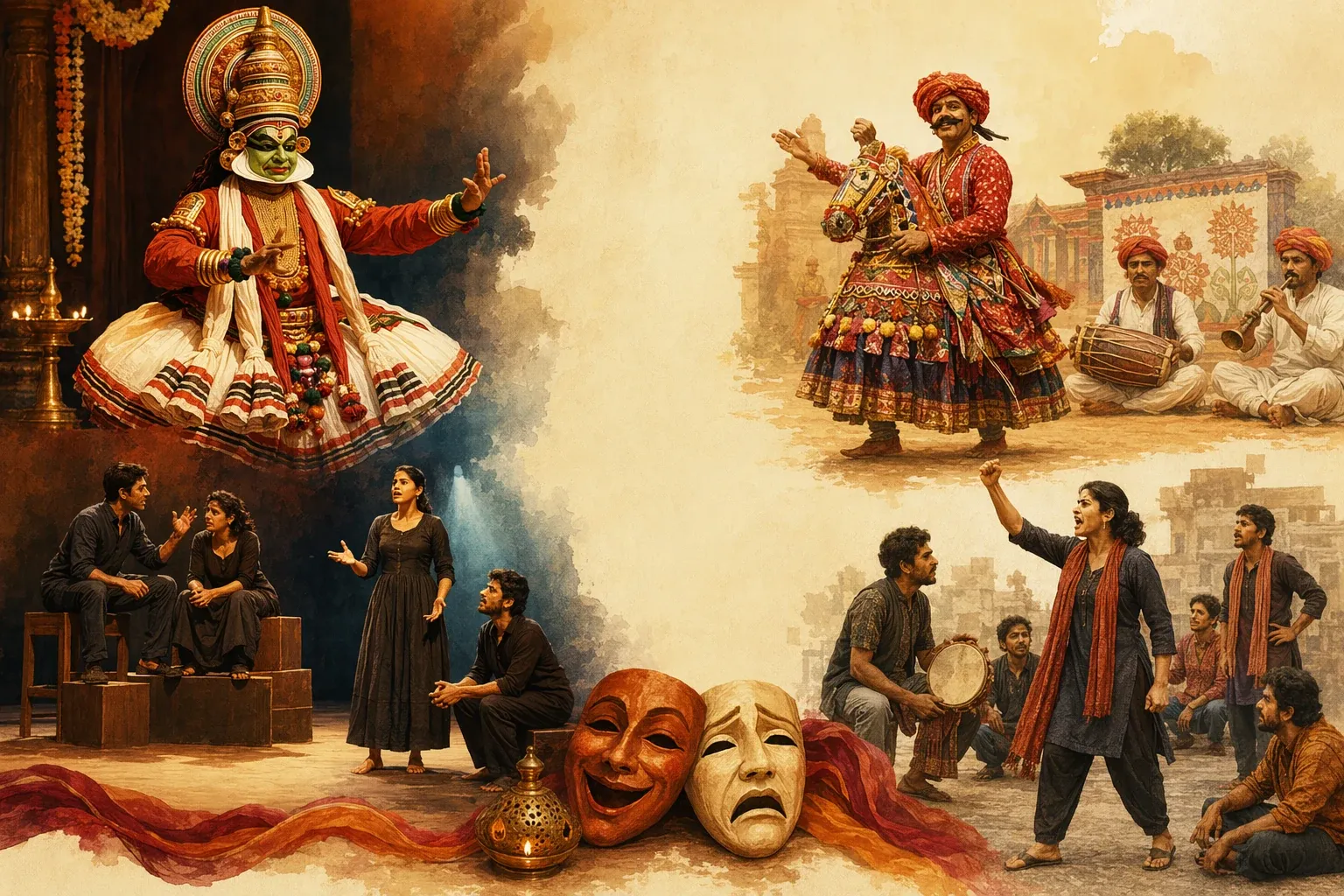
Indian theatre is not one form. It is a huge performance world with many branches: classical Sanskrit drama, temple-linked performance, folk theatre, devotional storytelling, modern auditorium plays, street theatre, children’s theatre, campus theatre, and experimental work. The categories are useful for learning, but real performances often mix them. A folk form may include devotion and comedy. A modern play may borrow folk music. A street performance may use old storytelling techniques for a current issue.
These categories become clearer when you also look at Indian classical dance, how a Ramlila performance is made, Indian puppetry, and Indian classical music since theatre often borrows from dance, festival staging, puppet traditions and musical performance.
For beginners, the best way to understand the types of Indian theatre is to ask three questions. Where is it performed? Who is performing it? What relationship does it create with the audience? A temple theatre, a village ground, a city auditorium, and a street corner all produce different kinds of theatre.
Classical Sanskrit theatre
Classical Sanskrit theatre is connected with ancient Indian drama, performance theory, and the Natya Shastra tradition. It is often discussed through ideas such as rasa, abhinaya, gesture, music, costume, stage space, and the relationship between performer and audience. In tradition, Bharata Muni is linked with the Natya Shastra. Historically, scholars continue to discuss dates and development, so it is better to speak with respect and caution rather than make one exact claim.
Sanskrit drama included more than religious teaching. It had romance, heroism, comic figures, poetic language, courtly settings, and moral questions. Playwrights such as Bhasa, Kalidasa, Bhavabhuti, and Harsha are often discussed in this world. Kalidasa’s Abhijnanasakuntalam is one of the most famous examples because it brings together epic memory, love, separation, recognition, and elegant dramatic construction.
Kutiyattam from Kerala helps us see this category as living performance, not only ancient literature. UNESCO describes Kutiyattam as Sanskrit theatre, practised in Kerala, with stylized eye expression and hand gestures, temple theatre settings called Kuttampalams, long actor training, and performances that can expand a single episode over many days. That patience is very different from the speed of modern screens.
Folk theatre and regional performance
Folk theatre is rooted in local language, local music, community memory, seasonal festivals, and direct audience energy. It is not “lesser” than classical theatre. It is simply built differently. Folk performers often carry stories through song, humour, improvisation, bold costume, masks, dance, and strong character types. The audience may already know the story, but comes to enjoy the performance, the music, the jokes, and the local flavour.
India has many regional forms. Jatra is associated with Bengal and Odisha. Yakshagana is known in Karnataka and coastal regions. Tamasha is linked with Maharashtra. Bhavai belongs to Gujarati performance culture. Nautanki has been important in north India. Therukoothu is associated with Tamil areas. Ankiya Naat is connected with Assamese Vaishnava culture. Each has its own history, music, acting style, costume, and social world.
Chhau from eastern India shows how categories can overlap. UNESCO lists Chhau as intangible cultural heritage and describes its enactment of episodes from the Mahabharata and Ramayana, local folklore, and abstract themes. It has styles from Seraikella, Purulia, and Mayurbhanj, with masks in some styles and movement connected with martial practice. Is it dance? Theatre? Ritual? Folk performance? The answer can be “all of these”, depending on how we study it.
Devotional and epic performance
Devotional theatre carries sacred stories into public performance. Ramlila is one of the best-known examples. UNESCO describes it as a performance of the Ramayana through scenes with song, narration, recital, and dialogue, especially during Dussehra in northern India. It is strongly linked with Tulsidas’s Ramacharitmanas and with places such as Ayodhya, Ramnagar, Benares, Vrindavan, Almora, Satna, and Madhubani.
Devotional performance does not mean the audience is passive. In Ramlila, communities may help with costumes, make-up, lights, effigies, and arrangements. People come not only to watch a plot but to participate in a shared cultural rhythm. The story of Rama’s exile, struggle, return, and dharma becomes part of annual public memory.
Other devotional performance traditions may centre on Krishna, Shiva, Devi, local deities, saints, or regional legends. Some are playful and musical. Some are solemn. Some combine teaching with humour. The key point is that theatre can become a bridge between story, worship, festival, and community life.
Modern proscenium theatre
Modern Indian theatre often uses the proscenium stage: the audience sits in front, actors perform on a raised stage, and lighting, sets, curtains, and scripted scenes shape the experience. This style became especially important in colonial and postcolonial urban theatre. It was influenced by European stagecraft, Shakespeare, realism, printing, commercial theatre, and new public audiences, but Indian artists adapted it to Indian languages and concerns.
Modern plays may deal with family conflict, caste, gender, history, nationalism, labour, migration, memory, urban life, or mythology retold in new ways. Playwrights such as Vijay Tendulkar, Girish Karnad, Badal Sircar, Mohan Rakesh, Habib Tanvir, Utpal Dutt, Mahesh Elkunchwar, and many others helped make modern Indian theatre intellectually rich and emotionally powerful. Their work shows that modern theatre can be Indian without merely decorating a Western stage format.
This type of theatre is common in auditoriums, cultural centres, festivals, repertory companies, college spaces, and independent venues. It often depends on rehearsal discipline, script development, trained actors, direction, lighting, sound, set design, and ticketed audiences.
Street theatre and people’s performance
Street theatre is direct, mobile, low-cost, and public. It can happen in markets, campuses, factory gates, neighbourhood lanes, protest sites, or public squares. Instead of elaborate sets, street theatre uses voice, rhythm, chorus, placards, slogans, songs, body formations, and tight scenes. The audience may gather suddenly, stand around the performers, and respond immediately.
In India, street theatre has often been connected with social and political questions: workers’ rights, communal harmony, education, public health, gender violence, corruption, caste discrimination, and democracy. It does not hide behind distance. It stands near people and asks them to think. This makes it powerful, but also demanding, because performers must hold attention in noisy public spaces.
Street theatre is also a reminder that theatre does not require wealth. A group of committed performers can carry a performance in their bodies and voices. For students, this is often the first type of theatre they experience outside textbooks.
Children’s, campus, and amateur theatre
Not all important theatre is professional. Children’s theatre helps young audiences imagine, listen, speak, and cooperate. Campus theatre gives students a place to test ideas, adapt classics, write original scripts, and learn teamwork. Amateur theatre groups keep local languages and neighbourhood performance cultures alive even when commercial rewards are small.
These spaces matter because they create future audiences and performers. A person who acts in a school play may later become a director, teacher, writer, critic, stage manager, or simply a better listener. Theatre trains confidence, empathy, timing, memory, and respect for collective work.
Experimental and mixed-form theatre
Experimental theatre refuses to stay inside fixed boxes. It may mix documentary material, folk music, contemporary dance, projection, oral history, poetry, puppetry, stand-up style, or site-specific performance. A play may happen inside an old building, a courtyard, a classroom, or a public heritage site. The script may be partly improvised. The audience may move through the space instead of sitting in one place.
This kind of theatre is useful when artists want to explore memory, identity, trauma, ecology, gender, or history in forms that do not fit conventional scenes. It can be challenging, but it keeps theatre alive as a laboratory.
A practical way to sort the types
If you are confused, sort Indian theatre into four beginner buckets. Classical theatre includes Sanskrit drama traditions and highly codified performance. Folk and devotional theatre includes regional, community, festival, and epic-based performance. Modern theatre includes scripted plays in auditoriums and cultural spaces. Public and experimental theatre includes street plays, campus work, children’s theatre, and new mixed forms.
This map is not perfect, but it helps. The real beauty of Indian theatre is that the borders are porous. A modern director may borrow Yakshagana music. A folk troupe may comment on current politics. A devotional performance may use local humour. A street play may echo the chorus energy of older performance. Indian theatre remains rich because its types keep talking to each other.
FAQs
What are the main types of Indian theatre?
The main beginner categories are classical Sanskrit theatre, folk and regional theatre, devotional and epic performance, modern proscenium theatre, street theatre, children’s or campus theatre, and experimental mixed-form theatre.
What are the major features of Indian folk theatre?
Indian folk theatre usually uses local language, music, humour, dance, colourful costume, strong characters, direct audience contact, and stories from epics, legends, social life, or local history. It often grows around festivals and community gatherings.