
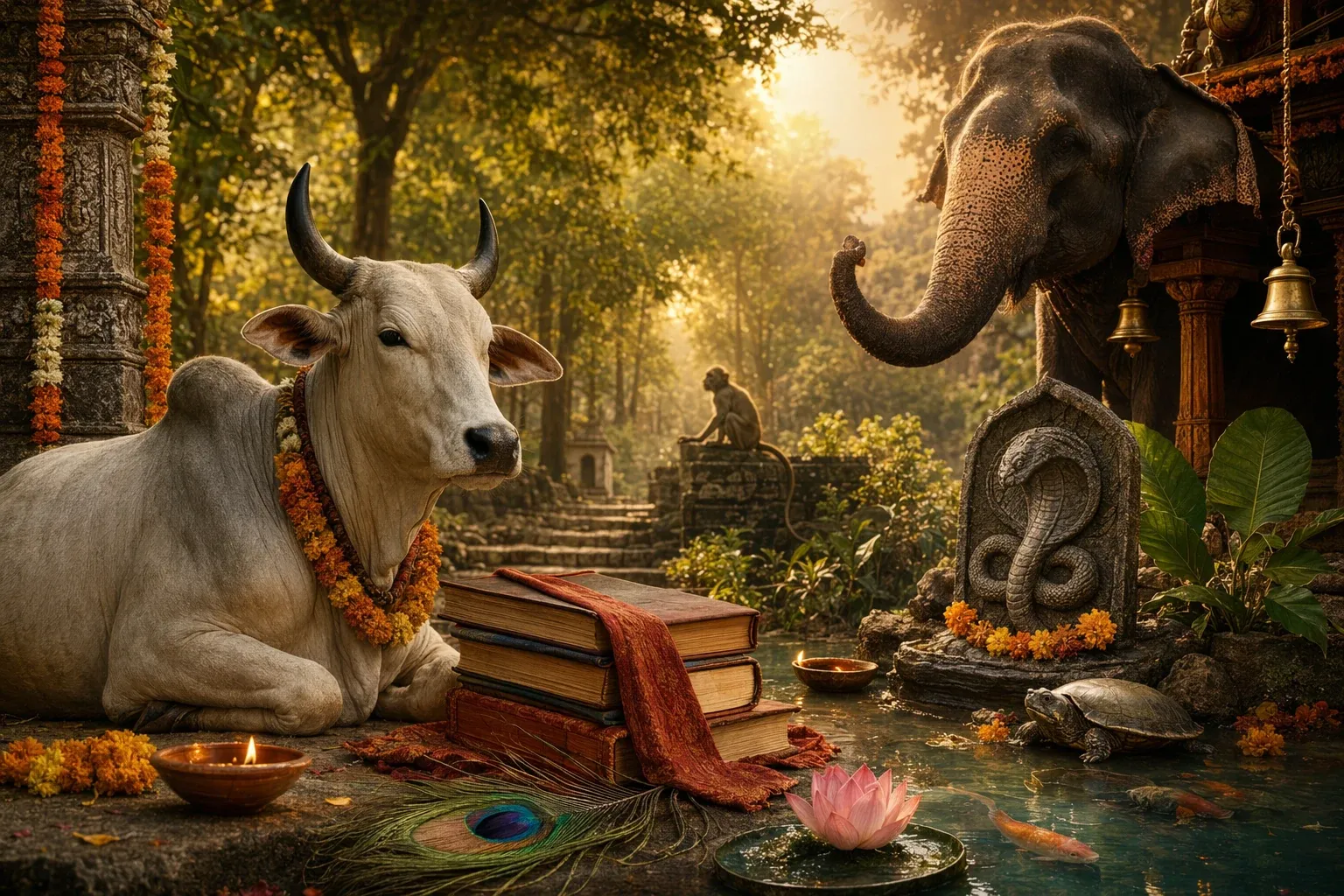
Sacred animals in India are a fascinating subject, but they are also easy to misunderstand. A random social media post may say “this animal is worshipped in India” without explaining region, community, text, ecology, or history. A random file link may look convenient, but it can be incomplete, unsafe, or disconnected from the book’s real context. If you want to learn properly, the better path is simple: use books, publisher pages, libraries, museum material, and careful online reading.
This guide is for beginners who want to understand the cow, elephant, monkey, snake, bull, tiger, lion, peacock, crow, swan, and other animals in Indian religious and cultural imagination. The goal is not to collect strange facts. The goal is to see how animals appear in dharma, mythology, temple art, folk practice, environmental thought, and everyday life.
Begin with Nanditha Krishna’s Sacred Animals of India
One useful starting point is Sacred Animals of India by Nanditha Krishna. The publisher’s description says the book explores animals worshipped as deities, animals connected with avatars, vahanas or divine vehicles, snakes worshipped partly through fear, birds connected with ancestors, the cow’s economic and sacred value, vanaras, and totemic symbols. It also connects the subject with Hinduism, Buddhism, Jainism, animal protection, and biodiversity.
That range is helpful because sacred animals are not one narrow topic. Ganesha brings the elephant into the world of auspicious beginnings. Hanuman brings the vanara into devotion and courage. Vishnu’s Matsya, Kurma, and Varaha forms connect fish, tortoise, and boar with avatar stories. Nandi connects the bull with Shiva. The lion appears with Durga. The peacock appears in national symbolism and devotional art. A good book helps you see these patterns without turning them into loose trivia.
Finding reliable books without shortcuts
When you look for a book online, begin with sources that clearly identify the author, publisher, edition, and context. The publisher’s page, Google Books preview, a local library, college library, public library network, authorised ebook sellers, or second-hand book platforms are usually better starting points than anonymous file-sharing pages.
If a book is expensive, try library routes first. Ask a librarian whether they can arrange inter-library access. Search Google Books for preview pages. Check publisher pages for edition details and author information. If you are in school or college, ask whether your institution has access to ebook databases. For Indian culture topics, museum shops and cultural foundations sometimes sell reliable books that do not appear at the top of normal shopping searches.
Read online sources with a filter
Online reading is useful, but you need a filter. Start with source types that are easier to check: publisher pages, university or museum material, official cultural institutions, encyclopaedia-style entries, scanned catalogues from recognised libraries, and articles that cite books or inscriptions. Wikipedia can be useful for orientation, names, dates, and links, but it should not be the only authority for sensitive claims.
When you read about an animal, ask four questions. Which community or region is being discussed? Is the claim from a text, a temple practice, a folk tradition, or a modern interpretation? Is the writer separating belief from history? Does the page name sources, or does it just make dramatic claims? These questions will save you from shallow content.
Build your own animal-wise notes
A good method is to make one page of notes per animal. For the cow, write about agriculture, milk, ahimsa, Hindu reverence, Jain and Buddhist non-violence, and modern diversity of practice; this pairs well with a focused explainer on why cows are sacred in India. For the elephant, write about Ganesha, temple and royal imagery, memory, strength, and auspiciousness. For the monkey, write about Hanuman, the Ramayana, devotion, courage, and self-discipline.
For the snake, note both fear and reverence: naga worship, water, fertility, protection, Shiva imagery, and local shrines. For the bull, note Nandi, Shiva temples, agriculture, strength, and patience. For birds, include the peacock, swan, crow, owl, and eagle-like Garuda where relevant. This method keeps your learning organised and prevents every animal from sounding the same.
Keep tradition, interpretation, and history separate
Many mistakes happen when people mix three different things. Tradition means what people actually do: worship, festival practice, temple ritual, storytelling, offerings, or art. Interpretation means what people say the symbol teaches: courage, purity, wisdom, fertility, protection, devotion, or dharma. History means how the meaning may have developed through agriculture, ecology, sectarian movements, royal patronage, tribal symbols, texts, and local customs.
For example, a cow can be discussed as a practical rural animal, a sacred symbol, a focus of non-violence, and a modern political subject. These are connected, but they are not identical. A snake can be feared, respected, worshipped, and represented in art. An elephant can be a real animal, a temple presence, a royal emblem, and a form connected with Ganesha. Clear notes protect you from oversimplification.
Learn from images, but do not stop at images
Images are powerful for this topic. Temple sculpture, calendar art, miniature painting, festival photographs, museum objects, and folk art can show how animals are represented. Look at details: What is the animal doing? Is it a deity, companion, vehicle, guardian, avatar, or offering symbol? Which region does the artwork come from? What period is it from? What material is used?
But images can also mislead when they are detached from context. A social media image may label a figure wrongly. A decorative product may borrow sacred imagery without explanation. A stock photo may mix regions. When possible, use museum captions, publisher captions, and academic or cultural catalogues. If you save an image for study, save the source link and caption too. For wider visual context, our guide to Hindu symbols and their meanings is a helpful next step.
Good beginner search habits
Search with precise phrases instead of only broad ones. Try “Ganesha elephant symbolism,” “Nandi bull Shiva temple,” “Hanuman vanara devotion,” “Naga worship India,” “cow reverence Hinduism ahimsa,” “Garuda Vishnu vahana,” or “peacock Krishna Kartikeya symbolism.” Add words such as “museum,” “publisher,” “university,” “encyclopedia,” or “library” to improve the quality of results.
When you need a book, search the title with “publisher,” “Google Books,” “library,” “WorldCat,” “author,” or “official ebook.” Prefer pages where the source is named clearly. If the source is unclear, do not depend on it for serious study.
Common questions
What are the most popular sacred animals in India?
Common examples include the cow, elephant, monkey, snake, bull, lion, tiger, peacock, swan, crow, owl, and Garuda-like eagle forms. Their meanings vary by religion, region, text, and local practice.
Where can I learn about sacred animals of India online?
Start with publisher pages, Google Books previews, library catalogues, museum or university material, official cultural portals, and carefully checked encyclopaedia entries. Use general websites only after checking their sources.
Is Sacred Animals of India by Nanditha Krishna a good starting book?
Yes, it is a useful starting point because it connects animals with deities, avatars, vahanas, customs, Indian religions, protection, and biodiversity. Pair it with image study, regional examples, and legal library access.
A respectful learning path
Begin with one good book, one notebook, and a habit of checking sources. Study one animal at a time. Ask what it means in tradition, what people interpret from it, and what historical context may explain it. Avoid miracle claims, viral “ancient secret” posts, and source pages that do not explain where their material comes from. Respect the fact that these are not just symbols on a page. For many people, these animals are connected with worship, memory, livelihood, ecology, and family practice.
If you learn slowly and legally, sacred animals become more than a list. They become a doorway into Indian ideas of dharma, interdependence, gratitude, fear, protection, devotion, and responsibility toward the living world.