
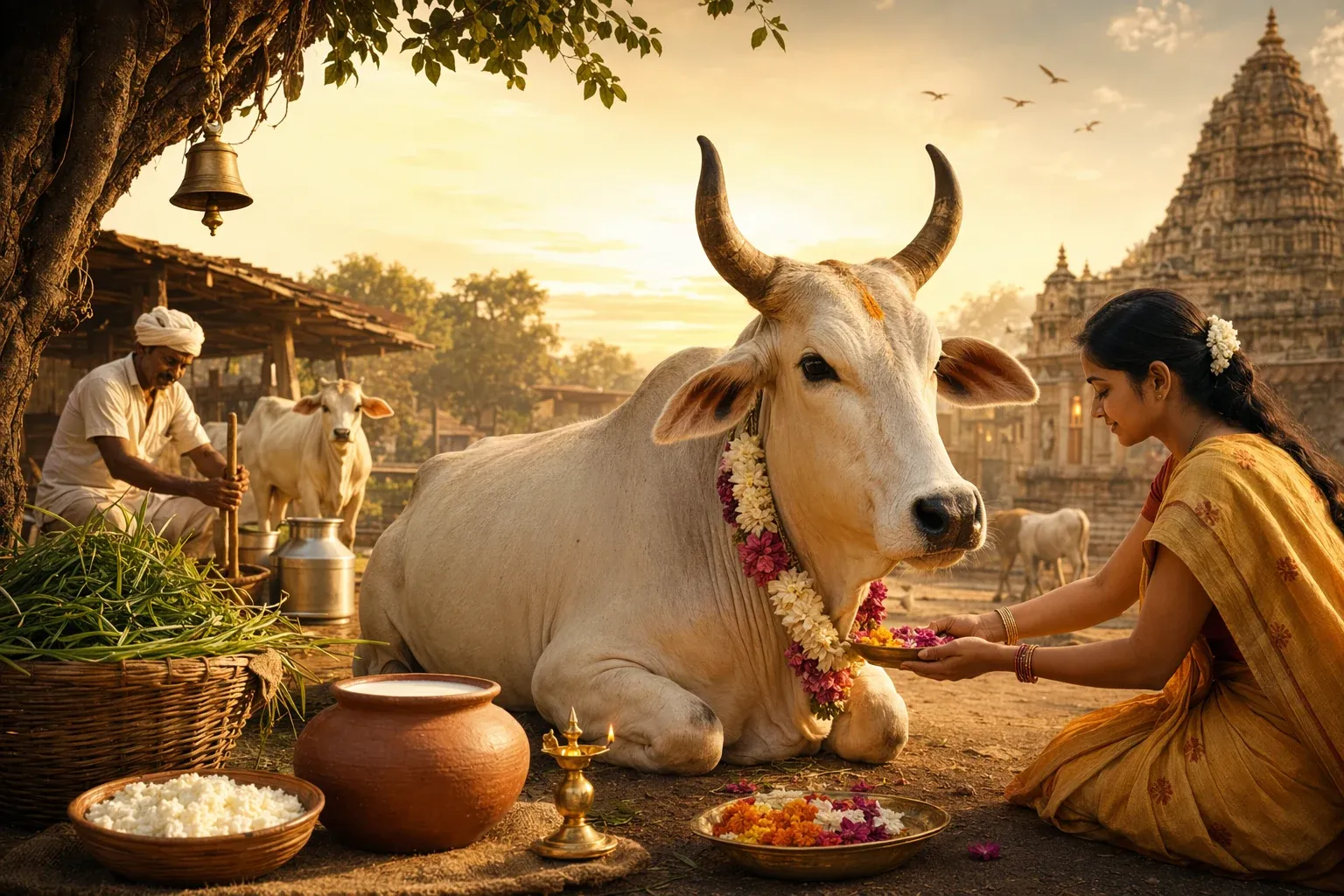
The cow is sacred in India because it stands at the meeting point of daily life, dharma, agriculture, devotion, and the ethic of non-harm. For many Hindus, the cow is not seen merely as an animal that gives milk. She is remembered as gau-mata, the motherly giver, because she nourishes without demanding much in return. That emotional language may sound poetic, but it comes from very practical history too: for centuries, cattle helped families survive.
A cow could provide milk, curd, butter, and ghee. Cow dung could be used as fuel, floor coating, manure, and a purifier in many village settings. Bulls helped with ploughing and transport. In an older agrarian world, protecting cattle was close to protecting food, soil, household economy, and community stability. When a living being becomes so central to survival, respect grows around it.
A motherly image in household life
The phrase gau-mata does not mean people think a cow is a human mother. It means the cow is honoured as a nourishing presence. Milk becomes kheer in a festival kitchen, curd becomes part of a simple meal, butter appears in Krishna stories, and ghee becomes important in many rituals. In this way, the cow enters both the body and the imagination of the home.
Many Indian families have seen cattle not as distant farm assets but as beings with names, temperaments, and daily care routines. Someone feeds them, washes the shed, collects dung, and knows when they are ill. This closeness matters. Sacredness is often born from repeated gratitude. A child who grows up watching elders touch a cow gently before a festival may learn that usefulness should not become exploitation.
Dharma and the value of ahimsa
One of the strongest reasons behind cow reverence is ahimsa, the value of non-harm. Ahimsa is not limited to cows, but the cow became one of its most visible symbols. Hindu, Jain, and Buddhist traditions all developed powerful ideas about compassion toward living beings, though each tradition expresses them differently. In many Hindu communities, avoiding beef became a marker of respect, purity, and restraint.
Still, a careful reader should avoid oversimplifying history. Indian food habits have varied by region, caste, community, income, ecology, and period. Texts and practices do not always speak in one voice. What is clear today is that many Hindu families treat the cow as deeply sacred, and many Indian states have legal restrictions around cattle slaughter. But cultural respect should be explained without turning neighbours into enemies. The dharmic point is compassion, not hatred.
Krishna, butter, and the cowherd world
Krishna’s childhood stories give cow reverence a sweet devotional face. In many popular traditions, Krishna grows up in Gokul and Vrindavan among cowherds, calves, butter, flutes, forests, and the Yamuna river. He is Gopala, protector of cows, and Govinda, a name often connected with cows, earth, and the senses depending on interpretation. These names made cow care part of bhakti imagination.
When people sing about Krishna stealing butter, they are not only enjoying a naughty childhood scene. They are entering a world where milk products, cattle, village women, play, love, and divine presence sit together. This is why cow imagery appears in paintings, temple songs, kirtans, Janmashtami decorations, and the emotional vocabulary of Vaishnava devotion. The sacred cow is not only an economic animal; she is part of Krishna’s landscape.
Nandi shows another side of cattle symbolism
The bull Nandi, linked with Shiva, shows that cattle symbolism is not limited to milk. Nandi sits facing Shiva in thousands of temples. Devotees often pause near Nandi before moving toward the inner shrine. He represents steadiness, strength, loyalty, and alert devotion. In stone, Nandi looks calm; in meaning, he is fully awake.
This matters because “cow sacredness” in India often includes wider cattle reverence. The female cow may suggest nourishment and motherhood, while the bull can suggest energy, patience, duty, and disciplined power. A farmer who depended on bullocks for ploughing would understand strength differently from a city reader who sees Nandi only as a temple sculpture. Both meanings belong to the larger cultural field.
Rituals, festivals, and everyday gestures
Cow respect appears in small actions as much as big ceremonies. Some families feed cows on certain days. In parts of India, cattle are decorated during harvest or regional festivals. During Govardhan Puja and related celebrations, cowherd imagery and cattle care may become part of worship. In rural areas, cattle sheds can be cleaned and decorated as a sign of gratitude.
These practices vary widely. A North Indian family’s custom may differ from a Tamil, Gujarati, Bengali, Marathi, or Assamese household. Some people may be deeply devotional; others may express respect more culturally. The shared thread is gratitude toward a being that has supported human life for generations.
What sacredness should mean today
In modern India, many people encounter cows in difficult conditions: traffic, plastic waste, crowded streets, shrinking grazing spaces, or neglected shelters. If cows are sacred, then care must be practical, not only emotional. Keeping streets clean, reducing plastic, supporting ethical dairy practices, treating injured animals, and caring for old cattle are all more meaningful than using the cow only as a slogan.
This also means speaking about cows with humility. For some Indians, the cow is among the holiest living symbols. For others, the subject is shaped by different community histories and food practices. A mature cultural understanding can honour Hindu reverence while also recognising India’s diversity. Sacredness should deepen responsibility.
The short answer
Cows are sacred in India because they represent nourishment, motherly giving, village economy, Krishna devotion, Shiva-linked cattle symbolism, and the moral value of ahimsa. The reverence is religious, but it is also agricultural, emotional, social, and historical. That is why the cow became such a powerful symbol: she stands close to the kitchen, the field, the temple, and the conscience.
The best way to understand the sacred cow is not as a political argument or a superstition. It is as a long memory of dependence and gratitude. A culture looked at an animal that helped sustain life and said: do not treat this being casually. Protect, feed, respect, and remember what you receive.