
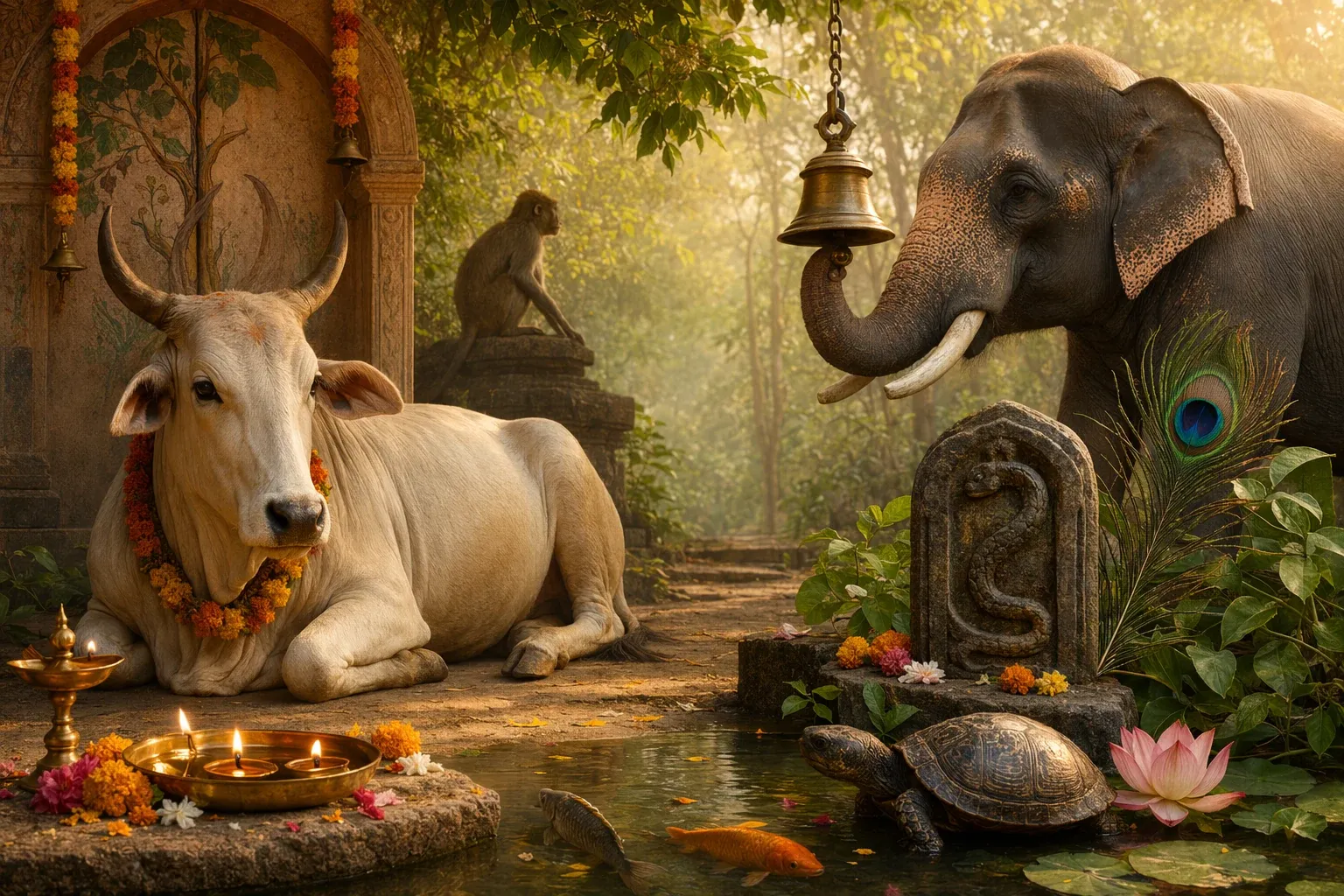
When people ask which animals in India are sacred, the honest answer is: many are revered, but not always in the same way. A cow, an elephant, a snake, a monkey, a peacock, a bull, an eagle-like Garuda, and even a small mouse can all carry sacred meaning in different stories and regions. Sacred does not always mean every person worships that animal every day. It can mean the animal is protected, offered food, connected to a deity, remembered in a festival, carved into temple art, or treated as a teacher of some human value.
India’s relationship with animals grew from several overlapping worlds: village agriculture, forest life, temple worship, royal symbols, family rituals, and philosophical ideas such as ahimsa, or non-harm. That is why a simple list can feel confusing. The same animal may be a deity’s companion in one tradition, a local guardian in another, a national symbol in modern India, and a living neighbour on the street or in the field.
Sacred means relationship, not just worship
In many Indian traditions, an animal becomes sacred through relationship. The bull Nandi faces Shiva in countless temples, not because every bull is treated as a deity in the same formal way, but because Nandi represents loyalty, strength, patience, and the devoted listener. The mouse of Ganesha is tiny beside the elephant-headed deity, yet it is meaningful because it shows how intelligence can move through small spaces and how desire must be guided. The peacock of Kartikeya, the swan or hamsa linked with Saraswati, and Garuda linked with Vishnu all work in a similar symbolic language.
This is the idea of the vahana: the being, often an animal or bird, associated with a deity. In temple sculpture and calendar art, the vahana is not random decoration. It helps people understand the quality of the deity. A lion near Durga suggests courage and royal power. Garuda suggests speed, sky, protection, and devotion to Vishnu. Nandi suggests steadiness before Shiva. These images made philosophy visible long before most people learned ideas from printed books.
The cow as care, food, and non-harm
The cow is probably the best-known sacred animal in India. For many Hindus, the cow is honoured as gau-mata, a motherly giver. Milk, curd, ghee, dung for fuel or flooring, and the animal’s role in older agrarian life made cattle deeply important to households. Religious respect and practical dependence strengthened each other. Over time, cow protection became connected with purity, vegetarian habits, compassion, and the wider value of ahimsa.
At the same time, it is important to speak carefully. Indian history is long, and practices have differed by period, community, region, and text. Not every Indian has the same food custom, and not every tradition explains the cow in one sentence. A respectful article should not turn a living culture into a slogan. The safest way to understand cow reverence is to see it as a mix of maternal symbolism, village economy, ethics of non-harm, devotional feeling, and social custom.
Elephants, monkeys, and snakes in story
The elephant is sacred partly because of Ganesha, one of India’s most widely loved deities. His elephant head is associated with wisdom, memory, patience, and the ability to remove obstacles. During Ganesh Chaturthi in Maharashtra, Goa, Karnataka, Telangana, Andhra Pradesh, and many other places, Ganesha becomes part of public and household worship. That does not mean every elephant is treated like Ganesha, but the animal’s form carries divine recognition.
Monkeys are often remembered through Hanuman, the devoted helper of Rama in the Ramayana. Hanuman’s form teaches strength with humility, courage with service, and power disciplined by bhakti. In many towns, people feed monkeys near temples, although modern readers should also remember that feeding wild animals carelessly can create problems for both humans and animals. Reverence should include responsibility.
Snakes, especially nagas, appear in stories, temple icons, village shrines, and festivals such as Nag Panchami. They are linked with water, fertility, hidden power, protection, and fear that must be handled with respect. Shiva is shown with a serpent around his neck; Vishnu rests on Shesha in many Vaishnava images. Here again, the meaning is not simple animal worship. It is a symbolic language about nature’s power and the need to live carefully with it.
Birds, bulls, and regional memory
Birds also carry sacred meaning. Garuda is the mighty bird linked with Vishnu and is important in Vaishnava temples and stories. The peacock appears with Kartikeya or Murugan and is also India’s national bird. The hamsa, often understood as a swan or goose, is associated with Saraswati and with the ability to separate truth from confusion. Crows are fed in many families during shraddha rites, where they can be treated as symbolic messengers connected with ancestors.
The bull deserves separate respect because of Nandi. In Shiva temples, devotees often pause before Nandi before looking toward the main shrine. In many places, Nandi sits in a straight line facing the Shiva linga. This simple arrangement teaches focus: the devotee looks through patience and steadiness toward the sacred centre. A village child may learn this symbolism simply by watching elders fold hands before the stone bull.
Reverence is not the same everywhere
India has Hindu, Jain, Buddhist, Sikh, Muslim, Christian, tribal, and many local traditions living beside one another. Even within Hindu practice, a family in Tamil Nadu, a village in Rajasthan, a temple town in Odisha, and a household in Bengal may highlight different animals. Some communities remember serpents strongly. Some celebrate cattle. Some connect with elephants through Ganesha. Some preserve local guardian-deity customs where animals appear in folk songs, terracotta figures, or village shrines.
So, are animals sacred in India? Many animals are sacred in many Indian contexts, but “sacred” is a layered word. It may mean protected, ritually honoured, symbolically important, mythologically linked, or ethically respected. The deeper lesson is that Indian culture often refuses to treat animals as mere background. Animals become companions in stories, mirrors for human qualities, reminders of nature, and signs that dharma includes how we behave toward beings weaker than us.
A simple way to remember the idea
If you are new to the topic, remember four words: story, symbol, service, and restraint. Story explains why Hanuman, Garuda, Nandi, Ganesha’s mouse, or the naga matters. Symbol explains what the animal teaches. Service reminds us that cattle, elephants, horses, birds, and other beings were part of everyday life. Restraint reminds us that reverence should reduce cruelty, not become empty display.
That balanced view is more useful than asking for one official sacred-animal list. India’s sacred animals are a living map of how people understood land, gods, duty, fear, gratitude, and care. The list changes by region, but the message is steady: life is connected, and culture becomes richer when humans remember that they are not alone in the world.