
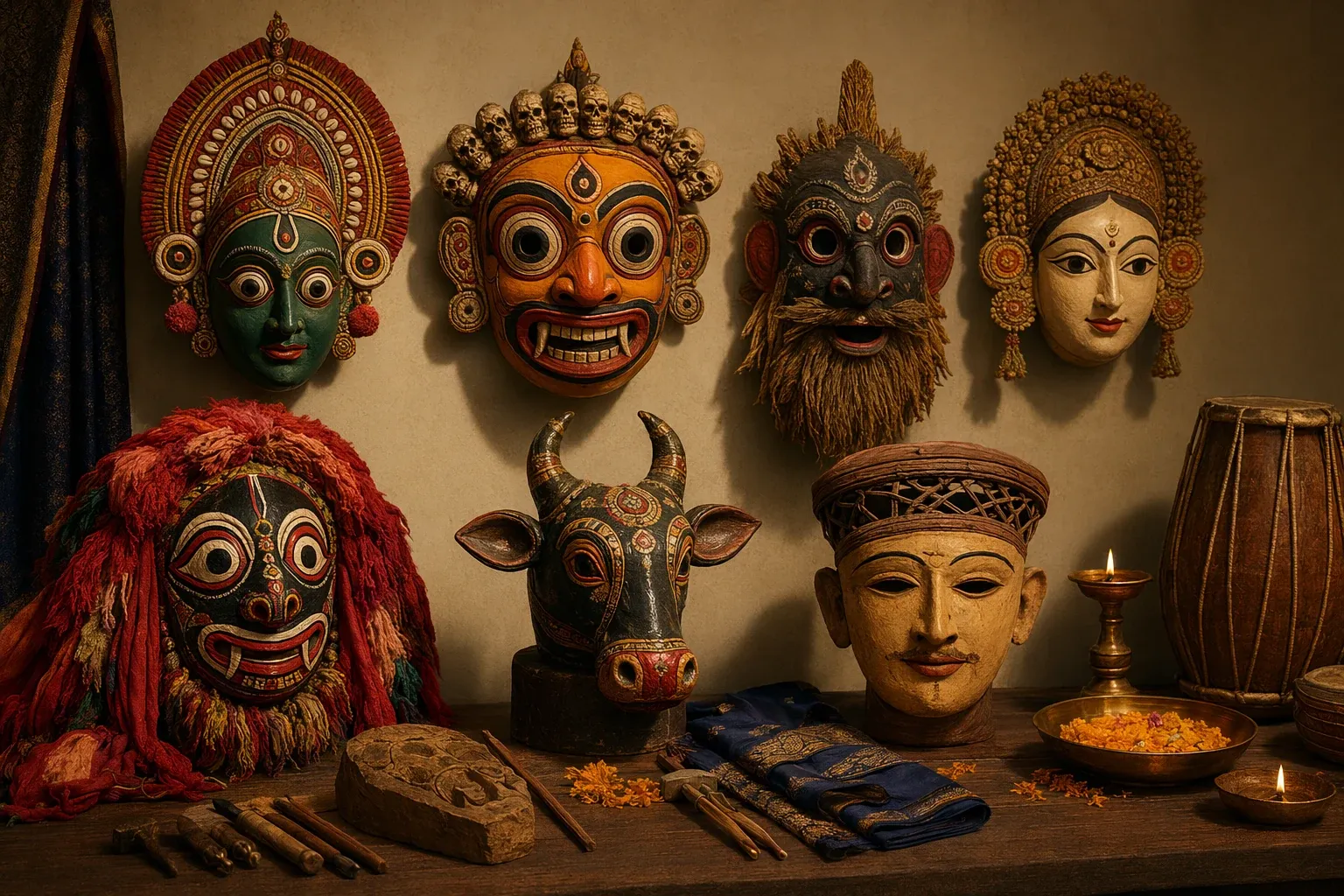
Indian mask traditions are not one single art form with one origin story. They are a wide family of performance objects, ritual presences, festival costumes, theatre tools, and craft traditions. A mask in Purulia Chhau, a Bhaona mask in Assam, a Kummatti face in Kerala, and a Cham mask in the Himalayan Buddhist world may all cover or transform the human face, but they do very different cultural work. Some are made for a dancer leaping through a martial performance. Some help a village understand a deity, an ancestor, a demon, or an animal. Some belong to temple-linked theatre. Some are now also made as decorative pieces for homes and collectors.
The easiest way to understand regional styles is to look at four things: where the mask is used, what material it is made from, what kind of character it represents, and how the community treats it. A tourist souvenir and a performance mask may look similar from a distance, but their meaning is not always the same. For Bhaktilipi readers, the goal is not to memorise every name. It is to notice how geography, faith, craft, and performance shape the face of a tradition.
Eastern India: Chhau and the dramatic face
Chhau is one of the clearest examples of regional variation. UNESCO describes Chhau as a tradition from eastern India with three distinct styles: Seraikella, Purulia, and Mayurbhanj. The first two use masks; Mayurbhanj is famous for not using masks during the dance. This contrast is important because it shows that even one performance family can treat the face differently.
Purulia Chhau of West Bengal is especially known for large, colourful, expressive masks. The Chhau mask of Purulia has a Geographical Indication registration, and the craft is closely associated with Purulia district and villages such as Charida. These masks may show gods, goddesses, heroes, demons, animals, and birds. Durga, Shiva, Krishna, Ganesha, Ravana, Mahishasura, lions, peacocks, and other figures can all appear with strong visual codes. A deity may have a calm or radiant face; a demon may have fierce eyes and dramatic colours; an animal mask may extend the performer’s body into a creature.
Materials matter here. Purulia Chhau masks are commonly described through clay, paper, cloth, glue, ash-like powders, painted surfaces, and decorated headgear. A performance mask is not just a wall hanging. It has to sit on the dancer’s head, survive movement, and remain readable to an audience watching at night in an open space. The mask must be bold because Chhau itself carries martial energy, acrobatics, epic storytelling, and community festival atmosphere.
Seraikella and Mayurbhanj: subtle masks and unmasked expression
Seraikella Chhau, from present-day Jharkhand, also uses masks, but its mask language is often described as more restrained and symbolic than the grand Purulia style. The dancer’s body, posture, and controlled movement carry much of the emotion. The mask does not need to shout; it allows the performer to become a type, a mood, or a character.
Mayurbhanj Chhau of Odisha gives an even more useful comparison because it is generally performed without masks. Facial expression, body movement, and gesture become central. For a beginner, this is a beautiful lesson: mask culture is not simply about covering the face. It is about deciding where expression should live. In Purulia it may live in the painted mask and costume. In Mayurbhanj it may live more directly in the dancer’s face and body.
Assam: Bhaona masks and Vaishnava theatre
In Assam, masks appear in the world of Bhaona and Ankiya Nat, the performance tradition associated with the Vaishnava saint Srimanta Sankardev and the satra culture of Assam. Bhaona tells religious and moral stories, often from Hindu mythological material, with a sutradhar guiding the performance and actors, singers, and musicians working together. Performances may happen in namghars or public spaces, and different satras have their own performance habits.
The masks used in Bhaona help actors represent devas, asuras, animals, birds, and extraordinary beings. This is a different need from Chhau. A Bhaona mask must serve theatre, narration, devotion, and community learning. The viewer is not only watching a dancer’s physical power; the viewer is entering a story-world where character, moral conflict, and bhakti are important.
Kerala: Kummatti, Theyyam, and layered transformation
Kerala has several traditions where the face becomes transformed, but they should not all be flattened into the same category. Kummattikali, especially associated with Onam in parts of Thrissur, Palakkad, and South Malabar, uses colourful wooden masks and grass costumes. Performers may move from house to house, entertaining people and collecting small gifts. The masks may represent Krishna, Narada, hunters, Darika, and other figures, while the rhythm can be supported by instruments such as the Onavillu.
Theyyam, mainly associated with North Malabar and neighbouring areas, needs more careful language. It is a ritual performance involving elaborate make-up, headgear, costume, songs, preparations, sacred spaces, and community relationships. The performer’s face may be transformed through painting and adornment rather than a simple detachable mask in the souvenir sense. People often approach Theyyam not as ordinary theatre, but as a powerful ritual presence connected with local deities, ancestors, sacred groves, and community memory.
This difference is important for respect. A Kummatti mask may be discussed as a festival mask. A Theyyam face should be discussed as part of a living ritual system. Both are visually powerful, but the social and sacred context is not identical.
Coastal Karnataka and Tulu Nadu: daiva performance and decorated presence
In Tulu Nadu and nearby regions, daiva traditions such as Buta Kola or Daiva Nema involve highly stylised performance, local deities, music, costume, and ritual authority. The visual transformation may include headpieces, facial treatment, ornaments, and symbolic forms rather than a simple mask category. These traditions are connected to communities, land, justice, memory, and local worship.
Yakshagana from coastal Karnataka is also useful as a comparison. It is famous for dramatic costume, face paint, headgear, music, dialogue, and epic storytelling. It is not usually explained as a mask tradition in the same way as Purulia Chhau, but it shows how the Indian performing face can be transformed through make-up and costume instead of a separate face covering. For learners, this widens the map: mask-like transformation can happen through many visual technologies.
Himalayan Buddhist regions: Cham and the sacred dance mask
In Himalayan and Tibetan Buddhist contexts, including regions connected with Ladakh, Sikkim, Darjeeling, and monastic festival culture, Cham dance uses masks and costumes within religious performance. Cham is associated with Buddhist festivals, monastic music, moral teaching, and the lives or deeds of important figures such as Padmasambhava in many traditions. Masks may represent protective beings, teachers, symbolic forces, or dramatic characters in a sacred narrative.
The mood is different from a village fair mask or a theatre prop. A Cham mask belongs to a ritual and monastic setting where dance can teach, bless, and dramatise the defeat of harmful forces. The mask helps the viewer see moral and spiritual ideas in visible form.
Why regional masks look so different
Regional masks differ because their jobs differ. A Chhau mask must be readable in vigorous outdoor dance. A Bhaona mask supports Vaishnava storytelling. A Kummatti mask brings festival play into streets and homes. A Cham mask belongs to Buddhist ritual performance. They also differ because local materials differ: clay, paper, cloth, wood, paint, grass, metal ornaments, textile, and plant-based substances all shape the final look.
Climate and performance space matter too. A mask used in a night festival, an open-air akhada, a temple-linked courtyard, a namghar, a monastery, or a house-to-house Onam procession must solve different practical problems. Weight, visibility, durability, ventilation, and symbolic clarity all shape design.
Questions people ask
What are the regional styles of masks from India?
Major examples include Purulia and Seraikella Chhau masks in eastern India, Bhaona masks in Assam, Kummatti masks in Kerala, ritual face traditions around Theyyam and daiva performance, and Cham masks in Himalayan Buddhist regions. Each style has its own community context and purpose.
How do masks differ across the Indian subcontinent?
They differ by material, scale, character type, performance setting, and sacred meaning. Some are large and theatrical; some are subtle; some are wooden; some use clay and paper; some are not detachable masks at all but full facial transformation through paint, headgear, and costume.
Why do different regions make different kinds of masks?
Regions make different masks because they tell different stories, worship in different ways, use different materials, and perform in different spaces. A mask grows from local life. It is not only an object; it is a cultural solution to a performance and belief need.
A respectful way to remember the map
Do not think of Indian masks as one museum shelf. Think of them as many doors. One door opens to the martial energy of Chhau. Another opens to Assam’s Vaishnava theatre. Another opens to Onam festival play in Kerala. Another opens to Theyyam and daiva ritual worlds. Another opens to Buddhist monastic dance. The face changes, but the deeper pattern is the same: communities use art to make story, devotion, fear, courage, memory, and protection visible.