
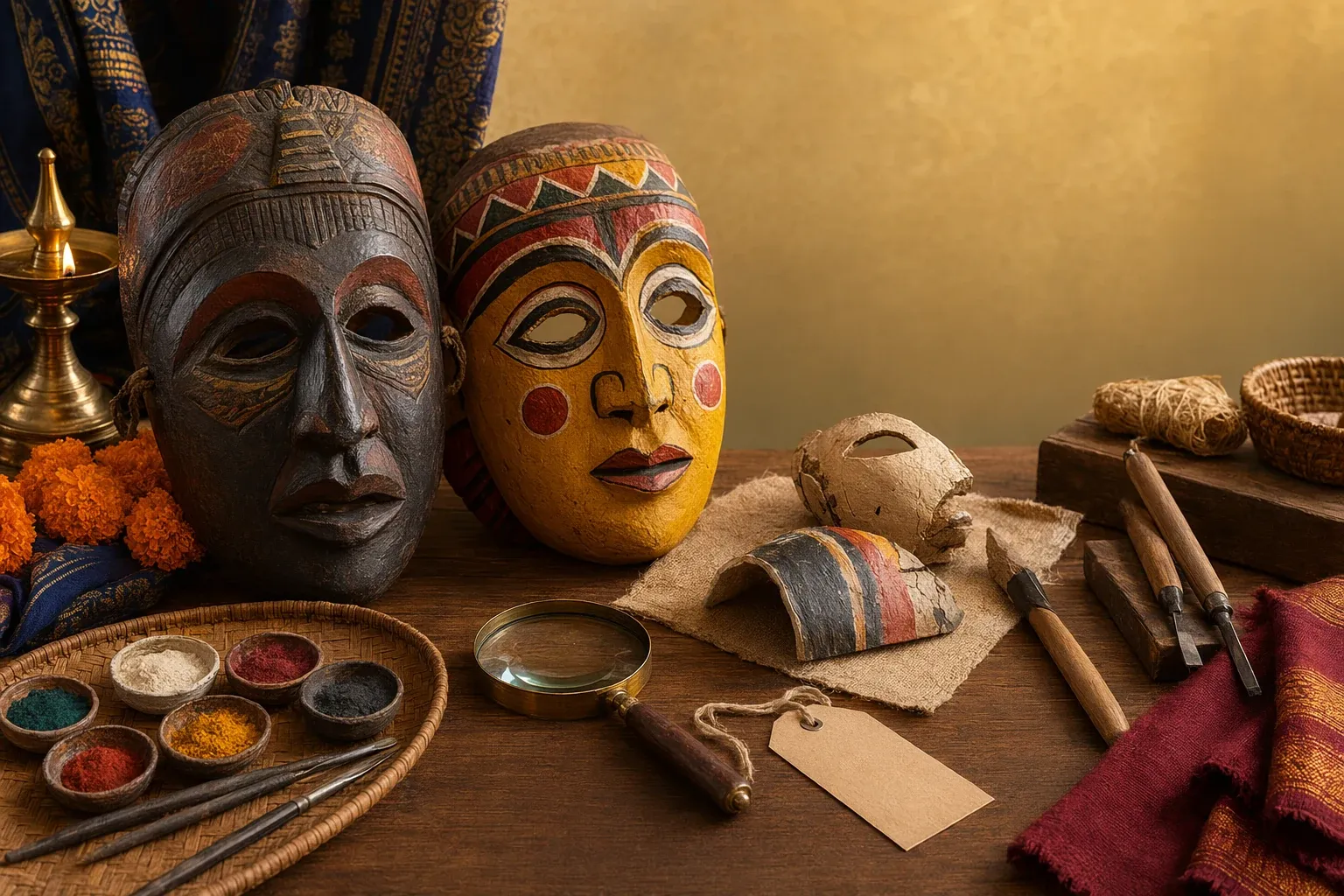
Identifying an authentic Indian mask is not like checking whether a phone charger is original. A mask can be a performance object, a ritual object, a craft product, a tourist souvenir, a museum-style replica, or a decorative piece made by a real artisan for income. Some masks are made for living traditions such as Purulia Chhau, Bhaona, Kummatti, Cham, Theyyam-related visual culture, or daiva performance worlds. Others borrow those looks loosely for shops, hotels, online listings, or film-inspired décor. The respectful question is not only “Is this real?” It is also “Real in what sense, made by whom, for what purpose, and with what cultural permission?”
A genuine mask does not always mean an old sacred object. In many traditions, newly made masks can be fully genuine because they are made by trained artisans for a recognised performance or community context. A replica can also be honest if it is clearly sold as decorative and does not pretend to be a ritual-used antique. The problem begins when sellers invent stories, hide the maker, misuse sacred language, or sell machine-made decoration as if it came directly from a living ritual community.
Purpose matters more than price
The first clue is purpose. Ask what the mask was made for. Was it made for a Chhau dancer? Was it made for Bhaona theatre? Was it made as a smaller souvenir by artisans from a mask-making village? Was it created as a festival costume? Was it made only as wall décor? These answers change how you should judge it.
Purulia Chhau gives a good example. A large performance mask and a small tourist mask may both come from artists connected to the same craft world. The performance mask must fit a dancer, support headgear, show the character clearly, and survive movement. A decorative version may use the same visual language but be lighter, smaller, or simplified. The souvenir is not automatically fake. It becomes misleading only if it is sold as a performance-used or ritually used piece when it is not.
Ask for provenance in simple language
Provenance means the story of where the object came from. You do not need museum vocabulary to ask good questions. Ask: Who made it? Which village, workshop, or community is connected to it? Which tradition is it based on? Was it used in performance or made for sale? When was it made? Is the seller willing to name the craft cluster or artisan?
Good sellers usually do not panic when asked these questions. They may not have perfect documentation, especially in small craft markets, but they should be able to give a grounded answer. Be careful with vague phrases such as “ancient temple mask,” “tribal god mask,” “rare sacred antique,” or “used in secret ritual” when there is no community name, region, artisan, or evidence. Such language often turns culture into mystery for profit.
Study the regional visual grammar
Each mask tradition has its own visual grammar. Purulia Chhau masks often use bold colour, strong facial expression, decorated crowns or headgear, and clear character types such as gods, goddesses, demons, animals, and birds. Seraikella Chhau masks may be more symbolic and restrained. Bhaona masks from Assam may represent devas, asuras, animals, and birds within Vaishnava theatre. Kummatti masks in Kerala are often wooden and linked with Onam processions. Cham masks in Himalayan Buddhist contexts belong to monastic and festival performance settings.
If a seller calls every colourful Indian mask “Chhau,” that is a warning sign. If a wooden Kerala-style festival mask is labelled as a Purulia clay Chhau mask, the listing may be careless or false. If a Theyyam-inspired face is sold as a removable “temple mask” without explaining that Theyyam often involves elaborate face painting, headgear, costume, and ritual presence rather than a simple collectible mask category, you should slow down.
Look at materials and construction
Material clues can help, though they are not enough by themselves. Purulia Chhau masks are commonly associated with clay modelling, paper, cloth, adhesive, paint, and decorated headgear. Kummatti masks are described as wooden, with forms connected to characters such as Krishna, Narada, hunters, or Darika, and the wider performance includes grass costumes. Bhaona masks may use local craft methods suited to theatre characters. Cham masks may be made within monastic or regional craft systems and are usually tied to specific ritual performance worlds.
Check whether the construction matches the claimed use. A performance mask should show practical decisions: strap points, inner finish, weight balance, ventilation, repair marks, or wear in places that make sense. A purely decorative piece may have a flat back, hanging hook, glossy uniform finish, or fragile decorations. None of these are wrong. They simply tell you what the object was probably made to do.
Be careful with sacred-use claims
Sacred-use claims deserve extra caution. A mask connected to ritual life is not just an “aesthetic object.” It may have rules about handling, storage, performance, or photography. In traditions such as Theyyam, daiva performance, or Cham, the transformed face is part of a larger sacred and community setting. Buying or displaying something inspired by that world without context can become disrespectful if it treats living belief as exotic decoration.
A respectful buyer does not chase a “used sacred mask” for thrill value. Ask whether the community actually sells such objects. Many authentic artisan-made pieces are created specifically for education, décor, or cultural appreciation. That can be better than trying to acquire something that should remain within its performance or ritual environment.
Know the difference between artisan replica and fake
An artisan replica can be ethical. For example, a Chhau artisan may make smaller masks for visitors because performance masks are large and costly. A craftsperson may create a decorative version of a god, goddess, demon, or animal character using traditional skills. If the seller is honest, the buyer supports living craft without pretending the object has a false history.
A fake is different. A fake hides its origin or invents one. It may claim machine-made resin is handmade clay. It may call a new tourist piece an antique. It may label a general fantasy face as a specific deity or community mask. It may use words such as “rare,” “ancient,” or “sacred” to inflate value while giving no evidence. The ethical issue is not newness; it is deception.
Check whether the purchase helps the makers
Authenticity also has an economic side. If possible, buy from craft clusters, artisan cooperatives, museum shops, cultural institutions, or sellers who credit makers clearly. Ask whether the artisan’s name can be recorded. For Geographical Indication-linked crafts such as Purulia Chhau masks, check whether the seller understands the regional origin and craft identity rather than using the name casually.
Online marketplaces can be useful, but they also blur context. A listing may use copied photos, invented histories, or keywords from many traditions. Reverse-image search, seller reviews, maker details, and clear photographs of the back, side, and inner surface can help. If the seller cannot answer basic questions, do not reward the confusion.
Handle and display with humility
If you own a mask, display it with context. Write down the tradition, region, maker if known, date of purchase, and whether it was made for performance, ritual, education, or décor. Do not wear sacred-looking masks for jokes, costume parties, or social media shock value. Do not rename deities or characters because a label sounds more marketable. If you photograph the mask, avoid captions that make exaggerated claims.
This is especially important for masks representing gods, goddesses, ancestors, local deities, protective beings, or community-specific spirits. Respect does not mean fear. It means remembering that the object carries people’s work, belief, and memory.
Questions people ask
How can you identify genuine Indian masks from replicas?
Check provenance, maker information, regional style, material, construction, and purpose. A genuine mask should have a believable connection to a craft or performance tradition. A replica is acceptable if it is honestly described as decorative or educational.
What should buyers know about traditional masks from India?
Buyers should know that “traditional” does not always mean antique or ritual-used. Many genuine masks are newly made by artisans. The most respectful purchase is one that credits the maker, names the tradition accurately, and does not invent sacred or historical claims.
When is a cultural mask sacred, decorative, or made for tourists?
It depends on context. A mask used in a ritual or performance may be sacred or community-bound. A smaller artisan-made version may be decorative. A tourist piece may still support craft if honestly sold. The label should come from the maker or tradition, not from a seller’s imagination.
A simple checklist before buying
Ask five questions before you buy: Can the seller name the region? Can they explain the tradition? Can they identify the maker or workshop? Does the material match the claim? Is the object being sold honestly as performance-made, ritual-related, educational, or decorative? If the answers are grounded, you are closer to an ethical purchase. If the answers are dramatic but empty, walk away.
The deeper lesson is simple. Authenticity is not only about an object looking old or “tribal.” It is about relationship: artisan to material, performer to character, community to tradition, and buyer to responsibility. When you identify a mask with that humility, you protect both the craft and the culture behind the face.