
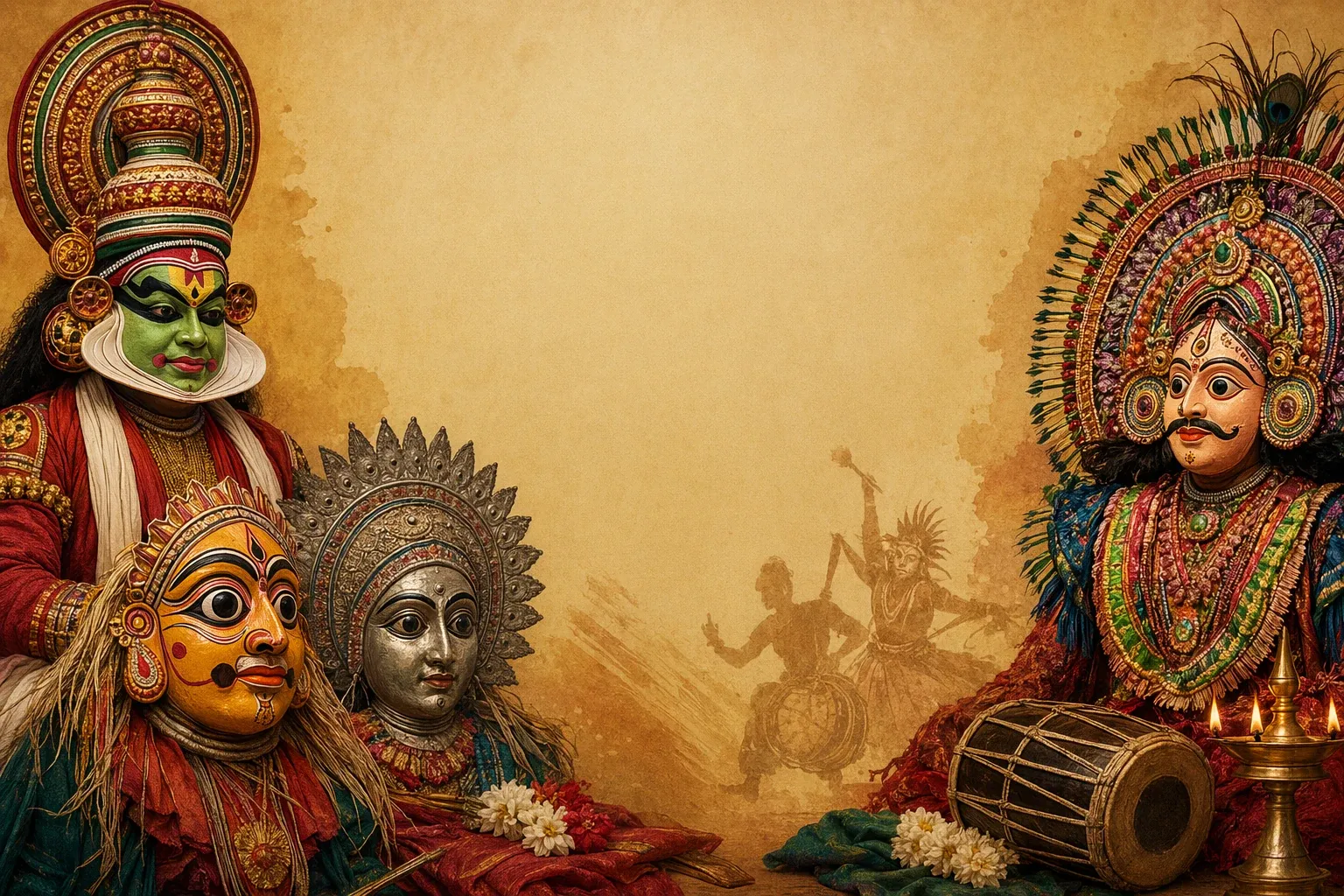
Indian theatre uses the face in many different ways. Sometimes a performer wears a carved or painted mask. Sometimes the face itself is transformed through makeup, beard, crown, headgear, or body paint. Sometimes the “mask” is not a separate object at all, but a full performance identity made from costume, music, gesture, and movement. That is why the phrase “Indian theatre masks” needs a careful answer.
If we use “mask” broadly, Indian performance is full of mask-like transformations. Chhau dancers become heroes, demons, animals, birds, and gods. Kerala’s Kummattikali uses colourful wooden masks during Onam. Padayani uses bold ritual forms in a temple setting. Kathakali, meanwhile, is often searched as a “mask” tradition, but its famous faces are usually elaborate makeup and headgear, not a removable face mask. Each tradition has its own grammar.
Theatre begins with recognition
A mask helps the audience recognise a character before a single line is explained. In a crowded village ground or temple courtyard, not everyone can see small facial expressions. A large eye, curved moustache, crown, tusk, beak, fangs, or bright colour can speak from far away. The viewer knows that a king, sage, demon, deity, animal, or comic figure has entered.
This visual recognition is especially useful in traditions based on epics, Puranic stories, local legends, and moral conflicts. A child may not know the full story of the Ramayana or Mahabharata, but the mask or painted face helps them understand who is noble, who is fierce, who is playful, and who is dangerous. It turns storytelling into a shared visual language.
Chhau and the fixed face in motion
UNESCO describes Chhau as an eastern Indian dance tradition with three styles: Seraikella, Purulia, and Mayurbhanj. Seraikella and Purulia use masks; Mayurbhanj is usually known without masks. Chhau performances can present stories from the Ramayana, Mahabharata, local folklore, and abstract themes. The movement vocabulary includes martial energy, mock combat, animal movements, and stylised gestures from everyday life.
In masked Chhau, the face may be fixed, but the body is never still. Because the mask cannot smile, frown, blink, or speak in a natural way, the dancer must express feeling through posture, speed, rhythm, and shape. A heroic walk, a sudden leap, a curved back, a bird-like turn, or a battle movement tells the audience what the mask cannot change on its surface. The mask sets the identity; the body gives it life.
Kathakali is not simply a mask show
Kathakali is one of the most famous Indian theatre-dance forms in popular images. Its green faces, white chutti frame, painted patterns, heavy costume, and towering headgear are instantly recognisable. Because the face looks highly stylised, many beginners call it a mask. But in performance, Kathakali is usually built through makeup and costume rather than a separate face-covering mask.
This difference matters. Kathakali performers use facial muscles, eye movement, hand gestures, body control, music, and dramatic training to express character and rasa. The painted face is mask-like, but it is also alive and mobile. Calling it only a mask can hide the skill of the performer. A better phrase is “face transformation”: makeup, headgear, costume, gesture, and training working together.
Folk masks and festival theatre
Outside the classical stage, folk and ritual traditions show many literal masks. Kummattikali in Kerala is associated with Onam in places such as Thrissur and Palakkad. Performers wear colourful wooden masks depicting figures such as Krishna, Narada, Kiratha, Darika, or hunters, along with grass costumes. They move through public space, entertaining people and especially delighting children.
Padayani, also from Kerala, brings together masks, painted forms, dance, percussion, theatre, satire, and Bhadrakali-related temple worship. It reminds us that theatre in India is not always separated from ritual. A performance can be devotional, playful, frightening, satirical, musical, and communal at the same time. The mask helps hold all these moods in one visible form.
Rasa, character, and distance
Masks can make emotion bigger. In a modern camera close-up, a tiny eyebrow movement may be enough. In an open-air performance, emotion has to travel across distance. A mask with large eyes and strong colours amplifies the character. It can hold a heroic, comic, furious, calm, or terrifying mood long enough for the audience to read it clearly.
This connects naturally with the Indian idea of rasa, the emotional flavour of performance. A performer may evoke courage, wonder, laughter, fear, devotion, compassion, or anger. The mask is one tool for shaping that experience. But it is not the only tool. Music, percussion, costume, lighting, story, audience memory, and the performer’s training all work together.
Why masks also protect tradition
A theatre mask is not only an object; it is a portable archive. Its design remembers older stories, local heroes, village festivals, craft techniques, and community roles. The shape of a Chhau mask, the painted surface of a Padayani form, or the wooden face of Kummattikali carries knowledge that is learned by making, wearing, repairing, storing, and performing.
When these traditions are shown on tourism posters or social media, the mask often becomes a quick image. But inside the community, it may be connected to rehearsal, festival calendars, musicians, temple committees, craft families, donors, elders, and children who learn by watching. Theatre keeps culture alive because it gathers many people around a shared act.
Modern stages and respectful borrowing
Contemporary theatre makers, schools, and cultural festivals sometimes borrow mask styles. Borrowing can be creative, but it should be done carefully. A Chhau-inspired mask used in a new play should not pretend to be an actual ritual object. A Kathakali-inspired face design should acknowledge the tradition instead of turning it into random “Indian makeup.” Sacred or community-specific forms should not be copied casually for shock value.
A respectful approach is simple: name the tradition when possible, learn the difference between literal mask and makeup, credit performers and artisans, and avoid reducing every Indian form to exotic decoration. The face in Indian theatre is not a gimmick. It is a disciplined language of character, emotion, memory, and community.
The face as a doorway
Masks in Indian theatre help audiences cross from ordinary life into story. In Chhau, the fixed mask and moving body create powerful characters. In Kathakali, makeup and headgear turn the face into a living dramatic surface. In Kummattikali and Padayani, masks carry festival energy into streets and temple spaces. These forms are different, but they share one beautiful idea: the face can become a doorway into another world.
To place this topic in a wider cultural frame, read our beginner guides to Indian theatre and Indian ritual masks.