
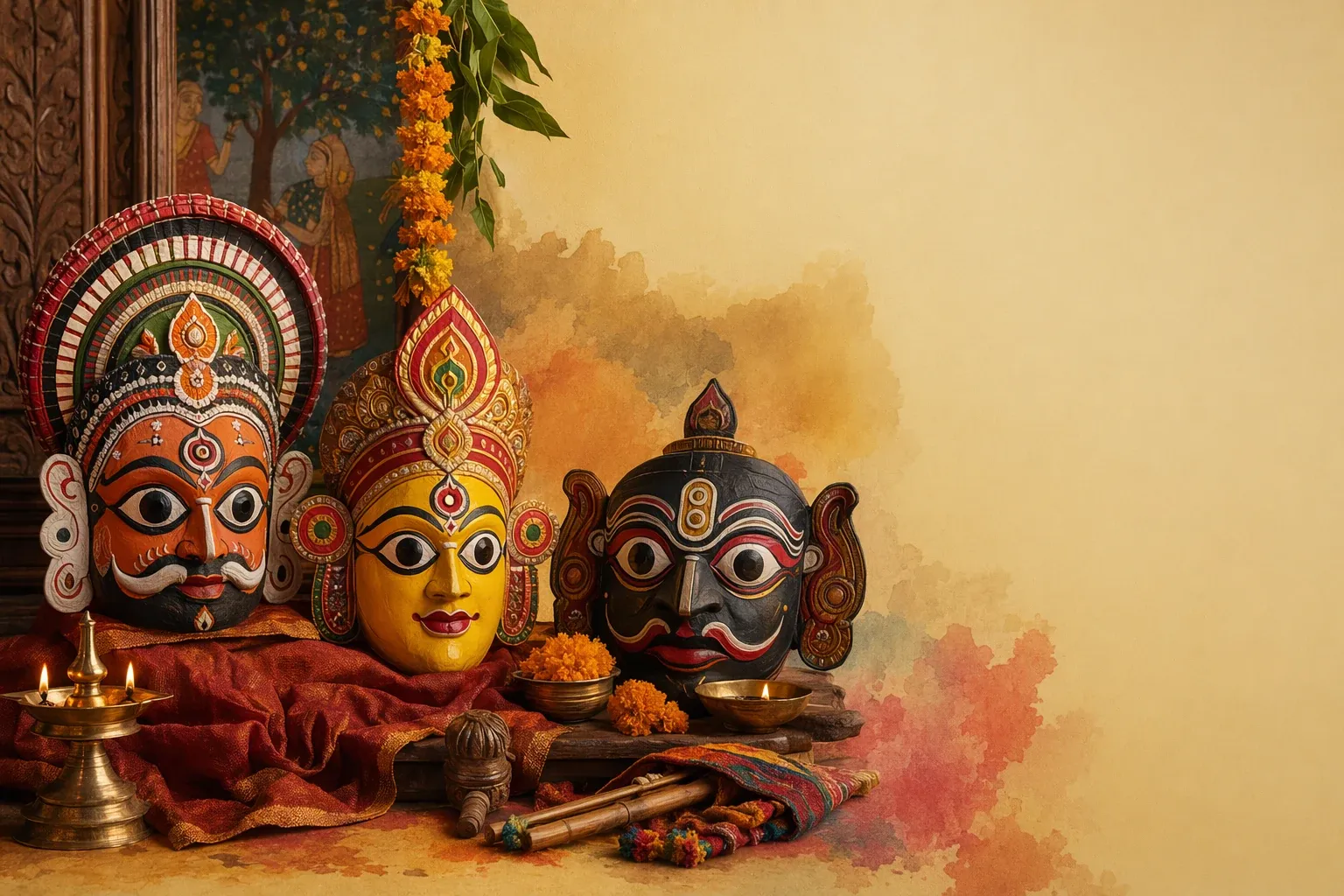
Indian god masks and ceremonial masks can look dramatic at first glance: wide eyes, sharp teeth, crowns, bright colours, animal faces, heroic moustaches, or calm divine expressions. But their meaning is usually deeper than “scary mask” or “festival costume.” In many Indian traditions, a mask helps a community recognise a sacred role, a story character, a protective force, an ancestor, a local deity, or a moral emotion. The mask makes an idea visible.
The most important thing is context. A mask used in a living ritual is not the same as a decorative souvenir on a wall. A performer wearing a mask inside a festival may be following inherited rules, community permissions, songs, offerings, and movement patterns. A museum object may show the craft but not the full performance. A new mask made for tourists may borrow the style without carrying the same ritual duty. So the question is not simply “what does this mask mean?” A better question is: where is it from, who uses it, when is it worn, and what story does the community attach to it?
Presence, not just disguise
In ordinary speech, a mask often means hiding the face. In ceremonial traditions, it can do almost the opposite. It reveals a role that the human face alone cannot show. A dancer may become Rama, Ravana, Durga, Narasimha, a demon, an animal, a guardian, or a comic figure for the duration of the performance. The mask tells the audience, “this person is now carrying another identity in the story.”
This does not mean every Indian mask is treated as a deity in exactly the same way. Traditions differ. In some places, devotees may experience the performer as a living presence of a deity. In other places, the mask is a respected theatre object that helps narrate sacred stories. Both are meaningful, but they are not identical. A careful reader should avoid making one big statement for all of India.
Deity masks and community permission
UNESCO’s note on Ramman, a religious festival and ritual theatre of the Garhwal Himalayas, is a useful example. The festival honours Bhumiyal Devta in the twin villages of Saloor-Dungra in Uttarakhand. It includes the recitation of a version of the Rama story, local legends, songs, and masked dances. UNESCO also notes that village groups have distinct roles, and that one of the most sacred masks, Narasimha, is worn only by those with the traditional right to do so.
That detail matters. The meaning of the mask is not only in its painted surface. It is also in permission, responsibility, lineage, and local trust. If a sacred mask is tied to a festival role, copying it casually for a party, school skit, or social media look can miss the point. Respect begins with understanding that some objects belong to a living web of duties.
Good, fierce, comic, and protective forms
Many god and ceremonial masks use strong visual language because they need to be readable in public space. A crown may suggest royalty or divinity. Large eyes may signal alertness, power, or a superhuman gaze. Fangs, tusks, flames, or exaggerated mouths may show a fierce force. A calm face may point to dignity or compassion. A funny or awkward face may create laughter and release tension in a festival crowd.
Fierce does not always mean evil. In Hindu and regional traditions, fierce forms can also protect, destroy injustice, guard boundaries, or frighten away harmful forces. Narasimha, for example, is a half-human, half-lion form associated with Vishnu’s protection of Prahlada in the well-known Puranic story. Bhadrakali-related performances in Kerala can be visually intense, but that intensity belongs to a protective goddess context, not a horror-movie category.
Chhau masks and epic characters
Chhau dance offers another grounded example. UNESCO describes Chhau as an eastern Indian tradition with three styles: Seraikella, Purulia, and Mayurbhanj. The Seraikella and Purulia styles use masks, while Mayurbhanj is generally known without masks. The performances can enact episodes from the Mahabharata and Ramayana, local folklore, and abstract themes. They are also linked with festivals such as Chaitra Parva.
In Chhau, a mask helps the audience recognise the character quickly. A demon king, a warrior, a bird, a goddess, or a heroic figure can be identified from shape, colour, expression, crown, and costume. Because the face is fixed, the dancer must carry feeling through the body: jumps, turns, martial movement, gait, shoulders, hands, and rhythm. The mask is not a shortcut that replaces performance. It becomes one powerful part of the performance language.
When the face itself becomes the mask
Not every “god mask” people see online is a literal mask. Kathakali is a good reminder. This Kerala theatre-dance is famous for elaborate facial makeup, costume, headgear, gestures, and the expression of rasa. Many people call Kathakali images “masks” because the painted face looks mask-like. But in many performances, the transformation is made through makeup and costume rather than a removable face-covering.
This distinction is helpful because it stops us from forcing every Indian performance into one category. Sometimes the mask is carved or built. Sometimes the face is painted. Sometimes the headgear, crown, beard, ornaments, and body costume together create the sacred or theatrical identity. The cultural idea is transformation; the material method changes by region.
Respectful viewing in modern life
Today, ceremonial masks appear in museums, craft shops, online stores, home décor, school projects, theatre workshops, and travel photography. Appreciation is good when it is informed. Before calling a mask “weird,” “demonic,” “tribal,” or “superstitious,” ask what role it plays in its own community. Is it linked to a deity, festival, village memory, folk theatre, seasonal worship, or craft lineage? Is it meant for sale, performance, ritual, or teaching?
Respect does not mean we must understand everything instantly. It means we slow down. We name the region if we know it. We avoid pretending that all Indian masks mean the same thing. We do not wear sacred-looking forms as a joke. We credit artisans and communities. We remember that behind the painted face there may be songs, vows, rehearsals, caste or community roles, temple spaces, and generations of practice.
A simple meaning to carry forward
Indian god and ceremonial masks usually mean transformation. They help a human performer carry a role larger than everyday identity: a deity, guardian, hero, animal, ancestor, demon, clown, or moral force. They also carry community memory. Their colours and forms are beautiful, but the deeper meaning comes from story, place, permission, and performance.
So if you see one, do not stop at “mask.” Ask: whose story is being made visible? Which festival or performance does it belong to? What values does it protect or teach? That curiosity is the first step from looking at an object to understanding a tradition.
For a wider background, start with our guides to Indian ritual masks and Indian mask history and culture.