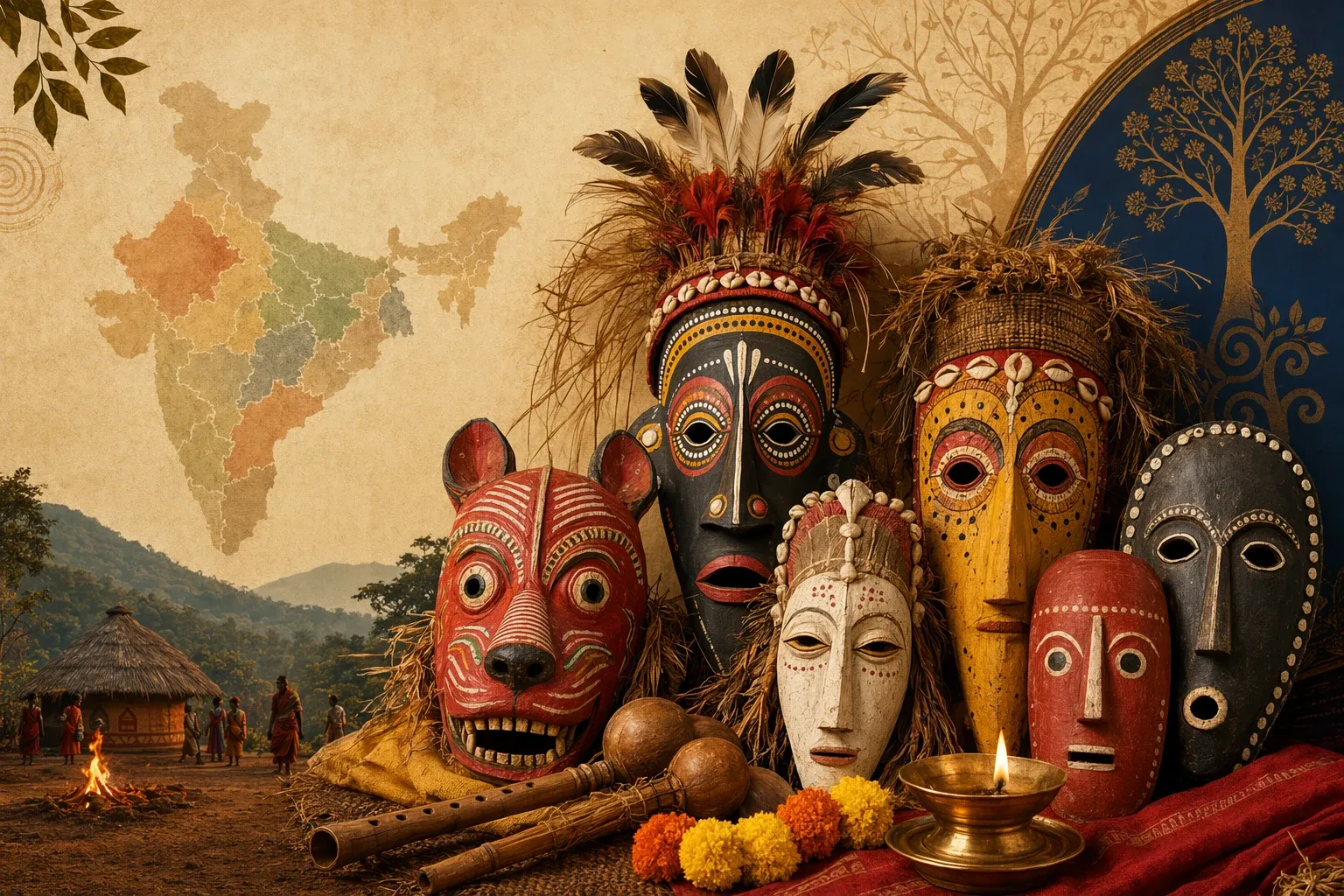
The phrase “Indian tribal masks” needs care. It can be useful when people are searching for masks connected with Adivasi, indigenous, village, forest, hill, or local community traditions. But it can also become misleading if we treat hundreds of communities as one culture. India does not have one tribal mask tradition. It has many regional traditions, each with its own language, festival calendar, materials, rights, stories, and sacred rules.
A better way to learn is to ask: Which region? Which community? Which festival? Which deity or story? Which performance form? A Purulia Chhau mask, a Seraikella Chhau mask, a sacred Narasimha mask in Ramman, a Kerala Padayani kolam, and a Kummattikali mask do not belong to the same social world. They may all involve masks or mask-like transformation, but their meanings are different.
Why community context matters
In many local traditions, a mask is not only an artwork. It belongs to a performance ecosystem. There may be people who make the mask, people who paint it, people who play drums, people who sing, people who train young performers, people who sponsor the festival, and people who hold ritual authority. The mask becomes meaningful because these roles work together.
This is especially important when a tradition is described as tribal or indigenous. Outsiders often focus on the object because it is visually dramatic. The community may focus equally on the festival, vow, deity, harvest season, village protection, teacher-student training, or ancestral memory. A respectful article should not reduce living people to “exotic masks.” It should treat masks as one part of a living cultural relationship.
Chhau and eastern Indian regions
Chhau is one of the clearest examples for beginners because it is well documented by UNESCO. It is an eastern Indian dance tradition with three regional styles: Seraikella in Jharkhand, Purulia in West Bengal, and Mayurbhanj in Odisha. UNESCO notes that Seraikella and Purulia use masks, while Mayurbhanj is a distinct style without that same mask usage. The dance draws on epic episodes, local folklore, abstract themes, martial practices, and festival life.
Chhau also shows why the word “tribal” must be handled carefully. UNESCO says its origin is traceable to indigenous forms of dance and martial practices, and that it binds people across different social and ethnic backgrounds. That does not mean every Chhau performer or maker should be placed under one simple label. The tradition has regional courts, village communities, artisan makers, ritual festivals, and modern stages in its history. Its masks are part of that layered story.
Purulia and Seraikella masks
Purulia Chhau masks are famous for their size, colour, crowns, expressive eyes, and strong character identity. They help audiences recognise figures such as Durga, Mahishasura, Rama, Ravana, animals, warriors, and other dramatic roles. Seraikella masks are often described as subtler and more restrained, supporting a different performance language. These differences show that even within one named tradition, regional style matters.
The mask also affects movement. A large mask can limit facial expression and vision, so the dancer must communicate through the body. Jumps, bends, martial stances, circular movement, and rhythm become central. The performer is not simply “wearing” the mask. The performer is learning how to move with its weight, shape, expression, and character.
Ramman in the Garhwal Himalayas
Ramman, from the twin villages of Saloor-Dungra in Uttarakhand, offers a different model. UNESCO describes it as a religious festival and ritual theatre in honour of Bhumiyal Devta. It includes ritual, recitation, songs, and masked dances. The description also notes that the sacred Narasimha mask is worn only by people with a specific traditional right. This is a strong example of mask use tied to village structure and ritual permission.
For readers, this detail is more important than the visual appearance alone. It tells us that masks can carry social responsibility. A person cannot always wear a sacred mask just because it looks beautiful. In some contexts, wearing it without the right role would be disrespectful. This is why cultural literacy matters before imitation.
Kerala examples beyond one label
Kerala gives useful examples of how mask and transformation traditions can be devotional, playful, and regional without fitting neatly into one tribal category. Padayani in central Kerala is a ritual art associated with Bhagavati or Bhadrakali temples. It brings together masks or large painted forms, percussion, dance, theatre, satire, and festival worship. Kummattikali, associated with Onam in regions such as Thrissur and Palakkad, uses colourful wooden masks, grass costumes, and house-to-house performance.
These examples should not be used to claim that all Kerala mask traditions are the same. They simply show how local ritual arts can use face covering, painted form, costume, music, humour, and devotion in different proportions. The local calendar and temple setting often decide the meaning.
Materials from local worlds
Community masks often use materials that make sense locally: wood, bamboo, cane, clay, cloth, paper, natural fibres, plant leaves, areca palm, pigments, and modern paint. Materials are chosen for availability, weight, durability, ritual preference, and visual effect. A mask meant for vigorous night performance must be readable from far away. A mask meant for indoor ritual may follow different rules. A market piece may use brighter, longer-lasting paint for buyers.
This material knowledge belongs to craft communities and teachers. It should not be treated as a free design library for copying sacred forms without credit. If someone buys or displays a mask, the respectful questions are: who made it, from which tradition, for what purpose, and with what permission?
Festivals, protection, and storytelling
Many regional mask traditions are connected with seasonal festivals. Chhau is linked with Chaitra Parva, a spring festival. Ramman happens annually in late April. Kummattikali appears around Onam. Padayani has its own temple festival cycles. These timings matter because masks often mark a special break from ordinary time. The village or neighbourhood gathers, music begins, characters appear, and stories become visible.
The themes can include protection, fertility, courage, victory of divine power, local legends, epic episodes, humour, and moral teaching. A fierce mask may frighten children a little and still be protective. A demon mask may look terrifying but help the community enact the defeat of disorder. A comic figure may make people laugh while also releasing social tension during festival time.
Respectful viewing and learning
If you are watching a mask performance, start with humility. Do not touch masks unless invited. Do not walk into ritual space for a better photo. Do not assume every performer wants to pose like a tourist attraction. If photography is allowed, give credit to the tradition and place. If you buy a mask, ask whether it is made for display or connected to sacred use.
The most important lesson is simple: Indian tribal and community masks are not primitive art objects. They are part of sophisticated systems of craft, performance, devotion, memory, and local knowledge. To understand them, we must move from “What does this mask look like?” to “Who carries this tradition, when is it performed, and what does it mean to them?” That shift turns curiosity into respect.
To place masks inside the wider performance world, you may also enjoy our beginner guide to Indian theatre.
For the craft and community-art side, read Indian folk art with the same respect for regional context.