Indian folk art is not just a style; it is a living memory of homes, festivals, stories, and communities. This beginner-friendly guide explains its meaning with warmth and clarity. This article introduces the subject in clear language for readers who want cultural context, visual clues, and practical appreciation.
A living art, not a museum label
Indian folk art is the visual language of communities. It grows from village walls, home thresholds, festival courtyards, cloth, palm leaves, paper, clay, and everyday ritual objects. A painting may show a wedding, a harvest, a goddess, a forest, a protective animal, or a pattern drawn before sunrise. The word folk does not mean simple in a lesser sense; it points to art carried through families, regions, occupations, songs, seasonal customs, and shared memory.
Why the meaning feels close to daily life
Many Indian folk traditions were made for occasions rather than galleries. A wall was painted for a marriage. A floor pattern welcomed guests and deities. A scroll carried stories from village to village. A painted toy taught children a local legend. Because of this, the art often feels intimate. It is close to food, prayer, weather, farming, birth, travel, hospitality, and gratitude. Its beauty comes from use as much as appearance.
Community memory in line and colour
A folk artist rarely begins with a blank idea in the modern sense. The artist inherits shapes, borders, colours, stories, and ways of arranging a scene. Within that inheritance, each hand still makes choices. One painter may give a fish a playful curve; another may fill a border with tiny leaves; another may place the sun in a different corner. Tradition provides a grammar, while the artist gives the sentence its voice.
The difference between folk, classical, and contemporary art
Indian art has many streams. Classical temple sculpture, court miniature painting, urban studio art, devotional calendar imagery, and folk practices can influence one another, but they are not identical. Folk art is usually tied to place and community use. It may be made by hereditary artists, women at home, ritual specialists, travelling storytellers, or craft families. Contemporary artists may also adapt folk forms, yet the older community setting remains important to understand.
Materials that reveal the local world
The materials often tell you where the art comes from. Rice paste, cow dung wash, natural dyes, handmade paper, cloth, bamboo pens, soot black, vegetable colours, mineral pigments, terracotta, wood, and woven fibre all connect the work to a landscape. Even when artists now use acrylic paints or commercial paper, older material memory remains visible in the line, palette, and surface. Learning materials is one of the easiest ways to understand meaning.
Stories that travel through pictures
Indian folk art often makes stories visible. A single painting may include gods, humans, animals, trees, rivers, musicians, wedding guests, and patterned skies at once. The space is not always realistic, because the purpose is not to imitate a camera. The purpose is to hold a whole story together. Time may fold into one frame, so a viewer can move through the image slowly, almost as if listening to a song.
Sacred and everyday themes belong together
A beginner sometimes expects sacred art to be separate from ordinary life, but Indian folk art often joins them. A goddess may appear beside a fish, a bride, a field, a parrot, a pot, or a village path. A protective sign may be drawn at a doorway where children run in and out. The sacred is not distant; it is woven through domestic rhythm. That is why the art can feel both devotional and homely.
Regional names matter
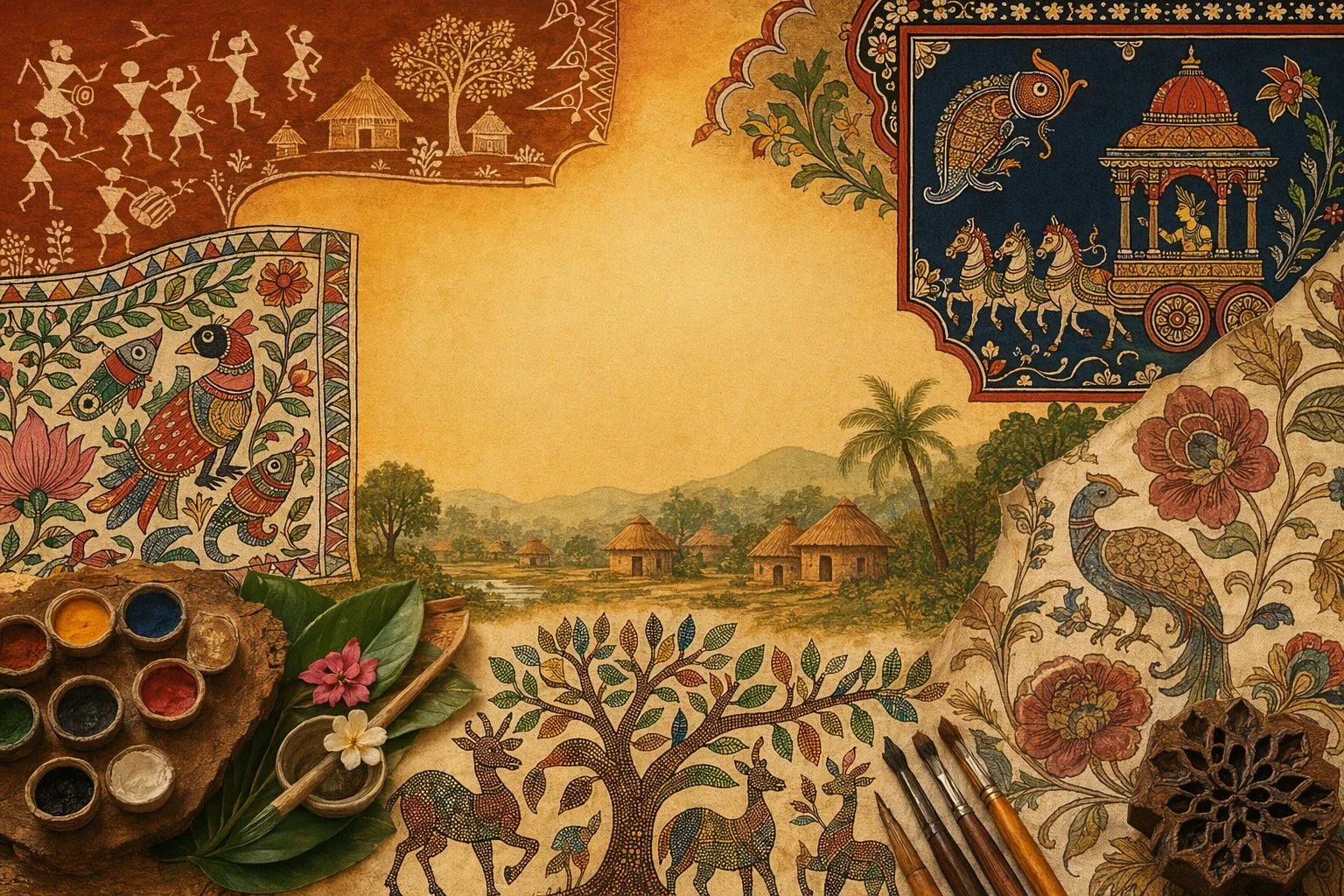
Names such as Madhubani, Warli, Pattachitra, Kalamkari, Gond, Phad, Pithora, Cheriyal, Kalighat, Mata ni Pachedi, and Sanjhi do more than classify styles. They point to regions, languages, communities, patronage systems, and ritual worlds. A helpful next step is to explore famous Indian folk art forms slowly, one tradition at a time, instead of treating all of them as one decorative category.
Patterns are full of intention
Borders, dots, grids, circles, vines, waves, and repeated leaves are not filler. They can suggest protection, fertility, order, abundance, water, movement, or the pleasure of careful labour. In some traditions, dense filling creates a world where nothing feels empty or abandoned. In others, open space gives figures room to breathe. Looking at pattern as intention changes the way a beginner sees the whole work.
Animals, plants, and natural signs
Peacocks, elephants, fish, snakes, turtles, bulls, birds, trees, lotuses, rivers, and the sun appear again and again across Indian folk art. Their meanings shift by region, but they often connect to prosperity, protection, rain, fertility, devotion, strength, or cosmic order. For a deeper reading of these motifs, see our guide to symbols in folk art, which separates common themes without flattening local difference.
Why handmade variation is part of the charm
A handmade line may wobble slightly. A border may turn with a tiny surprise. Two eyes may not be perfectly identical. These are not flaws in the way a printed factory pattern might have flaws. They are signs of a human rhythm. Folk art invites viewers to appreciate repetition with variation. The hand records time, patience, breath, and attention, which is why even a small piece can feel alive.
Respectful appreciation begins with context
It is natural to enjoy the colours first, but respectful appreciation goes further. Ask where the work comes from, who made it, what occasion or story it refers to, and whether the design has devotional or community significance. Buying directly from artists, crediting traditions accurately, and avoiding careless copying all help. Appreciation becomes richer when beauty and responsibility sit together.
A beginner’s way of looking
Stand before an Indian folk artwork and begin gently. Notice the main figure, then the border, then the smallest repeated marks. Ask what is happening, what season or celebration might be present, what animals are included, and how the artist fills space. You do not need expert vocabulary to begin. Patient looking is already a meaningful entry into the art.
Why Indian folk art remains contemporary
These traditions are old, but they are not frozen. Artists paint buses, forests under threat, city life, women’s experiences, public health stories, migration, festivals, and family memories in inherited visual languages. A living tradition can remember the past while speaking to the present. That is the real meaning of Indian folk art: continuity with movement, rootedness with imagination, and community memory made visible.
Continuing the journey
For related reading, see Indian folk art for beginners. Let the next artwork you see become a patient conversation with region, maker, material, symbol, and use. Indian folk art rewards slow attention, and every careful question adds depth to the first moment of visual delight.