
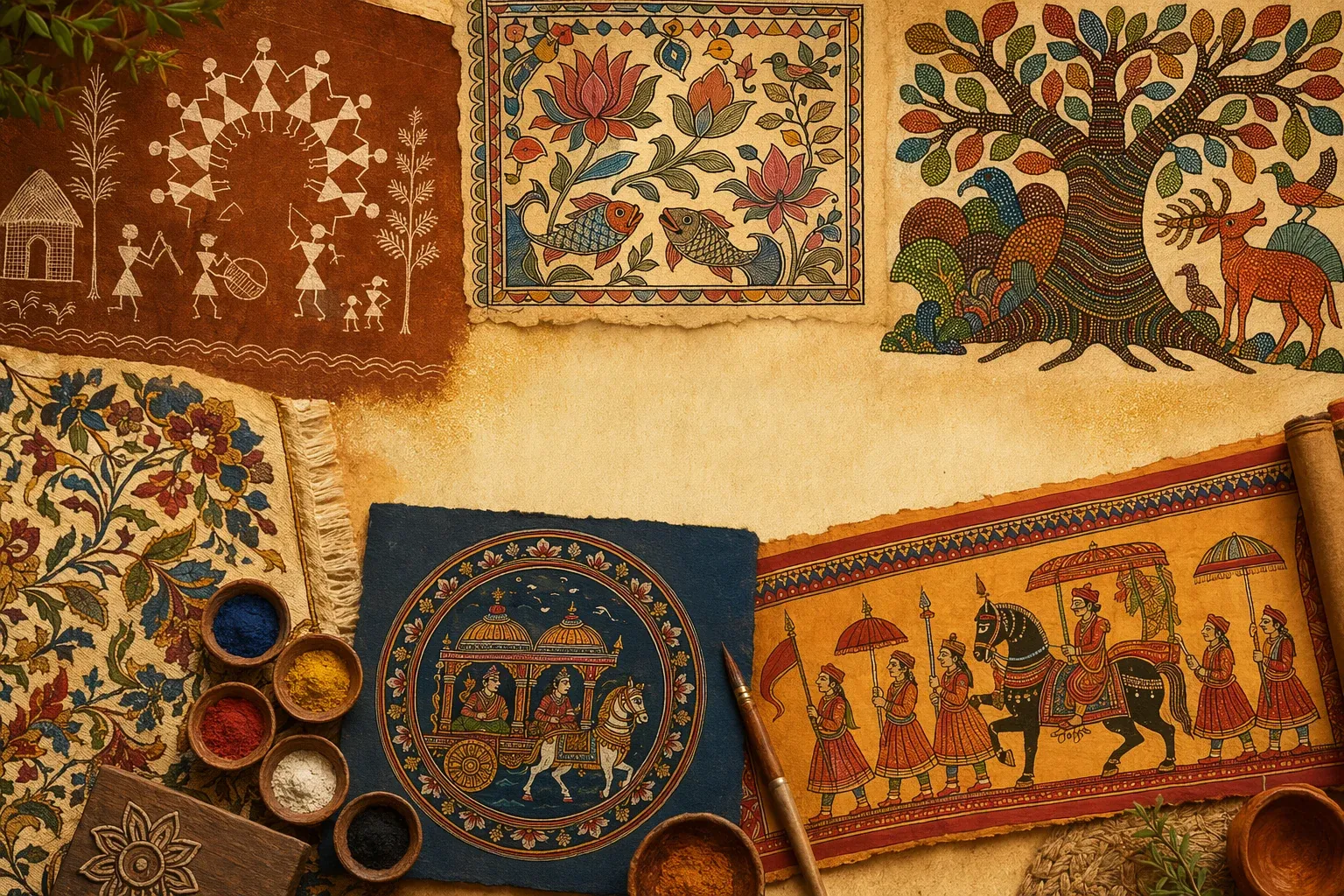
India’s folk art traditions are beautifully diverse. This guide introduces famous forms, their regions, themes, and visual character in beginner-friendly language. This article introduces the subject in clear language for readers who want cultural context, visual clues, and practical appreciation.
Many traditions, many Indias
Indian folk art cannot be reduced to one look. Each form carries a region’s climate, language, ritual life, materials, and memory. Some are painted on walls, some on cloth, some on scrolls, some on paper, some on the ground, and some on objects used in worship or celebration. The joy of learning these traditions is discovering how many different ways communities have made beauty useful, sacred, portable, and memorable.
Madhubani from Mithila
Madhubani, also called Mithila painting, is associated with the Mithila region of Bihar and Nepal. It is known for strong outlines, filled backgrounds, patterned borders, and themes such as marriage, fertility, Krishna, Rama, Durga, village life, fish, birds, lotuses, and the tree of life. Older wall traditions moved onto paper, creating a wider audience while preserving the dense storytelling energy. Beginners can continue with our Madhubani painting guide.
Warli from Maharashtra
Warli art is recognized by its earthy background and white figures built from circles, triangles, and lines. The people, animals, trees, musicians, and dancers are usually arranged with remarkable balance. A tarpa dance circle may suggest community rhythm, while farming scenes show the bond between humans and land. The style looks minimal at first, but it contains a deep sense of movement, ceremony, and social life.
Gond from central India
Gond art, associated with communities in central India, often uses dots, dashes, flowing lines, and bright colours to animate animals, trees, and mythic beings. A fish, deer, bird, or tree may seem to pulse with pattern from within. Many Gond artists describe nature as alive with spirit and story. Contemporary Gond painting has also expanded onto canvas and paper, showing cities, memories, and environmental concerns through traditional visual rhythms.
Pattachitra from Odisha and Bengal
Pattachitra means painting on cloth or prepared surface, and it is famous for disciplined line, decorative borders, and stories of Jagannath, Krishna, Devi, and epic scenes. Odisha Pattachitra often has a jewel-like finish and precise ornamentation, while Bengal pata traditions include scroll storytelling accompanied by song. In both cases, picture and narrative are closely linked. The viewer is invited to read the image almost like a sacred performance.
Kalamkari from Andhra and Telangana
Kalamkari literally points to pen work, though the tradition includes complex processes of drawing, dyeing, washing, and mordanting cloth. Srikalahasti Kalamkari is known for freehand mythological drawing, while Machilipatnam Kalamkari developed with block printing and textile trade. The art often features flowing vines, temple stories, divine figures, and richly patterned garments. Its beauty lies not only in image but also in the patient relationship between cloth, dye, and hand.
Phad painting from Rajasthan
Phad is a long painted cloth scroll traditionally used by priest-singers to narrate the lives of folk deities such as Pabuji and Devnarayan. The painting is not merely an object; it belongs to performance, night travel, music, and oral history. Figures are arranged across the cloth so the storyteller can move through episodes. This form reminds beginners that Indian folk art is often inseparable from voice and community gathering.
Pithora painting from Gujarat and Madhya Pradesh
Pithora painting is associated with Rathwa, Bhilala, and related communities, and it carries ritual significance. Traditionally made on walls, it includes horses, riders, animals, ancestors, fields, celestial signs, and ceremonial motifs. The painted wall is connected to vows, healing, gratitude, and community participation. Its visual abundance should not be treated as random decoration. It belongs to a living ritual setting and deserves careful respect.
Kalighat painting from Bengal
Kalighat painting developed around the Kalighat temple area in nineteenth-century Kolkata. Artists created swift, expressive paintings for pilgrims and urban buyers, often showing gods, goddesses, social satire, fashionable figures, animals, and moral scenes. The bold brush, plain background, and dramatic curve gave the images immediacy. Kalighat shows how folk and urban popular art can meet, respond to modern life, and still retain a distinctive regional voice.
Mata ni Pachedi from Gujarat
Mata ni Pachedi is a devotional textile tradition linked to mother goddess worship, especially among communities that created shrine cloths when temple access was restricted or limited. The cloth may show the goddess, attendants, animals, borders, and ritual scenes in red, black, and white. It is a powerful example of art as portable sacred space. The design is beautiful, but its devotional function is central.
Sanjhi and paper-cut devotion
Sanjhi, associated especially with Krishna devotion in parts of north India, uses intricate paper stencils to create delicate images and patterns. The cut paper may be used with coloured powders or as a devotional image itself. Its refinement shows that folk art is not always bold and heavy; it can also be airy, precise, and quiet. The patient cutting turns devotion into lace-like visual meditation.
Kolam, rangoli, and threshold arts
Floor arts such as kolam, rangoli, alpana, aripana, mandana, and muggu are made at thresholds, courtyards, and festival spaces. They may use rice flour, chalk, coloured powders, flowers, or natural pigments. These forms are often temporary, which makes them deeply moving. Their purpose is not permanence but welcome, auspiciousness, rhythm, and daily renewal. Bhaktilipi’s kolam guides are a good companion for this area of learning.
How to compare without ranking
It is tempting to ask which form is best, oldest, or most famous. A better question is what each form is meant to do. Madhubani may fill a surface with symbolic abundance; Warli may reveal community through elegant geometry; Phad may unfold a sung epic; Pithora may mark ritual gratitude; Kalamkari may bring myth onto cloth. Comparison becomes respectful when it notices purpose rather than creating a hierarchy.
A map for further looking
The famous forms are only an entry point. India also has Cheriyal scrolls, Sohrai and Khovar wall painting, Chittara, Mandana, Aipan, Thangka in Himalayan Buddhist contexts, leather puppetry traditions, painted toys, masks, and many local practices. Let every name become an invitation to learn region, maker, material, and meaning. That way, the diversity of Indian folk art remains alive instead of becoming a checklist.
Continuing the journey
For related reading, see Madhubani painting guide. Let the next artwork you see become a patient conversation with region, maker, material, symbol, and use. Indian folk art rewards slow attention, and every careful question adds depth to the first moment of visual delight.