Students can learn Indian folk art through examples, maps, motifs, storytelling, and careful art projects. This guide keeps creativity connected to cultural respect. This article introduces the subject in clear language for readers who want cultural context, visual clues, and practical appreciation.
A colourful subject with real people behind it
Indian folk art is a wonderful subject for students because it connects art with geography, history, language, festivals, ecology, and community life. It is also important to remember that these are living traditions made by real artists, not just school craft patterns. A good classroom project should help students see beauty, meaning, and respect together. The goal is to learn from traditions, not to copy them carelessly.
Start with a map
Place a map of India at the centre of the lesson. Mark Mithila for Madhubani, Maharashtra for Warli, Odisha for Pattachitra, Rajasthan for Phad, Gujarat and Madhya Pradesh for Pithora, central India for Gond, Andhra and Telangana for Kalamkari, and Bengal for Kalighat or pata traditions. A map helps students understand that Indian folk art is not one single style. It belongs to many regions and communities.
Example: Madhubani
Madhubani or Mithila painting is known for strong outlines, filled backgrounds, borders, fish, birds, lotuses, trees, and devotional or marriage themes. A student project can focus on a fish, tree of life, or border study rather than copying a sacred scene without context. Students can learn how repeated lines create richness. They can also read about symbols in Indian folk art before choosing motifs.
Example: Warli
Warli art uses simple geometric figures to show dancing, farming, hunting, music, animals, and village life. Students can build human figures from circles, triangles, and lines, then arrange them around a tree or dance circle. This teaches composition and movement. It also opens discussion about community life and nature. Teachers should explain that Warli is associated with Adivasi communities and should not be treated as anonymous stick-figure decoration.
Example: Gond
Gond art often fills animals, trees, and birds with dots, dashes, waves, and bright pattern. A student project can invite each child to draw one animal and fill it with lines that follow the body’s movement. The lesson can include ecology: what animals live in forests, why trees matter, and how art can express respect for nature. This makes the project more thoughtful than simply colouring a printed outline.
Example: Pattachitra
Pattachitra from Odisha and Bengal connects painting with storytelling. Students can study borders, expressive eyes, and scenes from epics or local tales. For a classroom project, they might create a story panel from a familiar school story, using a decorative border and clear sequence, while noting that traditional Pattachitra has its own sacred and regional subjects. This approach teaches narrative structure without pretending to reproduce a ritual artwork.
Project idea: motif museum
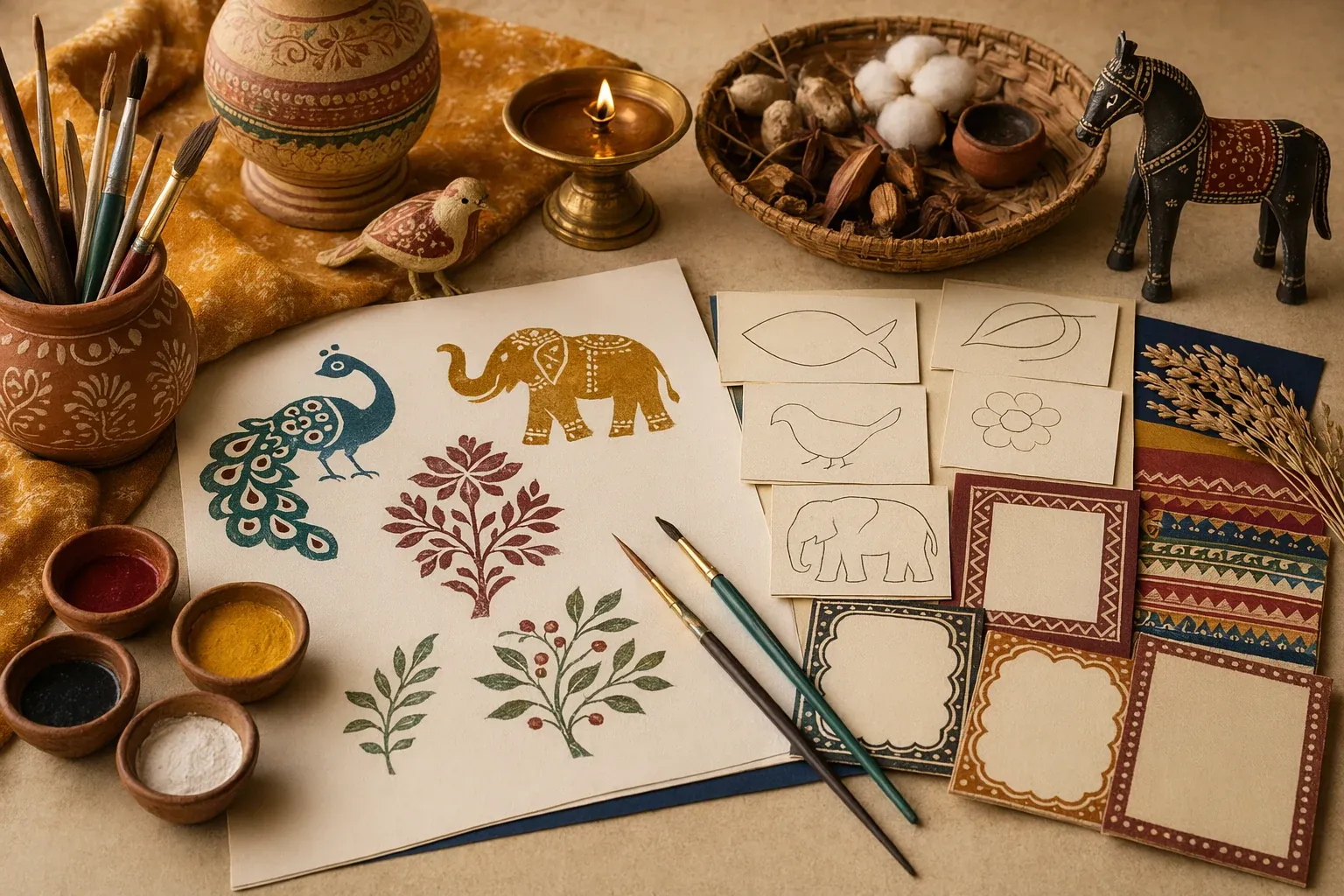
Ask students to create a small motif museum on chart paper. Each student chooses one motif: fish, peacock, elephant, lotus, tree, sun, moon, dancer, drum, or border. They draw it, write the tradition where they saw it, and add a careful meaning note. The class can display all motifs together. This project encourages research, comparison, and visual observation without forcing everyone to make a full imitation painting.
Project idea: border laboratory
Borders are perfect for younger students. Provide strips of paper and ask them to create repeating patterns using dots, triangles, leaves, waves, and flowers. Then discuss how borders frame a picture and create rhythm. Students can compare a Madhubani-style dense border with a simpler Warli-inspired edge. This teaches pattern, patience, and cultural awareness in a manageable format.
Project idea: story scroll
For older students, a story scroll project can connect Phad, pata, and other narrative traditions with language learning. Students choose a short story, divide it into scenes, and draw a long panel sequence with captions. They should clearly label the work as inspired by Indian storytelling scrolls, not as an authentic traditional scroll. The activity teaches sequencing, visual narration, and respect for travelling storyteller traditions.
Project idea: nature and community wall
Create a classroom wall showing trees, animals, rivers, homes, dancers, and musicians inspired by different folk art forms. Each student contributes one piece and writes a small label naming the inspiration. The final display becomes a shared landscape. This is especially good for mixed-age groups because it allows simple and complex contributions. It also shows how folk art often values community over isolated individual display.
Research questions that help
Students can ask: Where does this art form come from? Who makes it? What materials are used? Is it connected to a festival, ritual, story, or daily life? What animals or plants appear? How are borders used? What has changed in modern times? These questions make research more meaningful. They also prevent the common mistake of describing every form only as colourful or decorative.
Respectful classroom language
Use phrases such as Warli-inspired drawing, Madhubani-inspired border, or Gond-inspired animal study. This teaches students to credit sources. Avoid saying we are making real Madhubani art after one class. Real mastery belongs to artists who learn through community, family, apprenticeship, and long practice. Students can still create beautiful learning pieces while being honest about inspiration.
Assessment beyond neatness
Do not grade only on neat colouring. Assess observation, effort, pattern control, research accuracy, respectful labelling, and reflection. A slightly uneven handmade line may show genuine effort. A student who explains why they chose a fish or tree has learned more than one who simply copied a design perfectly. Art education should reward attention and understanding, not only polish.
A learning path that stays open
Students can begin with examples, then move to drawing, storytelling, research, and perhaps meeting artists through workshops or videos. Bhaktilipi’s guides to draw Indian folk art and famous Indian folk art forms can support that path. The best student projects leave curiosity alive. They make children want to ask who made this, where is it from, and what does it mean.
Continuing the journey
For related reading, see draw Indian folk art. Let the next artwork you see become a patient conversation with region, maker, material, symbol, and use. Indian folk art rewards slow attention, and every careful question adds depth to the first moment of visual delight.