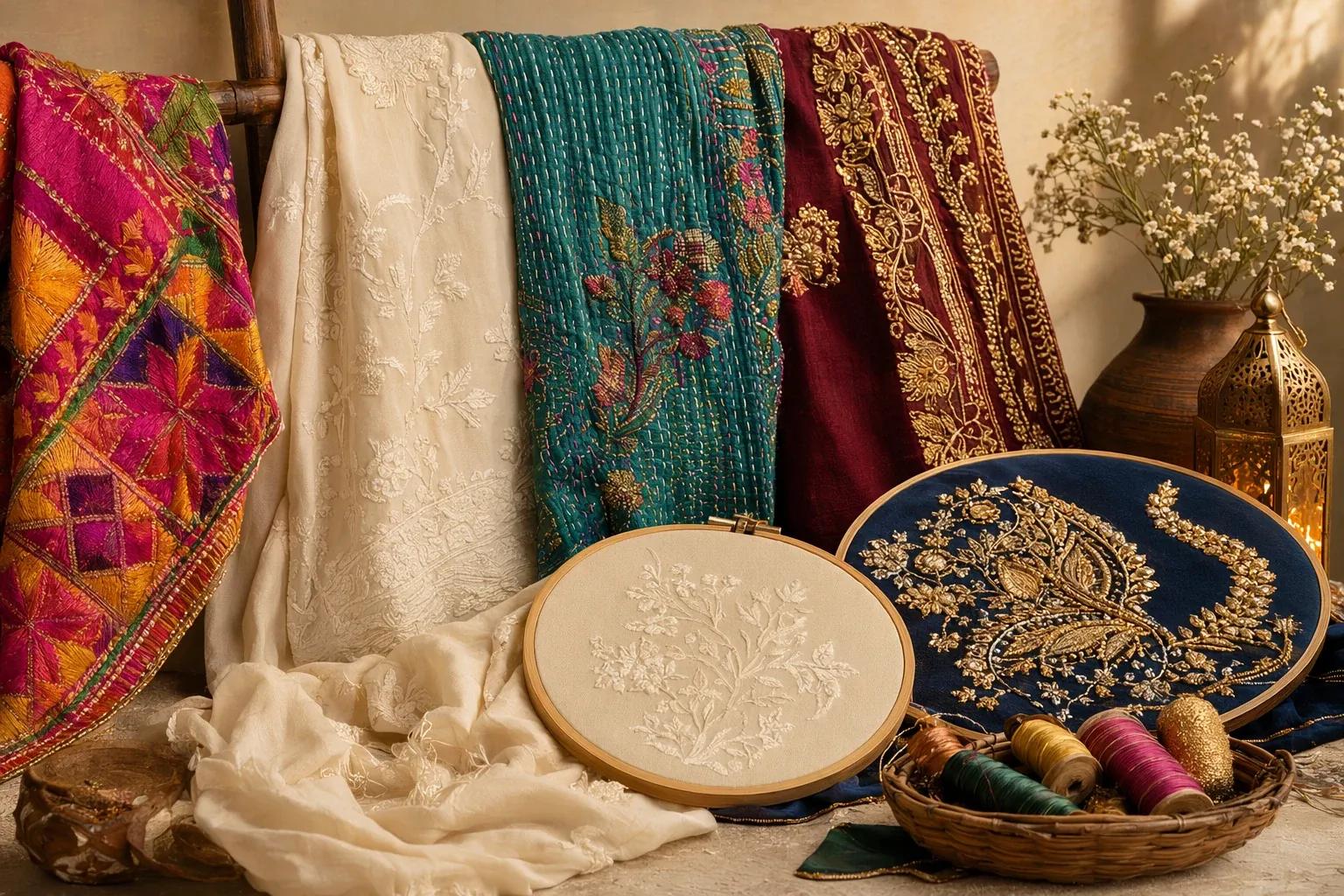
Indian embroidery is easiest to understand when it is seen as a family of local languages. A stitch in Punjab does not speak in the same rhythm as a stitch in Bengal, Kashmir, Lucknow, Gujarat, Karnataka, or the Nilgiris. Some traditions celebrate bright fields and harvest joy; some prefer white thread on airy cotton; some build glittering surfaces for wedding wear; others turn old cloth into soft story blankets. Together they show how Indian textile art grew from household skill, courtly patronage, trade, ritual, and everyday repair.
A beginner does not need to memorise every stitch name at once. It is more useful to notice four things: the ground fabric, the thread or embellishment, the motif, and the social setting. Is the embroidery dense or light? Does it cover the whole cloth or highlight borders? Is it meant for a shawl, sari, kurta, wall hanging, quilt, wedding garment, or household wrapper? These clues make regional styles far easier to recognise.
Phulkari: Punjab in fields of colour
Phulkari literally suggests flower work, but the tradition is broader than floral decoration. It is associated with Punjab and is known for bright silk floss worked on handspun or coarse cotton. The stitches are often made from the reverse side, producing a glowing surface on the front. In older pieces, the ground might be deep red, rust, brown, or indigo, while the silk thread brings orange, gold, green, crimson, and pink into lively conversation.
A very dense form, often called bagh, can cover the ground so fully that the cloth appears woven with light. Phulkari was historically tied to domestic life, marriage, and affection within families. Because of that, a good piece often feels personal rather than merely decorative. Look for geometric fields, floral suggestions, and a strong sense of movement created by repeated darning stitches.
Kantha: Bengal’s stitched memory
Kantha from Bengal and neighbouring regions grew from the practice of layering old cloth and binding it with running stitch. It can be humble, poetic, and astonishingly inventive. The running stitch may create rippling textures, while motifs can include animals, village scenes, flowers, deities, trees, boats, everyday objects, and flowing borders.
What makes Kantha powerful is the way it turns reuse into art. A worn sari or dhoti can become a quilt, wrap, or ceremonial cloth. The stitches may be fine or loose, plain or narrative. Even when modern Kantha appears on scarves, jackets, cushion covers, or saris, its charm still comes from that hand-drawn feeling. It is less about perfect symmetry and more about warmth, storytelling, and texture.
For a wider view of Indian painted and stitched surfaces, Bhaktilipi’s guide to Pattachitra, Madhubani, and Kalamkari is a helpful companion.
Chikankari: Lucknow’s quiet elegance
Chikankari is closely associated with Lucknow and is often recognised by white or pale thread worked on fine cotton, muslin, georgette, silk, or similar light fabrics. Its beauty is subtle: shadow work, delicate floral sprays, jaali-like open textures, small leaves, vines, and paisleys. Unlike embroidery that announces itself through metallic shine, Chikankari often asks the viewer to come closer.
Traditional Chikankari uses a vocabulary of stitches that can create raised forms, flat outlines, pulled-thread effects, and translucent shadows. On a summer kurta, dupatta, or sari, it can feel cool and graceful. A beginner can recognise it by its airy placement, refined floral motifs, and gentle tone-on-tone look, though contemporary versions also use coloured threads.
Zardozi: metal thread and ceremonial splendour
Zardozi is associated with royal courts, wedding garments, ceremonial textiles, and luxury craft. The name is linked to gold work, and the embroidery uses metallic threads, coils, sequins, beads, and other embellishments. It is often seen on bridal lehengas, sherwanis, velvet panels, purses, borders, and religious cloths.
The visual effect is rich and sculptural. Motifs may include vines, flowers, paisleys, birds, and architectural scrolls. Zardozi can be heavy, so it suits garments or panels designed for special occasions rather than everyday wear. When examining it, notice whether the metal elements are neatly couched and whether the design has balance; good Zardozi has grandeur without becoming chaotic.
Kashida and Kashmiri embroidery: gardens on wool
Kashmiri embroidery, often called Kashida in a broad sense, is loved for shawls and woollen garments. The motifs come from the valley’s landscape and artistic imagination: chinar leaves, almond shapes, blossoms, vines, birds, and paisley forms. The colour palette may be soft and natural or jewel-like, depending on the piece.
A famous association is the embroidered shawl, where fine needlework can create elaborate borders or all-over patterns. Sozni, a refined needle embroidery, is especially admired for its delicacy. Chain stitch embroidery from Kashmir is also used on rugs and furnishing textiles. The mood is painterly; the thread seems to sketch a garden across wool.
Kasuti: counted grace from Karnataka
Kasuti, associated with Karnataka, is known for counted-thread work and disciplined geometry. It appears on saris, blouse pieces, household cloths, and decorative textiles. Common motifs include temple forms, chariots, lamps, peacocks, elephants, flowers, and geometric borders. Because the work is counted, it has a woven precision even though it is embroidered.
A notable feature is that traditional Kasuti can look neat on both sides of the cloth. This requires planning and skill. The style is not loud; its beauty lies in order, rhythm, and the relationship between thread and grid. For beginners, Kasuti is a reminder that embroidery can be mathematical as well as expressive.
Mirror work, applique, and desert brightness
Western India, especially Gujarat and Rajasthan, offers many forms of mirror embroidery, applique, chain stitch, and colourful surface decoration. Small mirrors, known by names such as shisha in many craft contexts, catch light and turn garments or wall hangings into sparkling surfaces. Motifs may be geometric, floral, animal-based, or protective in feeling.
These traditions are often linked to community identity. A blouse, bag, toran, or embroidered panel may reveal local preferences in colour, mirror shape, stitch density, and border design. When buying modern pieces, it is worth valuing the handwork and community context rather than treating mirror work as a generic decorative style.
Toda embroidery and other distinctive traditions
Toda embroidery from the Nilgiris has a striking red and black pattern language on white cloth. It is associated with the Toda community and often appears on shawls. The designs are bold, geometric, and deeply connected to identity. The embroidery is not merely ornament; it carries cultural meaning.
Other regional forms include Kutch work, Rabari embroidery, Lambani or Banjara embroidery, Manipuri textile embellishment, Aari work, and many local variations that do not fit neatly into a single label. India’s embroidery map is dense because every region adapted stitch, fibre, colour, and motif to its own climate and social life.
Seeing embroidery with respect
The best way to approach Indian embroidery is to avoid flattening it into a fashion label. Ask where it comes from, who made it, what material is used, and how the design relates to its place. Handmade embroidery may show small variations; those variations are often signs of life, not flaws. Machine copies can be attractive, but they should not be confused with the labour and memory held in handwork.
For anyone beginning a textile journey, embroidery is a beautiful doorway. It connects clothing with family, ritual, landscape, migration, reuse, devotion, and artistry. Once you learn to notice the quiet differences between Phulkari, Kantha, Chikankari, Zardozi, Kashida, Kasuti, mirror work, and Toda embroidery, Indian textiles begin to look less like a single category and more like a vast conversation stitched across generations.