
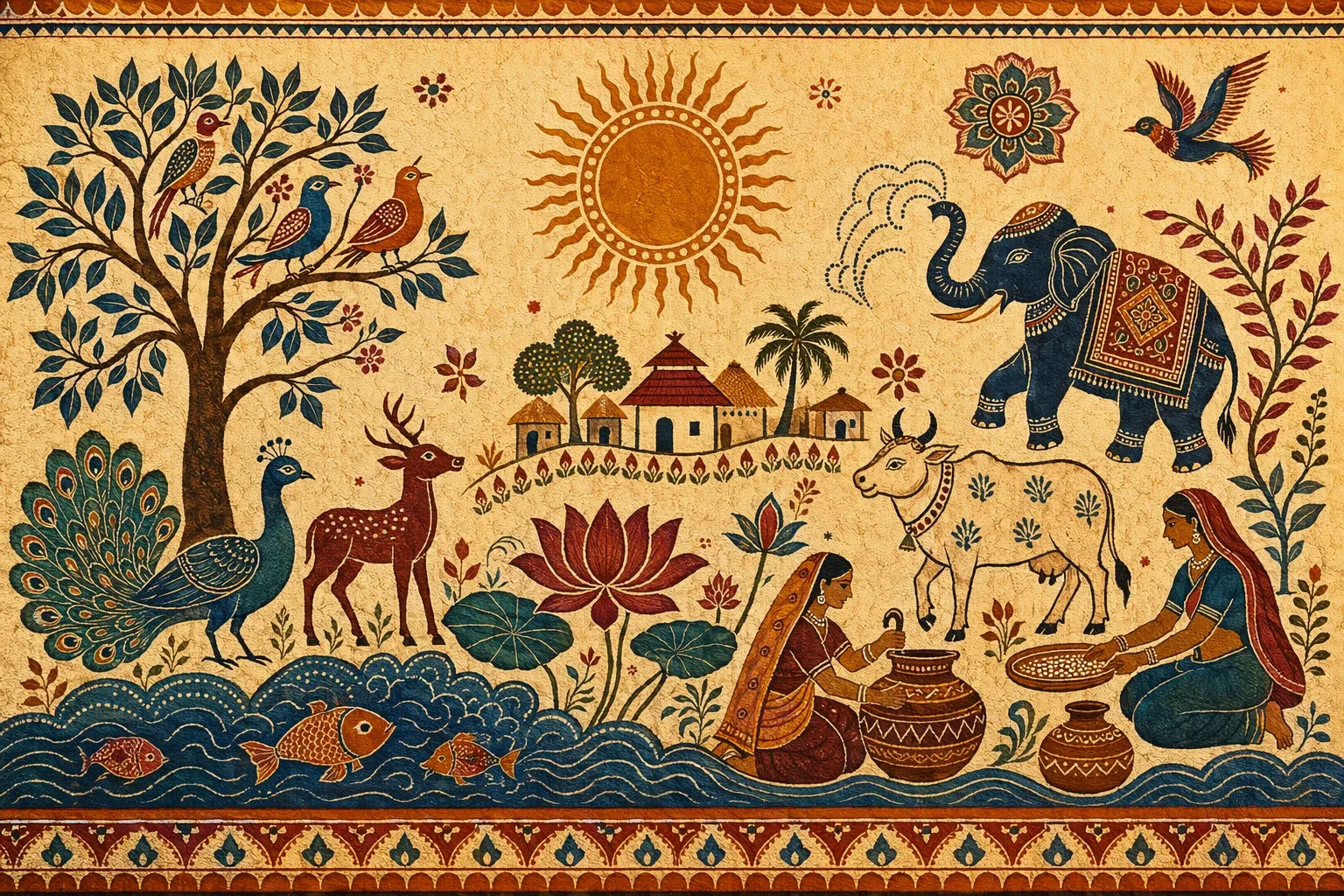
Animals and nature signs in Indian folk art carry memory, blessing, protection, and story. This guide explains common meanings while respecting regional differences. This article introduces the subject in clear language for readers who want cultural context, visual clues, and practical appreciation.
Symbols are clues, not fixed codes
Indian folk art uses animals, trees, flowers, rivers, celestial signs, and repeated patterns to carry meaning. Yet a symbol is rarely a single fixed code for all of India. A fish in one region may suggest fertility, abundance, or auspicious water; in another setting it may connect to a specific story or local ecology. The best way to read symbols is to combine common associations with regional context, artist knowledge, and the subject of the artwork.
The fish and the blessing of water
Fish appear often in Madhubani and other traditions because water is life-giving. They can suggest fertility, prosperity, movement, and the hope that a household will remain nourished. In floodplains and river cultures, fish are not abstract signs; they belong to food, monsoon, farming cycles, and survival. Their repeated forms can make a painting feel full of flowing energy, especially when surrounded by waves, plants, or patterned borders.
The peacock and festive beauty
The peacock is linked with beauty, rain, love, pride, courtship, and divine association. It appears in many Indian visual traditions, from folk paintings to temple ornament and textiles. In Krishna-related scenes, the peacock feather carries devotional tenderness. In other works, the bird may simply bring celebratory elegance. Its curved neck and feathered tail allow artists to create rhythm, which is why peacocks often become both symbol and design anchor.
Elephants and steady strength
Elephants can suggest strength, royal dignity, memory, rain clouds, and auspicious beginnings. Their connection with Ganesha gives them added devotional importance in many settings. In folk art, an elephant may carry a rider, stand near a wedding procession, appear in a festival scene, or become a patterned animal filled with flowers and dots. Its large body gives the artist a generous surface for decoration, turning power into grace.
The cow, bull, and agricultural life
Cows and bulls carry meanings of nourishment, labour, rural wealth, dharma, and domestic continuity. A bull may stand for strength in the field, while a cow may suggest care, milk, and sacred regard. In village scenes, these animals are not merely symbolic; they represent daily partnership between humans and animals. Their presence can tell us that the artwork is rooted in farming, household economy, and respect for living beings.
Birds as messengers and companions
Parrots, sparrows, swans, cranes, and unnamed birds appear across Indian folk art. Birds may indicate love, seasonal movement, speech, the soul’s journey, or the liveliness of a tree. In some paintings, pairs of birds suggest harmony or companionship. In others, birds fill empty space with sound-like movement. Because birds cross boundaries between ground and sky, they often help connect human scenes with a larger natural world.
Snakes, turtles, and older earth memories
Snakes may carry protective, fertility, ancestral, or divine associations, especially through naga traditions. Turtles can suggest steadiness, water, earth, and cosmic support in wider Indian symbolism. These creatures ask for careful reading because they can be sacred, feared, protective, or regionally specific. A beginner should avoid reducing them to one meaning. Their power often comes from being close to earth, water, hidden places, and old stories.
Trees and the idea of shelter
Trees are among the most generous symbols in Indian folk art. They shelter birds, hold fruit, mark village gathering places, and suggest fertility, continuity, and the axis between earth and sky. The tree of life appears in many forms, sometimes symmetrical and decorative, sometimes wild and inhabited. In Madhubani painting, trees may become dense worlds filled with leaves, flowers, animals, and protective energy.
Lotus, leaves, and flowering abundance
The lotus carries associations of purity, divine presence, beauty rising from water, and auspicious growth. Leaves and vines may suggest fertility, continuity, and the spreading of life. In border designs, flowering creepers can frame a scene like a blessing. These plant forms also let artists organize space. A vine can lead the eye around the picture, while a lotus can mark a sacred or emotionally important centre.
Sun, moon, and cosmic order
The sun and moon often appear as witnesses to human and divine events. They may suggest time, balance, seasonal rhythm, or the presence of cosmic order. In some paintings, both are shown together to indicate completeness or the continuity of day and night. Their faces may be humanized, making the sky feel attentive. Folk art often treats the universe as alive, watching, and involved in ordinary life.
Rivers, waves, and flowing lines
Rivers are more than background. They can stand for purification, fertility, journey, danger, abundance, and sacred geography. Flowing lines may show water directly or create the feeling of movement. In a region shaped by monsoon, drought, flood, or river worship, water motifs become deeply meaningful. They remind us that folk art is closely tied to environment, not just imagination.
Borders as protection and order
Borders are easy to overlook, but they often hold a picture together. A repeated border may protect the central scene, create auspicious enclosure, or show the artist’s discipline. Triangles, dots, leaves, waves, and tiny flowers can turn the edge into a meaningful threshold. When used in home decor, border motifs should be chosen with awareness rather than treated as empty ornament.
Human figures and shared rhythm
Human figures in folk art may be less about individual portrait and more about role, relation, and event. Dancers, brides, musicians, farmers, mothers, deities, and storytellers show the social world. Their repeated gestures create rhythm. A circle of dancers can suggest community unity; a procession can show movement toward ceremony; a seated pair can signal marriage or devotion. Meaning comes from relationship as much as from a single body.
Reading symbols with humility
The safest approach is to ask three questions: what tradition is this, what scene is shown, and what would local makers or knowledgeable sources say about it? A broad guide can open the door, but living traditions deserve humility. Symbols become richer when we allow them to remain layered. Indian folk art is not a puzzle to solve once; it is a conversation between nature, community, devotion, memory, and hand.
Continuing the journey
For related reading, see beginner guide to Indian folk art. Let the next artwork you see become a patient conversation with region, maker, material, symbol, and use. Indian folk art rewards slow attention, and every careful question adds depth to the first moment of visual delight.