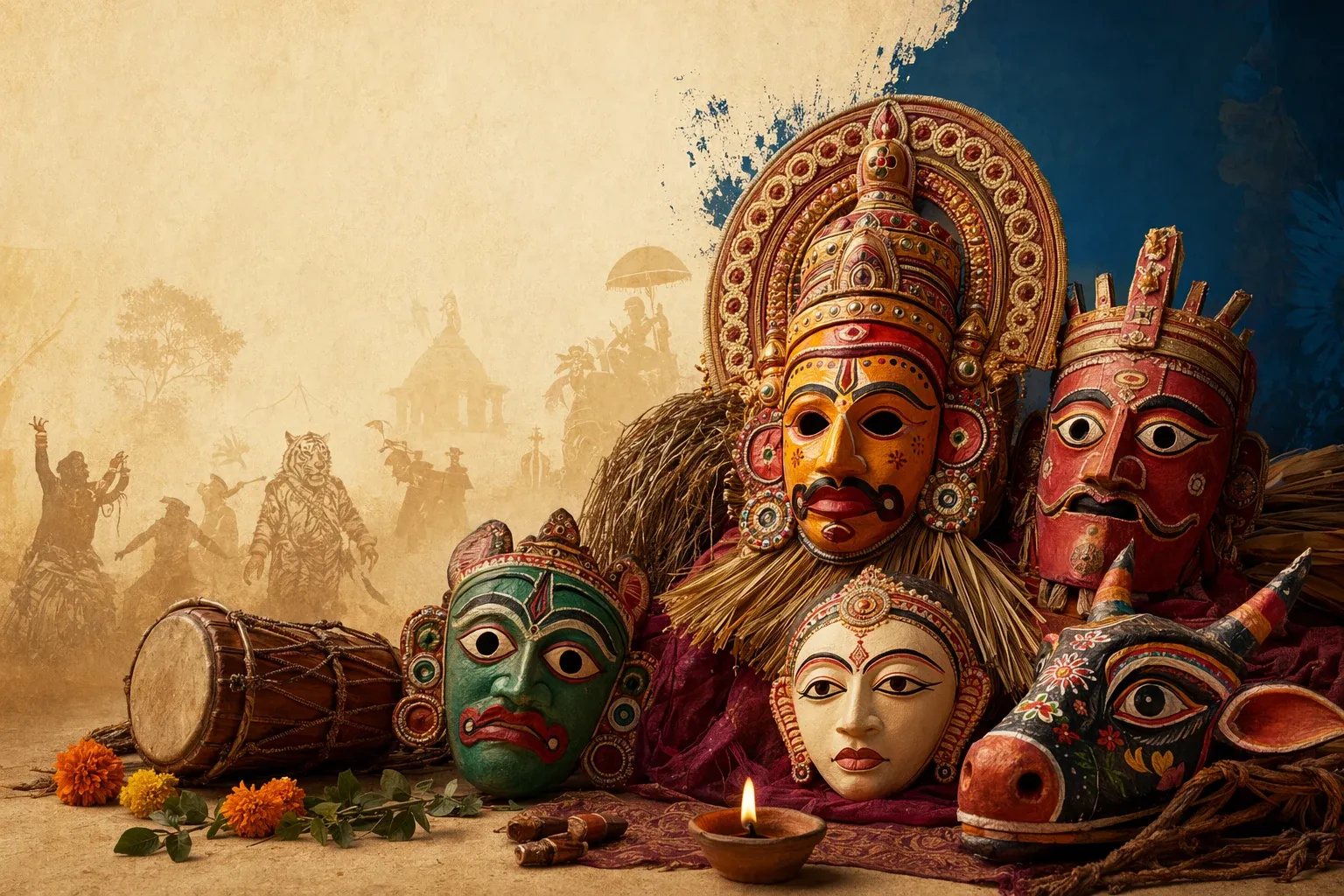
Indian masks do not have one single origin story. That is the first fact every beginner should know. India’s mask traditions grew in many regions, languages, faith settings, ecological zones, and performance worlds. Some masks belong to temple festivals. Some belong to dance-drama. Some are linked with local deities, village guardians, epic characters, animals, warriors, clowns, or spirits. Some are made for ritual use, some for theatre, and some for the art market.
So when we say “Indian masks,” we are really speaking about a family of traditions. A Chhau mask from Purulia, a ceremonial mask in Ramman from Uttarakhand, a Kummattikali mask from Kerala, and a museum mask linked with Gambhira dance do not all mean the same thing. They share the idea of transformation, but each one belongs to its own cultural home.
Many beginnings, not one beginning
It is tempting to say that Indian masks began in “ancient times” and leave it there. That sounds grand, but it is not very helpful. Masks and face transformation are certainly old in human culture, and Indian performance has long used costume, paint, ornaments, and symbolic forms. But each living tradition has a different history. Some are connected to dynastic courts, some to village festivals, some to temple ritual, some to folk theatre, and some to artisan lineages.
Chhau gives us a clearer example than a vague origin claim. UNESCO describes Chhau as an eastern Indian tradition with three distinct regional styles: Seraikella, Purulia, and Mayurbhanj. It enacts episodes from the Ramayana and Mahabharata, local folklore, and abstract themes. Its origin is traceable to indigenous forms of dance and martial practices. Two of its styles use masks. This tells us that a mask tradition can carry martial movement, festival timing, epic storytelling, and regional identity at once.
Ritual theatre and village responsibility
Ramman, the religious festival and ritual theatre of the Garhwal Himalayas, shows another side of mask culture. UNESCO describes it as a village festival in honour of Bhumiyal Devta, combining rituals, recitation of Rama stories, songs, masked dances, and community roles. The right to wear the sacred Narasimha mask is not open to anyone who feels interested. It belongs to specific traditional roles within the village structure.
This matters because masks are often part of social organization. They can express who does what in a community: priests, performers, musicians, craft workers, host families, elders, youth, and ritual specialists. A mask may be beautiful, but its deeper meaning may lie in the rules around it. Who makes it? Who keeps it? Who repairs it? Who brings it out? Who may wear it? These questions are part of the mask’s history.
Epic characters and local heroes
Many Indian masks help audiences recognise characters quickly. A mask with a crown, fierce eyes, strong moustache, fangs, or a particular colour can signal a king, demon, deity, warrior, animal, or comic figure. In Chhau, stories may come from the epics and Puranas as well as local folklore. In Kerala’s Kummattikali, performers wear colourful wooden masks depicting figures such as Krishna, Narada, Kiratha, Darika, hunters, and other folk characters.
These roles are not only decorative. They teach a community how to read emotion and character. A fierce mask may show danger, protection, anger, or divine energy. A smiling or exaggerated mask may invite laughter. An animal mask may connect the human world to the forest, field, or mythic imagination. The design is a language, and the audience learns that language through repeated festivals and performances.
Materials tell cultural stories
Indian masks are made from many materials: wood, clay, papier-mache, cloth, bamboo, cane, areca palm, natural pigments, plant fibre, metal, and modern paints. The material often depends on the region. A forested area may develop wood-carving traditions. A wetland or riverine region may use clay, bamboo, and cloth. A temple festival may use painted forms designed for visibility at night. A travelling performance may need something lighter and stronger.
Kummattikali masks, for example, are commonly described as painted wooden masks, and the full costume may include grass. Padayani uses large painted forms called kolams, often connected with areca palm material and temple ritual. These details are not small craft facts. They show how environment shapes culture. Local trees, leaves, soil, pigments, tools, and seasonal festivals all influence what a mask becomes.
Makeup can work like a mask
Not every Indian performance uses a literal removable mask. Some traditions use painted faces, headgear, and costume in a mask-like way. Theyyam in North Malabar is a good example to treat carefully. It is not simply “mask dance”; it is a ritual tradition in which performer, makeup, costume, headgear, song, temple or shrine setting, and local deity belief come together. The transformation can be as strong as any mask, even when the face is painted rather than covered by a separate object.
This point helps beginners avoid a common mistake. Indian visual performance does not always fit neat museum categories. A mask can be worn, painted, carried, built around the head, or extended through costume. What matters is the transformation: the performer becomes readable as more than an ordinary individual.
Culture changes without losing memory
Mask traditions are not frozen. They change with tourism, museum collecting, school performances, urban festivals, digital video, government recognition, and artisan markets. Some changes help survival by giving craftspeople income and visibility. Other changes can weaken community meaning if masks become only souvenirs, stripped from performance and ritual context.
UNESCO’s note on Chhau mentions pressure from industrialization, economic change, and new media. This is not a reason to panic; traditions have always adapted. But it is a reminder that cultural heritage depends on living people, not just old objects. A mask in a shop may look impressive, but the living tradition needs teachers, performers, musicians, makers, festivals, and younger learners.
Simple facts to remember
First, Indian masks are regional. A mask from Odisha, Bengal, Jharkhand, Kerala, Assam, Himachal, Uttarakhand, or Karnataka should not be treated as the same tradition. Second, masks can be sacred, theatrical, playful, decorative, or educational depending on use. Third, many masks are connected with music and movement; they are not meant to be understood only as still objects. Fourth, the right to wear or handle some masks may be culturally restricted.
Finally, the history of Indian masks is best understood through specific examples, not sweeping claims. Chhau teaches us about martial dance, epic storytelling, and regional styles. Ramman teaches us about ritual theatre and village responsibility. Kummattikali and Padayani show how masks can be festive, playful, fierce, and devotional within Kerala’s cultural world. Together, these traditions show why Indian masks remain so fascinating: they turn material craft into memory, movement, and meaning.
To place masks inside the wider performance world, you may also enjoy our beginner guide to Indian theatre.
For the craft and community-art side, read Indian folk art with the same respect for regional context.