
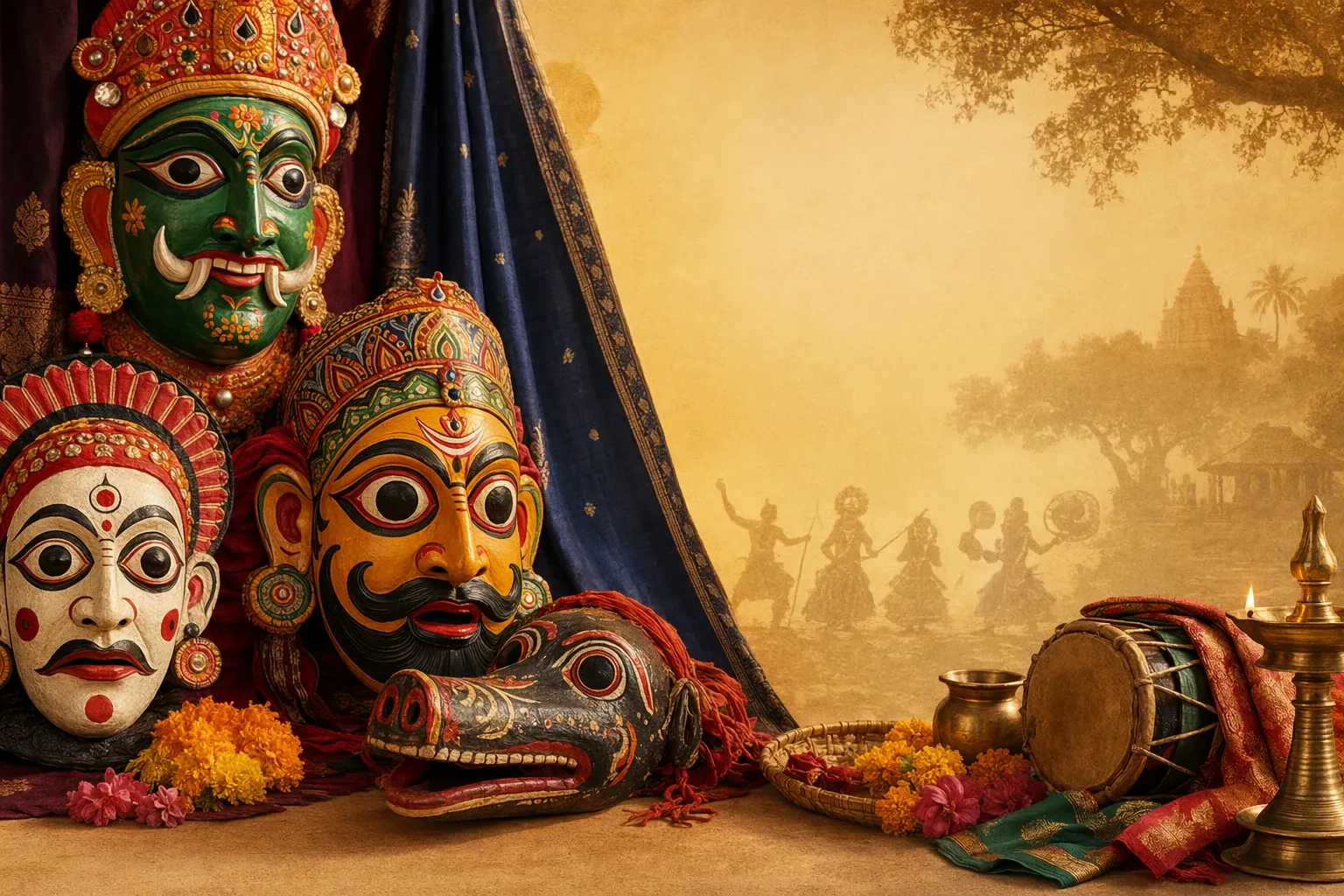
An Indian ritual mask is not simply a face-covering. In many traditions, it helps a performer become visible as a character, deity, ancestor, animal, spirit, hero, demon, or comic figure. Sometimes the mask is worn on the face. Sometimes the “mask” is part of a larger transformation made through headgear, paint, costume, ornaments, and movement. The point is not only to hide the wearer. The point is to make another presence readable to the community.
This is why masks can feel powerful in Indian cultural life. They stand at the meeting point of worship, theatre, dance, craft, storytelling, and public memory. A mask may appear in a temple festival, a village performance, a martial dance, an annual procession, a children’s Onam celebration, a museum case, or a household wall. But its meaning changes with context. A sacred mask in a ritual space is not the same as a decorative mask sold to visitors.
Sacred presence in festival space
In ritual settings, a mask can help mark the performer’s transition from ordinary person to sacred role. The mask does not always mean that everyone believes the object itself is divine in a simple mechanical way. Traditions differ. In some places, devotees may experience the performer as a living channel of a deity for that moment. In others, the mask is a respected performance object that helps tell a sacred story. Either way, the mask creates a boundary between everyday life and festival time.
UNESCO’s description of Ramman, the religious festival and ritual theatre of the Garhwal Himalayas, gives a useful example. The festival honours Bhumiyal Devta and includes songs and masked dances. It also mentions that specific community roles matter: one of the most sacred masks, Narasimha, is worn only by people with the traditional right to do so. This shows a key rule for beginners: masks are not just props. They may be tied to community duty, lineage, permission, and local belief.
Characters from epics and local stories
Masks are also used to make stories instantly understandable. In Chhau, an eastern Indian dance tradition, episodes can come from the Ramayana, Mahabharata, Puranic themes, local folklore, or abstract ideas. UNESCO notes three major styles: Seraikella, Purulia, and Mayurbhanj. The Seraikella and Purulia styles use masks, while Mayurbhanj is usually known without masks. This difference itself teaches us that Indian performance traditions are regional, not one-size-fits-all.
When a performer wears a mask of Rama, Ravana, Durga, Narasimha, Shiva, a bird, a lion, or a demon, the audience can recognise the role from colour, shape, expression, crown, moustache, eyes, teeth, or gesture. The mask becomes a visual shortcut, but a meaningful one. A child in the crowd may not know every verse of an epic, yet the mask helps them understand who has entered the scene and what kind of emotional energy is being shown.
Movement, music, and martial energy
A ritual mask does not work alone. It works with the whole body. Chhau is especially useful here because UNESCO describes its movement vocabulary as including mock combat, stylised movements of birds and animals, and actions inspired by village life. The mask gives the face a fixed expression, so the dancer must bring emotion through posture, jumps, turns, gait, hands, shoulders, and rhythm. The body completes what the mask begins.
This is why a still photograph can never fully explain a mask tradition. A Chhau mask in a museum may show excellent craft, but during performance it becomes part of drums, reed instruments, night air, festival gathering, dust, sweat, and collective attention. The mask is made to be seen in motion. Its large eyes, strong colours, and clear shapes help people read the character even from a distance.
Community memory and local identity
Indian ritual masks often carry a community’s memory. They help people remember stories, ancestors, festivals, seasonal cycles, local deities, and shared values. UNESCO’s Chhau description says the dance brings together people from different social backgrounds and languages. That is important. A mask performance can be a cultural meeting ground, not only an art object.
In village and temple contexts, preparations may involve craft families, musicians, priests, performers, donors, elders, children, and visitors. The mask is only one visible part of a larger network. Who makes it? Who stores it? Who has the right to wear it? When is it brought out? Which songs are sung? Which rules are followed before and after the performance? These questions are as important as the object’s design.
Entertainment does not cancel respect
Some mask traditions are playful. Kummattikali in Kerala, for example, is associated with Onam in regions such as Thrissur and Palakkad. Performers may wear colourful wooden masks of Krishna, Narada, hunters, Darika, and other figures, along with grass costumes, moving house to house and delighting children. Padayani in central Kerala brings together masks, painting, rhythm, satire, dance, theatre, and Bhadrakali temple worship. These examples remind us that sacred and entertaining elements can exist together.
Modern readers sometimes separate “religion” and “fun” too sharply. Many Indian festivals do not work like that. Laughter, music, fear, beauty, devotion, teasing, heroic stories, and community gathering may all be part of the same event. A mask can make people laugh and still belong to a respected tradition.
Decorative masks and sacred masks
Today, many masks are made for sale, tourism, wall display, school projects, and cultural exhibitions. There is nothing automatically wrong with decorative craft. Craft sales can support artisans and keep visual knowledge alive. But it is important not to confuse a market object with a sacred or performance object. A souvenir inspired by Chhau, Theyyam, Padayani, or another tradition may not carry the same ritual status as the object used by performers inside a living community practice.
A respectful viewer should ask simple questions before treating a mask casually: Is it made for performance, worship, teaching, museum display, or decoration? Is it connected to a living community? Are there restrictions around touching, wearing, photographing, or imitating it? If you do not know, it is better to be humble than overconfident.
A simple way to understand their purpose
Indian ritual masks are used to transform the performer, tell stories, mark sacred time, strengthen community memory, teach cultural values, and create powerful visual theatre. They are not only “costumes,” and they are not all “holy objects” in the same way. Their meaning depends on region, tradition, community, festival, and use.
The best way to approach them is with curiosity and respect. Look at the craft, but also listen for the songs. Notice the colours, but also ask who the character is. Admire the performance, but remember the people who carry the tradition. Then the mask stops being a mysterious object on a wall and becomes what it has often been in India: a doorway into story, devotion, art, and shared memory.
To place masks inside the wider performance world, you may also enjoy our beginner guide to Indian theatre.
For the craft and community-art side, read Indian folk art with the same respect for regional context.