
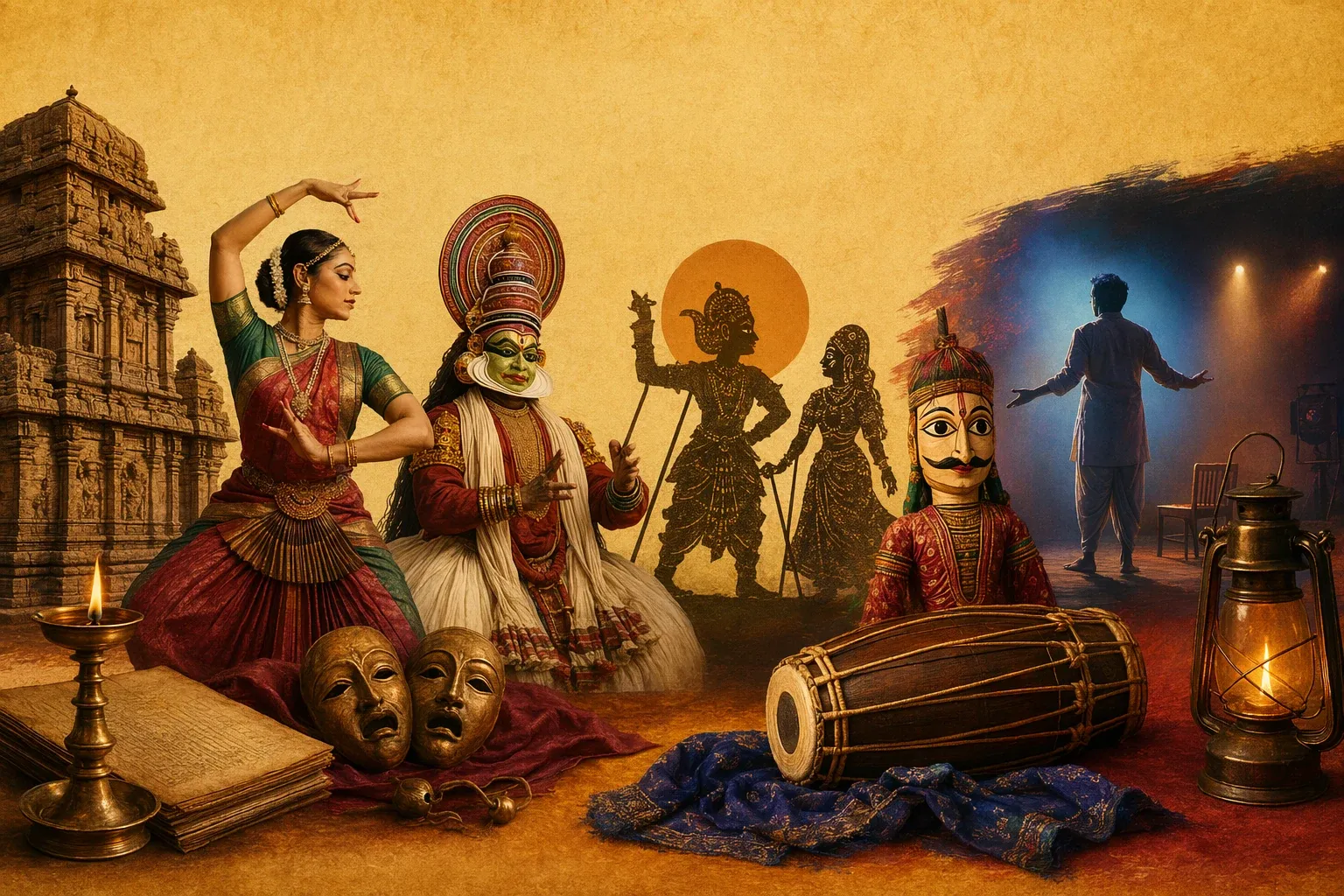
The history of Indian theatre is not a straight road with one founder, one language, and one first play. It is more like a large banyan tree. Some roots go into classical Sanskrit drama and performance theory. Some grow through temple spaces, epics, seasonal festivals, and village traditions. Some branches stretch into colonial cities, printing presses, reform movements, nationalist politics, radio, cinema, and modern experimental stages.
For useful background while reading this timeline, compare it with Natya Shastra and Indian performing arts, Ramlila performance tradition, Indian shadow puppetry, and Kuchipudi dance-drama because these traditions show how theory, epics, puppets and dance-drama kept performance alive in different settings.
For beginners, the safest way to understand this history is as a timeline of overlapping phases. These phases did not simply replace each other. Sanskrit theatre did not vanish the moment folk theatre became strong. Folk forms did not disappear when modern theatre arrived. Even today, a city may host a contemporary play in an auditorium while a nearby town stages Ramlila during Dussehra and a Kerala temple space supports Kutiyattam training.
Early performance worlds before formal theatre histories
India’s early culture included chant, ritual, dialogue, storytelling, dance, music, and public recitation. It is tempting to call all of this “theatre”, but we should be careful. A ritual dialogue or story recitation is related to drama, yet it may not be theatre in the later sense of actors performing a structured play for an audience.
What we can say with confidence is that Indian theatre grew in a cultural world that already valued voice, gesture, memory, rhythm, and story. Epics such as the Ramayana and Mahabharata became enormous reservoirs for performance. Later theatre traditions kept returning to these stories, not because artists lacked imagination, but because epic characters allowed communities to think about duty, exile, loyalty, war, kingship, family, temptation, and justice.
The classical Sanskrit drama phase
A major early phase is the world of Sanskrit drama and the Natya Shastra tradition. Indian tradition connects the Natya Shastra with Bharata Muni and treats it as a foundational work for performance. Modern scholars discuss its date and formation carefully, but its importance is clear: it presents theatre as a complex art involving acting, music, dance, emotion, costume, stage space, and audience response.
Sanskrit drama was not just a set of religious plays. It included courtly romance, heroic action, comedy, poetic beauty, and moral tension. Classical names often discussed include Bhasa, Kalidasa, Bhavabhuti, and Harsha. Kalidasa’s Abhijnanasakuntalam is especially famous because it connects epic material, poetic drama, love, memory, and recognition. These plays show how Indian theatre could be literary and performative at the same time.
Kerala’s Kutiyattam is especially useful for understanding the living afterlife of Sanskrit theatre. UNESCO calls Kutiyattam one of India’s oldest living theatrical traditions and describes its stylized language of eye expression and hand gestures. It is not a museum label; it is a demanding performance culture where actors train for many years and where a single episode may be elaborated slowly. This reminds us that “ancient theatre” can still breathe through living artists.
Temple, court, and community performance
Across Indian history, performance often depended on patronage. Temples, royal courts, landed elites, local communities, and later cultural institutions supported artists in different ways. A temple-linked performance could carry sacred meaning. A courtly performance might display refinement, poetry, and status. A village performance might bring people together around a seasonal festival or local deity.
This support was not always stable. Political change, loss of patronage, colonial policies, social reform movements, and new entertainment markets affected performers deeply. UNESCO’s note on Kutiyattam mentions the collapse of patronage with the feudal order in the nineteenth century and the difficulty faced by families who preserved acting techniques. That small detail tells a larger story: theatre survives not only because texts exist, but because performers can live, train, and teach.
Regional folk traditions from roughly medieval to early modern India
From around the second millennium onward, many regional performance traditions became powerful carriers of story and local identity. The exact dates differ by region and form, so it is better not to force one neat timeline. What matters is that performance moved strongly into local languages, marketplaces, fairs, temple festivals, and community grounds.
Ramlila is one of the clearest examples. UNESCO describes Ramlila as “Rama’s play”, a performance of the Ramayana through scenes with song, narration, recital, and dialogue, especially around Dussehra in northern India. It is linked with Tulsidas’s Ramacharitmanas, composed in the sixteenth century in a Hindi form so that the Rama story could reach a wider public. Some Ramlilas may last ten to twelve days, while Ramnagar’s tradition can extend much longer.
Other regions developed forms such as Jatra in Bengal and Odisha, Yakshagana in Karnataka and coastal regions, Tamasha in Maharashtra, Bhavai in Gujarat, Nautanki in north India, Therukoothu in Tamil areas, and Ankiya Naat in Assam. These forms differ greatly, but many share music, strong character types, colourful costume, mythological or heroic stories, satire, and direct audience connection.
Colonial cities and the modern stage
The nineteenth century brought new urban theatre cultures, especially in cities such as Calcutta, Bombay, Madras, and later many other centres. Colonial contact introduced proscenium stages, ticketed auditoriums, printed play texts, new lighting, Shakespearean influence, realism, and public theatre companies. Indian artists did not simply copy Europe. They adapted stage techniques into Indian languages and social concerns.
Parsi theatre became a major commercial force, travelling across regions with melodrama, music, romance, historical stories, and spectacular staging. Bengali theatre became connected with social reform and nationalist feeling. Marathi, Gujarati, Urdu, Hindi, Tamil, Malayalam, Kannada, and Telugu theatre cultures developed their own public voices. Plays could ask questions about widowhood, caste, education, colonial power, gender, religious reform, and national identity.
Twentieth-century theatre and public questions
In the twentieth century, Indian theatre became increasingly connected with politics, social change, and experimentation. The Indian People’s Theatre Association, formed in the 1940s, is often remembered for people’s theatre, anti-fascist and anti-colonial energy, songs, and performances connected with workers, peasants, famine, and social justice. After independence, theatre groups continued to explore realism, folk revival, absurdism, regional identity, and street performance.
Important modern figures include Ebrahim Alkazi, Habib Tanvir, Vijay Tendulkar, Badal Sircar, Girish Karnad, Utpal Dutt, Mohan Rakesh, B.V. Karanth, Safdar Hashmi, and many others. They did not all do the same kind of theatre. Some worked with institutions and actor training. Some created plays rooted in history and mythology. Some used street performance. Some mixed folk forms with modern questions. Together, they show that modern Indian theatre is a conversation, not a single style.
Indian theatre today
Today Indian theatre exists in many spaces at once. There are large festivals, intimate studio performances, college theatre, children’s theatre, community productions, amateur groups, professional troupes, experimental plays, stand-up influenced performance, multilingual productions, and online documentation. Cinema and streaming have changed audience habits, but they have not made theatre irrelevant.
Theatre continues because it offers something direct. A performer stands in front of people and creates a world without the safety net of editing. In a country with so many languages and local memories, that directness matters. It allows a small group to keep a dialect alive, retell a myth from a new angle, question social injustice, or simply give a neighbourhood an evening of laughter.
A simple timeline to remember
Think of Indian theatre history in six overlapping movements. First, early performance culture: ritual, dialogue, storytelling, music, and epic memory. Second, classical Sanskrit drama and performance theory. Third, temple, court, and community patronage. Fourth, regional folk and devotional forms in local languages. Fifth, colonial-era urban theatre with proscenium stages, printed plays, commercial companies, and reform debates. Sixth, modern and contemporary theatre, including political theatre, experimental work, street performance, festivals, and revived traditional forms.
This timeline is simple, not complete. But it protects us from two common mistakes: imagining Indian theatre as only ancient Sanskrit drama, or imagining it as only modern auditorium plays. Its real history is older, wider, and more alive than either picture.
FAQs
When did Indian theatre begin?
There is no single agreed beginning. Early Indian culture had ritual, dialogue, storytelling, and performance, while formal Sanskrit drama and theatre theory developed in ancient India. Regional and folk traditions grew across later centuries, often in local languages and festival settings.
Who invented theatre in India?
Indian tradition honours Bharata Muni in connection with the Natya Shastra, but theatre in India was not invented by one person in a modern sense. It developed through texts, performers, communities, patrons, regions, and centuries of practice.