
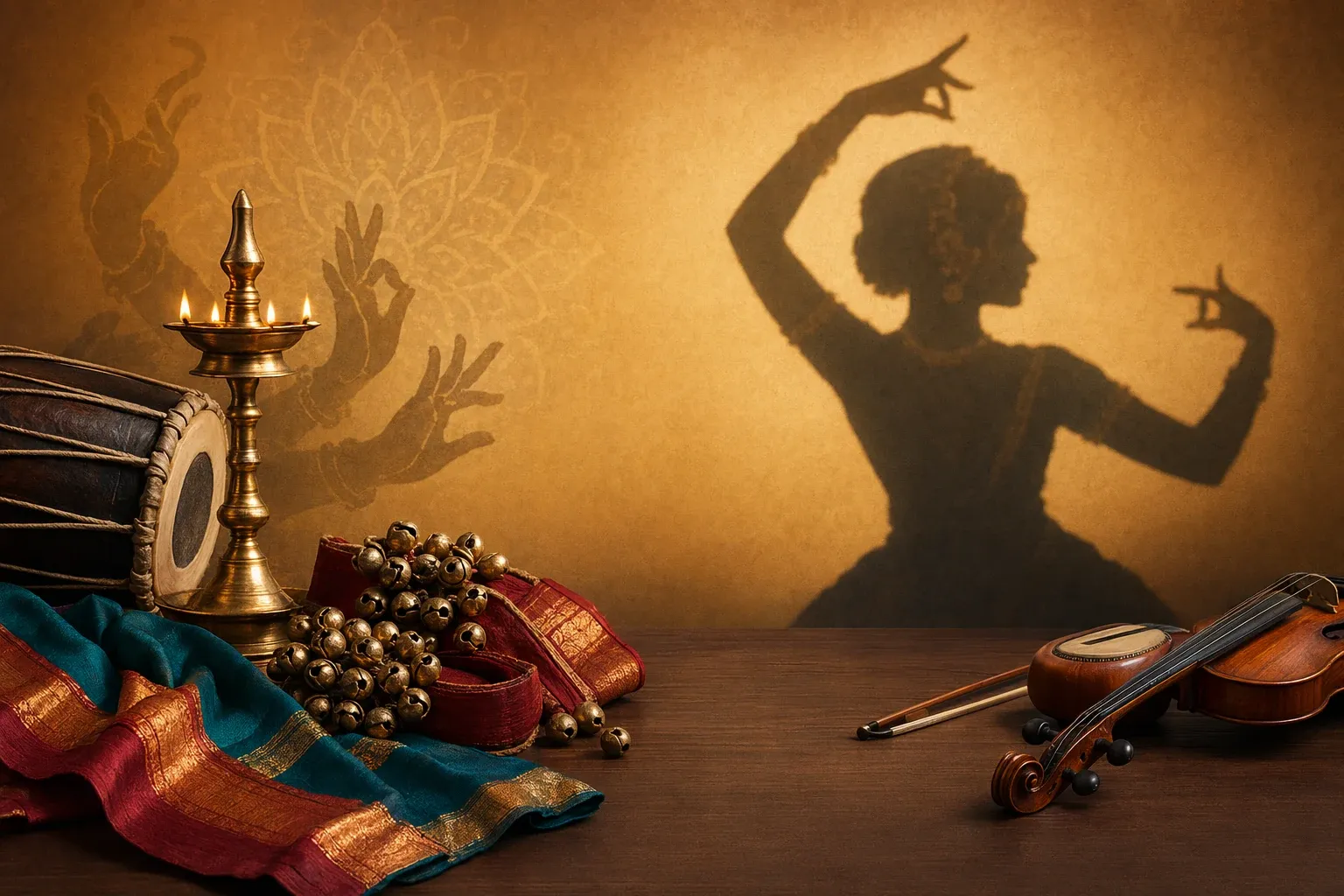
Kuchipudi is one of India’s major classical dance traditions, but for a beginner it is easiest to meet it as a lively conversation between dance, music, theatre, and devotion. A dancer does not only move to rhythm. They become a character, show emotion through the face and eyes, mark beats with the feet, and respond to songs and spoken passages. That is why Kuchipudi is often described as a dance-drama tradition.
The form is associated with Andhra Pradesh and takes its name from Kuchipudi, a village in the Krishna region. Older performance traditions connected it with travelling male troupes, temple-linked storytelling, and dramatic works about Krishna and other sacred themes. Today, Kuchipudi is performed by women and men, in solo recitals and group productions, on local stages and international platforms. The setting has changed, but the core feeling remains: movement is joined with story.
If you are comparing Kuchipudi with the wider tradition, start with Indian Classical Dance, then see the eight classical dance forms of India. For visual details like costume, makeup, and ankle bells, read Indian classical dance costumes and ghungroos.
Where Kuchipudi comes from
The place-name matters because Kuchipudi grew from a living regional culture, not from a textbook category. Telugu language, Carnatic music, devotional poetry, village performance, and classical stage discipline all shaped the form. Many accounts connect its development with Siddhendra Yogi and the famous dance-drama Bhama Kalapam, which centres on Satyabhama, a proud and emotionally rich character from Krishna tradition. For beginners, this history explains why Kuchipudi often feels theatrical: the dancer may suggest a whole scene, not just a pattern of steps.
Like other Indian classical dances, Kuchipudi uses ideas from the broader performance vocabulary of nritta, nritya, and natya. Nritta is pure dance: rhythm, geometry, and footwork. Nritya is expressive dance: gesture and emotion joined to meaning. Natya is dramatic presentation: story, character, mood, and staged action. Kuchipudi becomes especially interesting when these three are woven together.
Why it is called dance-drama
A Kuchipudi performance can include song, rhythm, mime, dramatic entry, and sometimes spoken dialogue. The dancer may show a heroine waiting for Krishna, a child Krishna stealing butter, a proud queen softening into devotion, or a devotee speaking to Shiva or Vishnu. The body becomes a storytelling instrument. A hand gesture can point to a river, a flower, a crown, or a flute. A glance can show shyness, anger, humour, wonder, or surrender.
This dramatic quality does not mean every piece is a full play. Modern recitals often include short items that focus on rhythm or expression. Still, even a solo item can feel like theatre because the performer shifts between narrator, character, and dancer. When you watch, notice how quickly the face changes. A raised eyebrow, a half-smile, or a sudden stillness can carry as much meaning as a fast sequence of steps.
Movement, rhythm, and expression
Kuchipudi is known for bright energy, graceful curves, quick footwork, and fluid transitions. The dancer’s feet mark rhythm with ankle bells, while the hands and eyes shape the meaning of the song. The torso is not stiff; it has buoyancy and flow. Beginners sometimes expect classical dance to be slow or purely formal, but Kuchipudi can be playful, brisk, and sparkling.
Expression, called abhinaya, is central. The dancer uses the eyes, eyebrows, neck, hands, and posture to communicate feeling. A beginner does not need to memorise every gesture at first. Start by asking: Who is speaking? To whom? What emotion is changing? Is the dancer describing a scene, becoming a character, or showing devotion? These questions make the performance easier to follow.
Music and practice basics
Kuchipudi is usually accompanied by Carnatic music. A performance may include a vocalist, mridangam, violin, flute, cymbals, and other support depending on the production. Many compositions are in Telugu or Sanskrit, so a new viewer may not understand every word. That is normal. Listen for the repeated line, the rising speed, the drum patterns, and the way the dancer answers the music with footwork or expression.
For students, practice begins with posture, basic steps, rhythm counting, hand gestures, and eye movement. A good teacher also builds stamina and safety: warm the feet and knees, practise on a suitable surface, and avoid forcing dramatic poses before the body is ready. Beginners should not rush into showy items. Clean rhythm, balance, and clarity of expression matter more than speed.
If you are looking for music for home practice, choose recordings recommended by your teacher rather than random fast tracks. A beginner may need slow tempo practice pieces, clear beat cycles, and familiar compositions. Performance albums are useful for listening, but they may not always be ideal for drilling basics. If you do not have a teacher yet, listen widely to Kuchipudi recitals and Carnatic vocal music to train your ear before trying to copy movements.
Costume, stage presence, and the Tarangam
The Kuchipudi costume is designed to support movement and visual storytelling. It often includes pleated fabric that opens during bends and steps, jewellery, makeup that highlights the eyes, and ankle bells that make rhythm audible. Costume is not decoration alone; it helps the audience read the dancer’s lines, turns, and expressions from a distance.
One famous Kuchipudi feature is the Tarangam, in which a dancer may perform rhythmic patterns while balancing on the rim of a brass plate. This is often exciting for audiences, but it should be understood as an advanced element, not the whole identity of the form. The real foundation remains training: rhythm, balance, expression, music, and storytelling discipline.
How to watch Kuchipudi as a beginner
Before watching a recital, read the short programme note if one is available. It will usually name the item, composer, language, deity or character, and mood. During the performance, follow the opening invocation, then watch how pure dance and expressive passages alternate. In a rhythmic section, enjoy the patterns of feet and drum. In an expressive section, look at the eyes and hands.
It also helps to avoid comparing Kuchipudi too quickly with Bharatanatyam, Kathak, Odissi, or other classical forms. Each has its own grammar and history. Kuchipudi’s charm often lies in its theatrical ease: it can move from devotion to humour, from crisp rhythm to lyrical acting, from group drama to intimate solo expression.
FAQs
What is Kuchipudi dance?
Kuchipudi is an Indian classical dance form from Andhra Pradesh. It combines pure dance, expressive gesture, music, and dramatic storytelling. Traditional themes often draw from Hindu devotional literature, especially Krishna stories, but modern performances may present many kinds of compositions.
Is Kuchipudi good for beginners?
Yes, if learnt gradually with a trained teacher. Beginners can start with posture, basic steps, rhythm, simple hand gestures, and listening practice. The advanced dramatic and balancing elements should come later, after the body and musical understanding are ready.
What music is used for Kuchipudi practice?
Kuchipudi is generally set to Carnatic music, often with Telugu or Sanskrit lyrics. For practice, students should use teacher-recommended tracks with a clear tempo. Listening to full recitals is also helpful because it trains the ear to recognise rhythm, melody, and expressive pauses.
What should I notice in my first Kuchipudi performance?
Notice the footwork, the ankle-bell rhythm, the expressive eyes, the hand gestures, and the way the dancer shifts between narrator and character. Even if you do not understand the language of the song, the emotional shape of the scene can still be clear.