
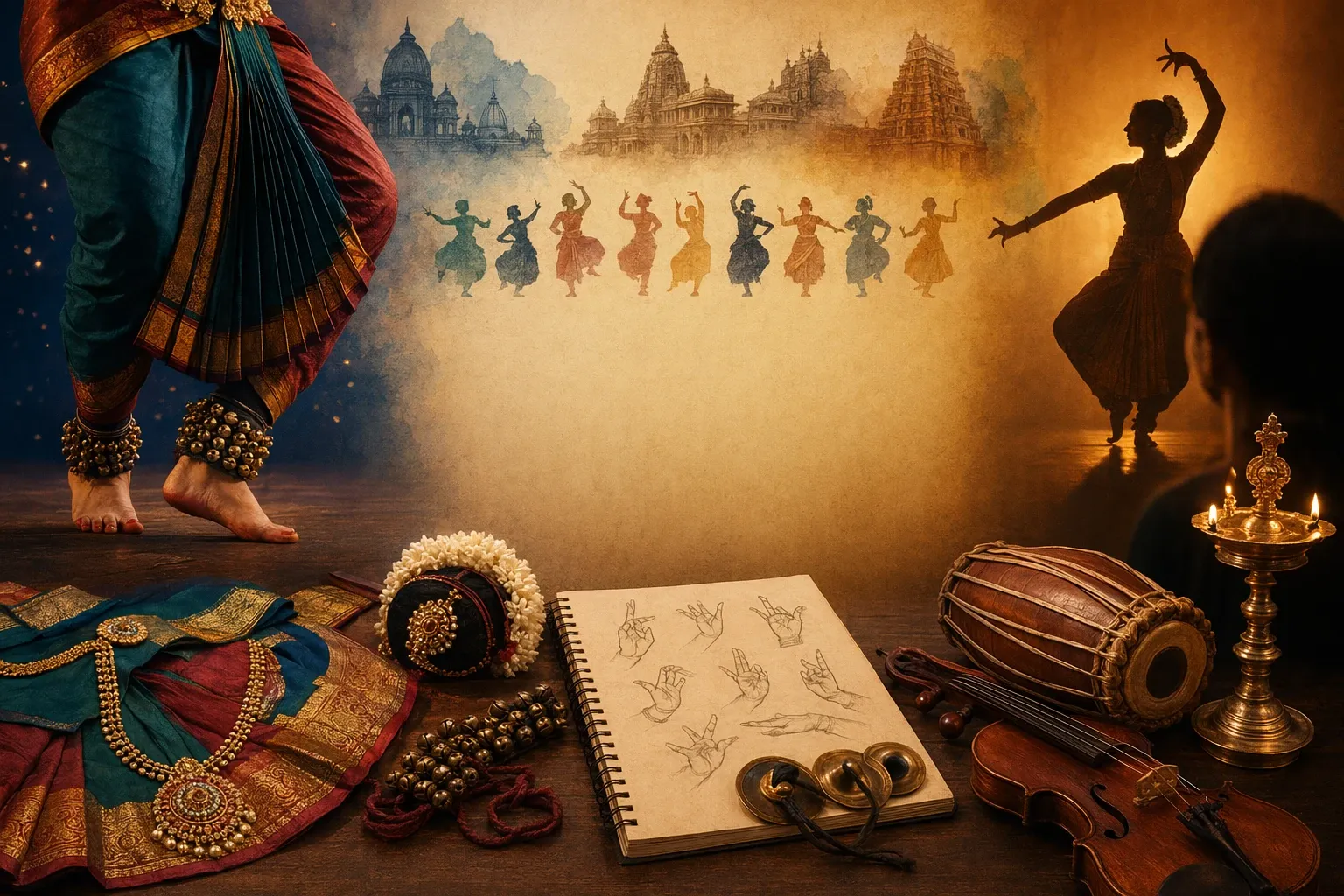
Indian classical dance is one of the most beautiful ways India tells stories without needing a long explanation. A dancer can show a river, a bird, a king, a child, a devotee, anger, shyness, courage, and surrender through eyes, hands, feet, rhythm, and expression. For beginners, it may look complex at first, but the basic idea is simple: the body becomes a language.
These dance traditions are not only stage performances. They carry memory from temples, courts, devotional poetry, music, regional cultures, gurus, and disciplined practice. They combine art, emotion, storytelling, philosophy, and physical training.
The major classical dance forms
India has several recognised classical dance forms, commonly including Bharatanatyam, Kathak, Odissi, Kuchipudi, Kathakali, Manipuri, Mohiniyattam, and Sattriya. Each form has its own history, costume, movement style, music connection, and regional identity.
To understand the sound world behind many performances, pair this with our Indian classical music beginner guide. For a wider cultural lens, see how folk music and dance shape Indian heritage.
Bharatanatyam is strongly associated with Tamil Nadu and is known for clear lines, expressive abhinaya, and powerful footwork. Kathak, associated with North India, is famous for spins, rhythmic footwork, storytelling, and courtly as well as devotional influences. Odissi from Odisha has graceful curves and temple roots. Kuchipudi from Andhra Pradesh blends dance and drama. Kathakali from Kerala is highly theatrical, with elaborate costume and makeup.
Mudras, abhinaya, and storytelling
Mudras are hand gestures used to communicate meaning. But a mudra alone is not enough. The face, eyes, body angle, rhythm, and context complete the meaning. The same gesture may suggest different things depending on how it is used.
Abhinaya means expression or the art of carrying meaning toward the audience. Through abhinaya, a dancer may show devotion to Krishna, the longing of a nayika, the strength of Devi, the playfulness of a child, or the seriousness of a moral choice. This is where dance becomes emotional storytelling.
Rhythm, music, and training
Classical dance is deeply tied to rhythm. Footwork patterns, hand movements, and body positions must align with tala and music. A beginner may first notice costume and expression, but trained dancers spend years building balance, stamina, timing, posture, and control.
The guru-shishya relationship has been important in many traditions. Learning is not only copying steps. Students learn discipline, respect, repertoire, meaning, and how to carry a tradition without making it lifeless.
Tradition, interpretation, and history
In tradition, many classical dances are connected with sacred stories, temple culture, bhakti, and texts such as the Natya Shastra. They can be offerings, art, education, and cultural memory at the same time.
In interpretation, it is important not to flatten all dance into one “Indian dance” label. Each form has its own grammar and community. At the same time, traditions have adapted to modern stages, new audiences, and changing social realities.
Historically, these forms developed through complex journeys. Some had temple links, some court links, some devotional links, and many were reshaped during colonial and modern periods. Respecting the art means respecting both its sacred imagination and its social history.
How to watch as a beginner
Do not worry if you cannot understand every gesture. Start by noticing three things: rhythm in the feet, expression in the face, and story in the body. Ask what mood the dancer is creating. Is it devotion, heroism, playfulness, longing, anger, or peace?
Reading a short description before a performance helps. If you know the dancer is portraying Krishna lifting Govardhan or a devotee speaking to Shiva, the movements become easier to follow.
Why it still matters
Indian classical dance keeps stories alive in the body. It shows young people that tradition is not only in books; it can move, breathe, sweat, smile, and speak through silence. If you watch with patience, a performance can teach you how rhythm becomes discipline and expression becomes devotion.
Common beginner mistakes
One mistake is watching only the costume. Costumes are beautiful, but the real art is in timing, expression, control, and meaning. A dancer may spend years learning how to hold the eyes, place the foot, turn the neck, or shift from one emotion to another with grace.
Another mistake is comparing forms as if one must be “best.” Bharatanatyam, Kathak, Odissi, Kuchipudi, Kathakali, Manipuri, Mohiniyattam, and Sattriya carry different histories and aesthetics. The better question is not which is superior, but what each form is trying to express.
A simple viewing plan
Before watching a performance, read the title and theme. During the performance, notice the dancer’s eyes, hands, feet, and relationship with music. After the performance, ask what emotion stayed with you. Did the piece feel devotional, playful, heroic, romantic, or peaceful?
If you want to learn, begin with a qualified teacher and respect the basics. Classical dance is not only choreography for social media. It is a discipline of body, memory, culture, and emotion. The foundation may feel slow, but it protects the beauty of the art.
Dance as cultural memory
Classical dance also helps young viewers understand Indian stories visually. A performance may bring the Ramayana, Mahabharata, Puranas, Tamil bhakti poetry, Vaishnava padams, Shaiva devotion, or local legends onto the stage. The dancer becomes a bridge between text, music, and audience.
This is why learning even a little vocabulary makes performances richer. When you recognise a mudra, a rhythmic pattern, or a familiar story, the stage stops feeling distant. It begins to feel like a living conversation with heritage.
That conversation is the real gift. You do not need to become an expert on day one. Just learn to watch with attention, honour the teacher behind the dancer, and let the performance open a doorway into Indian aesthetics.