
Simple meaning
Indian classical music is India’s traditional art music: a disciplined way of exploring melody, rhythm, mood, and devotion through sound. It is not simply “old music,” and it is not only background music for films, temples, or ceremonies. At its heart, it is a living performance tradition where an artist learns a musical language deeply and then expresses it with care.
A beginner can start with three words: raga, tala, and listening. A raga gives the melody its personality. A tala gives rhythm a cycle and shape. Listening teaches the ear to notice mood, repetition, silence, and gradual development.
The two main traditions
Most beginners hear two big names first: Hindustani music and Carnatic music. Hindustani music is more associated with North India, while Carnatic music is more associated with South India. Both have deep roots in Indian musical thought, devotional culture, oral training, and long practice.
They are not rival teams. They are two rich streams of one wider Indian classical heritage. Their concert styles, compositions, ornamentation, languages, and instruments can differ, but both value raga, tala, disciplined learning, improvisation, and the relationship between teacher and student.
Raga, tala, swara, and laya
Raga is often explained as a melodic framework, but that can sound too dry. A raga is closer to a musical personality. It has important notes, preferred movements, characteristic phrases, and a mood that the artist slowly reveals.
Tala is the rhythmic cycle. Swara means musical note, and laya means flow or tempo. Together, these ideas help the music feel structured without becoming mechanical. In Indian classical music, rhythm is not just a beat in the background; it becomes a living conversation with melody. You can read more in our beginner guide to taal, swara, and laya.
Why improvisation matters
One reason Indian classical music can feel different from a fixed song is improvisation. The artist may begin slowly, explore the raga, repeat certain phrases, build tension, and then move into faster or more rhythmic sections. The performance grows in front of the listener.
This does not mean the artist is doing anything random. The freedom comes after years of training. A good performer respects the grammar of the raga while still bringing personal imagination, emotion, and timing into the moment. That balance of rule and freedom is one of the tradition’s great beauties.
How it differs from film or pop music
Film songs and pop songs usually give the listener a compact composition with a memorable hook, fixed lyrics, and a clear beginning and ending. Indian classical music may ask for more patience. A performance can be slow, spacious, and exploratory before it becomes energetic.
That does not make one form superior to another. India’s music culture is wide enough for classical concerts, bhajans, folk songs, film music, devotional music, and independent music. Classical music simply trains the listener to hear smaller details: how a note bends, how a phrase returns, how rhythm circles back, and how mood deepens over time.
The guru-shishya spirit
Traditionally, Indian classical music is learned through the guru-shishya relationship: teacher and student, guidance and practice, correction and humility. Books and videos can help a beginner, but the tradition itself values listening, imitation, repetition, and patient correction.
This is why words like riyaz or sadhana often appear around classical music. Riyaz means regular practice. Sadhana suggests disciplined effort with devotion. Even when the music is performed on a modern stage or shared online, that inner discipline remains important.
Common instruments and voices
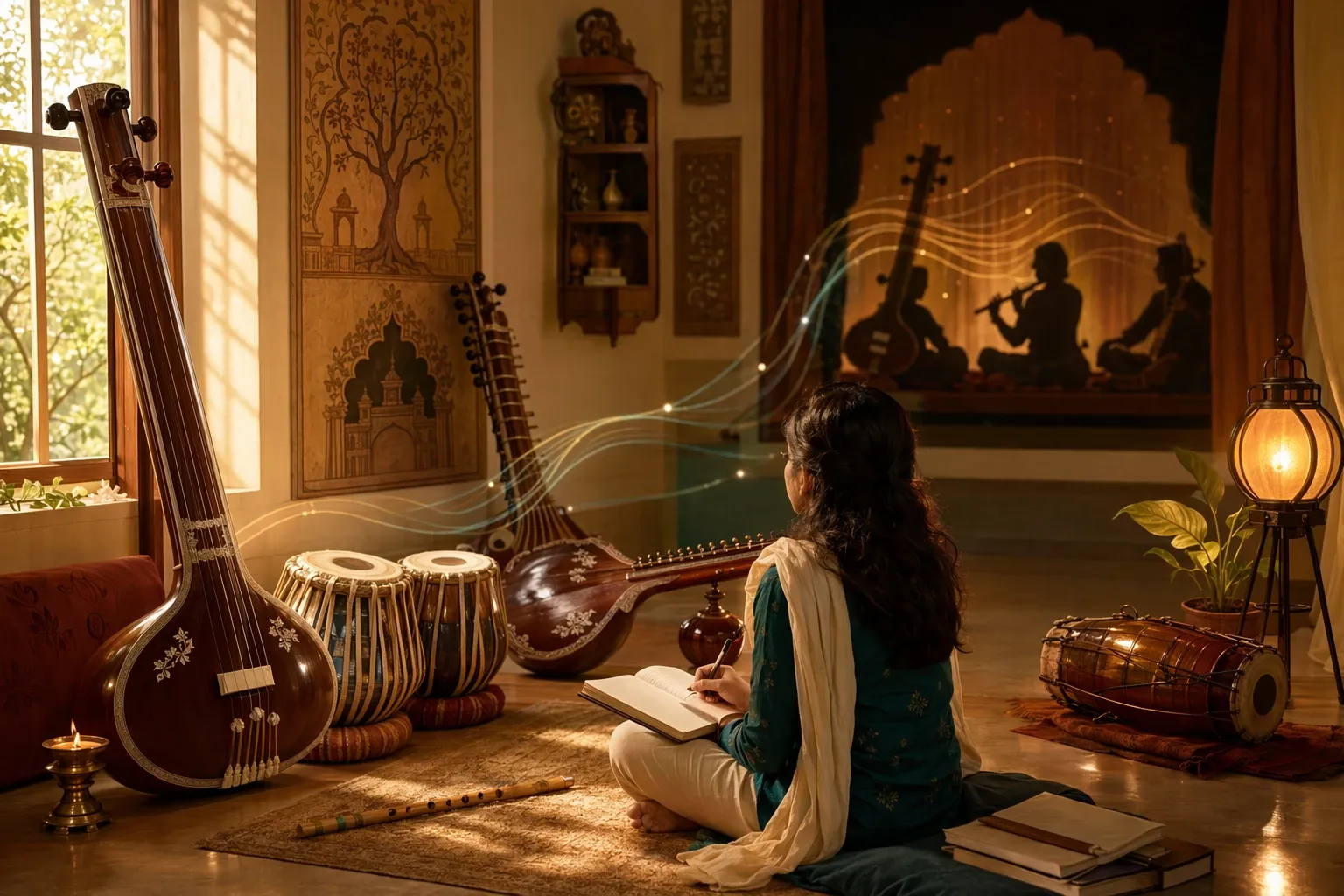
Indian classical music is not limited to one sound. In Hindustani music, listeners may hear voice, sitar, sarod, bansuri, shehnai, sarangi, tabla, pakhawaj, and tanpura. In Carnatic music, voice, violin, veena, flute, mridangam, ghatam, kanjira, and tanpura are common.
The tanpura drone is especially helpful for beginners because it creates a steady sound-space around the performance. Melody instruments and singers move inside that space, while percussion instruments bring rhythmic life. If you want a simple overview, start with our guide to Indian classical music instruments.
How to start listening
Do not try to understand everything in one sitting. Choose one short performance by a respected artist and listen for mood first. Does it feel peaceful, devotional, serious, playful, bright, or meditative? Then listen again and notice the drone, the main melody, the rhythm, and repeated phrases.
It also helps to read a little context before listening, but not so much that listening becomes homework. Know the artist, the tradition, and the raga name if available. Then let the sound teach you. Over time, repeated listening builds familiarity more naturally than memorising definitions.
After that, compare one Hindustani performance and one Carnatic performance. Notice how both are Indian classical music, yet their sound-worlds are different. This approach makes the tradition less intimidating and more enjoyable for young listeners.
Why it still matters
Indian classical music matters because it carries memory, discipline, beauty, and cultural confidence. It connects temples, courts, homes, radio, films, festivals, teachers, students, and modern digital audiences. It teaches that art can be both ancient and alive.
It also gives young listeners a different relationship with time. In a world of short clips and instant scrolling, a raga performance asks the listener to slow down. That slowness is not boring when you know what to notice: the returning note, the drone, the rhythmic cycle, the artist’s patience, and the feeling that slowly gathers.
For Bhaktilipi readers, the simplest takeaway is this: Indian classical music is not a museum object. It is a living Indian knowledge-and-art tradition. Enter it slowly, listen with respect, and let curiosity grow one layer at a time.