
Simple answer
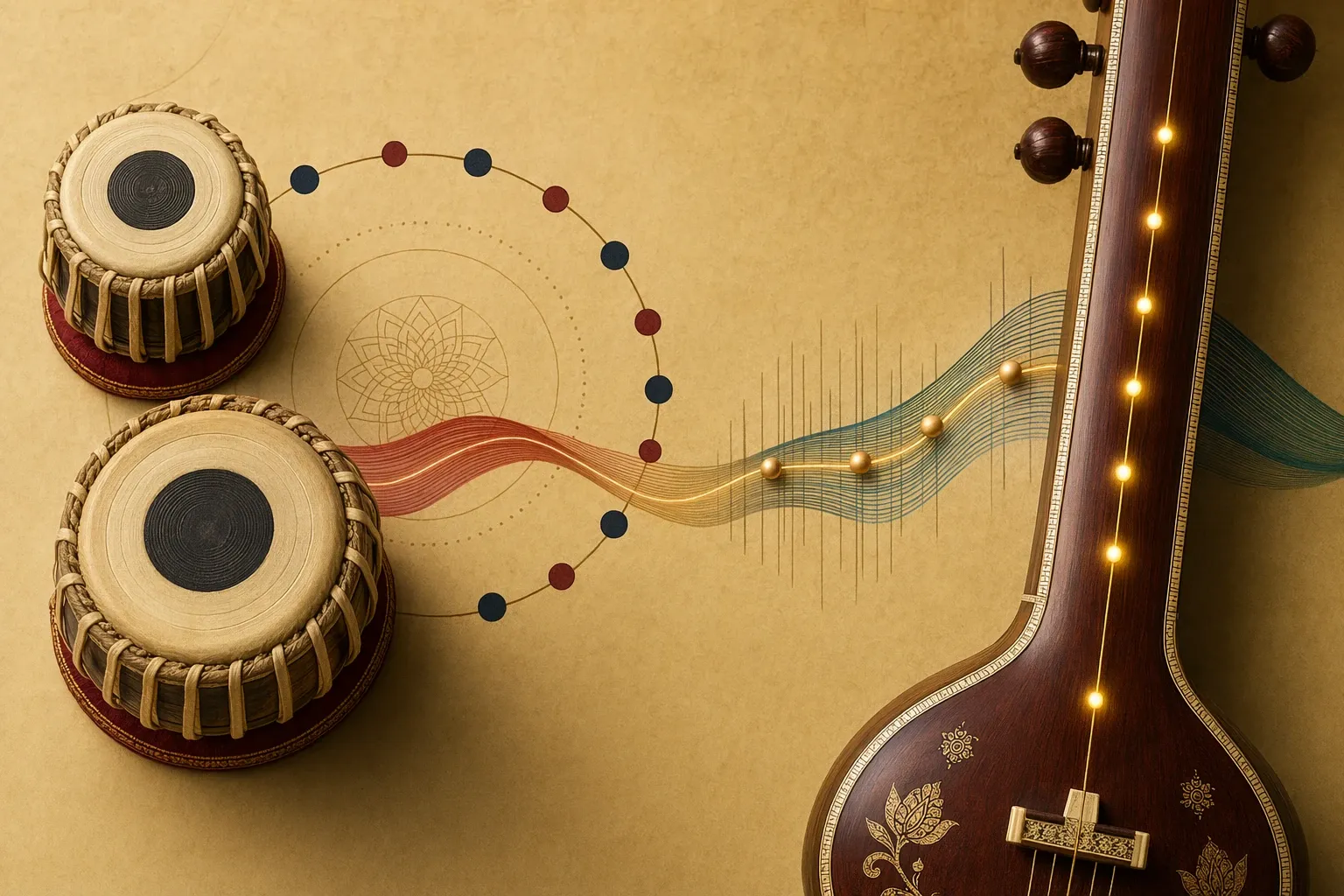
Swara means musical note, laya means tempo or flow, and taal means rhythmic cycle. These three ideas help Indian classical music stay both structured and alive.
If raga is the melodic personality, then swara gives its notes, laya gives its movement, and taal gives its rhythmic shape.
Swara: the notes
The seven basic swaras are Sa, Re, Ga, Ma, Pa, Dha, and Ni. They are often compared to Do Re Mi, but Indian music treats them with its own grammar and expression.
Sa is the main reference note, like a musical home. From there, a singer or instrumentalist learns how other swaras behave in a raga. The same swara can feel different depending on the raga and phrase.
Laya: the speed and flow
Laya means the flow of time in music. It may be slow, medium, or fast, but it is not only about speed. It is about steadiness and control.
A beginner mistake is to think faster means better. In classical music, a slow phrase sung with perfect control can be more powerful than a fast phrase without clarity.
Taal: the rhythmic cycle
Taal is a repeating cycle of beats. These beats are called matras. A common Hindustani example is teentaal, which has 16 matras grouped as 4 + 4 + 4 + 4.
Carnatic music also has rich tala structures with its own vocabulary and counting methods. The larger idea is the same: rhythm is cyclic, not just a straight line.
How tabla keeps taal
In Hindustani music, tabla often supports the taal through a pattern called theka. The tabla player does not simply “keep beat”; they converse with the main artist while respecting the cycle.
In Carnatic music, mridangam often plays a similar central rhythmic role. The percussionist helps create energy, tension, return, and joy.
A simple clap-count example
Try counting 1 to 16 slowly. Clap on 1, 5, and 13, and wave your hand on 9. This is a simple way many learners feel the divisions of teentaal.
You do not need to become a musician to enjoy this. Even basic counting helps you hear why Indian classical rhythm feels circular and satisfying when the artist returns to sam, the first beat.
Additional beginner context
The next sections add plain-language context so the article is more useful as a complete beginner guide.
A beginner-friendly way to read this
This guide is mainly about Taal, Swara, and Laya: The Rhythm Basics of Indian Classical Music. The useful way to read it is not as a final verdict, but as a beginner-friendly map: learn the key idea, notice the context, and then connect it with the wider Indian cultural world. Important terms in this article include Taal, Swara, Laya, Rhythm, Basics. The central angle is: Create a beginner-friendly vocabulary article: Sa Re Ga Ma, swara, laya, tala/taal, matra, theka, and how rhythm supports melody. Good youth-friendly explainer with clap/count examples.
Indian classical music becomes easier when beginners listen for mood before memorising theory. Raga, tala, swara, laya, instruments, voice, and improvisation are not separate exam topics; they work together in a performance. The listener slowly learns how a note returns, how rhythm cycles, and how silence creates expectation.
What to remember
It is also important to avoid turning Hindustani and Carnatic traditions into a competition. They have different histories, regions, languages, and concert styles, but both carry discipline, listening, teacher-student learning, and deep musical imagination. A young reader can respect both without needing to choose a side immediately.
A good memory trick is to connect the idea with three layers: the word itself, the lived practice around it, and the value it points toward. That method keeps the article practical for students while still respecting the tradition behind it.
The best next step is repeated listening. One short performance heard carefully is often more useful than ten definitions read quickly. Notice the drone, the main melody, the percussion, the artist’s patience, and the feeling that gathers over time.
Where to go next
For a wider base before going deeper, read our Indian classical music beginner guide. It gives the surrounding context so this article feels less isolated.
More context for careful readers
Common misunderstandings to avoid
A common mistake is to treat Taal, Swara, and Laya: The Rhythm Basics of Indian Classical Music as only one sentence or one social-media definition. In reality, Indian classical music topics usually carry many layers: language, practice, regional memory, family tradition, teacher explanation, and modern interpretation. A beginner guide should simplify the entry point, but it should not erase that depth.
Another mistake is to assume that one version explains every community. Indian traditions often travel through many regions and languages, so examples may differ. That does not make the topic confused; it means the tradition is alive and has been remembered in more than one way.
The safest reading habit is to keep the main idea clear and hold details gently. Start with what the word means, then notice where it appears, who practices or discusses it, and what value it is trying to teach. This makes Taal, Swara, and Laya: The Rhythm Basics of Indian Classical Music easier to remember without forcing a narrow answer.
Why this matters today
This topic still matters because young readers are meeting Indian culture through school, family stories, social media, travel, music, health conversations, and festival posts. Without context, the same idea can look either too mysterious or too casual. A clear explanation helps readers respect the subject without feeling lost.
For Bhaktilipi readers, the practical value is not just information. The goal is better cultural literacy: knowing enough to ask good questions, avoid lazy stereotypes, and recognise why earlier generations preserved these ideas through stories, songs, rituals, debates, art, and daily habits.
Good learning also means knowing the limits of a short article. This guide gives a reliable starting point, but deeper study can come from teachers, trusted books, temple or community elders, museums, performances, and careful reading of primary traditions where possible.
Simple takeaway
If you remember only one thing, remember this: Taal, Swara, and Laya: The Rhythm Basics of Indian Classical Music becomes meaningful when the definition, the cultural setting, and the human purpose are read together. That balanced view protects the topic from both blind rejection and blind romanticisation.
Use this article as a first map. Revisit the key words, compare them with real examples, and keep learning patiently. Dharma-oriented learning is not about collecting facts quickly; it is about understanding what those facts ask us to value and practice.