
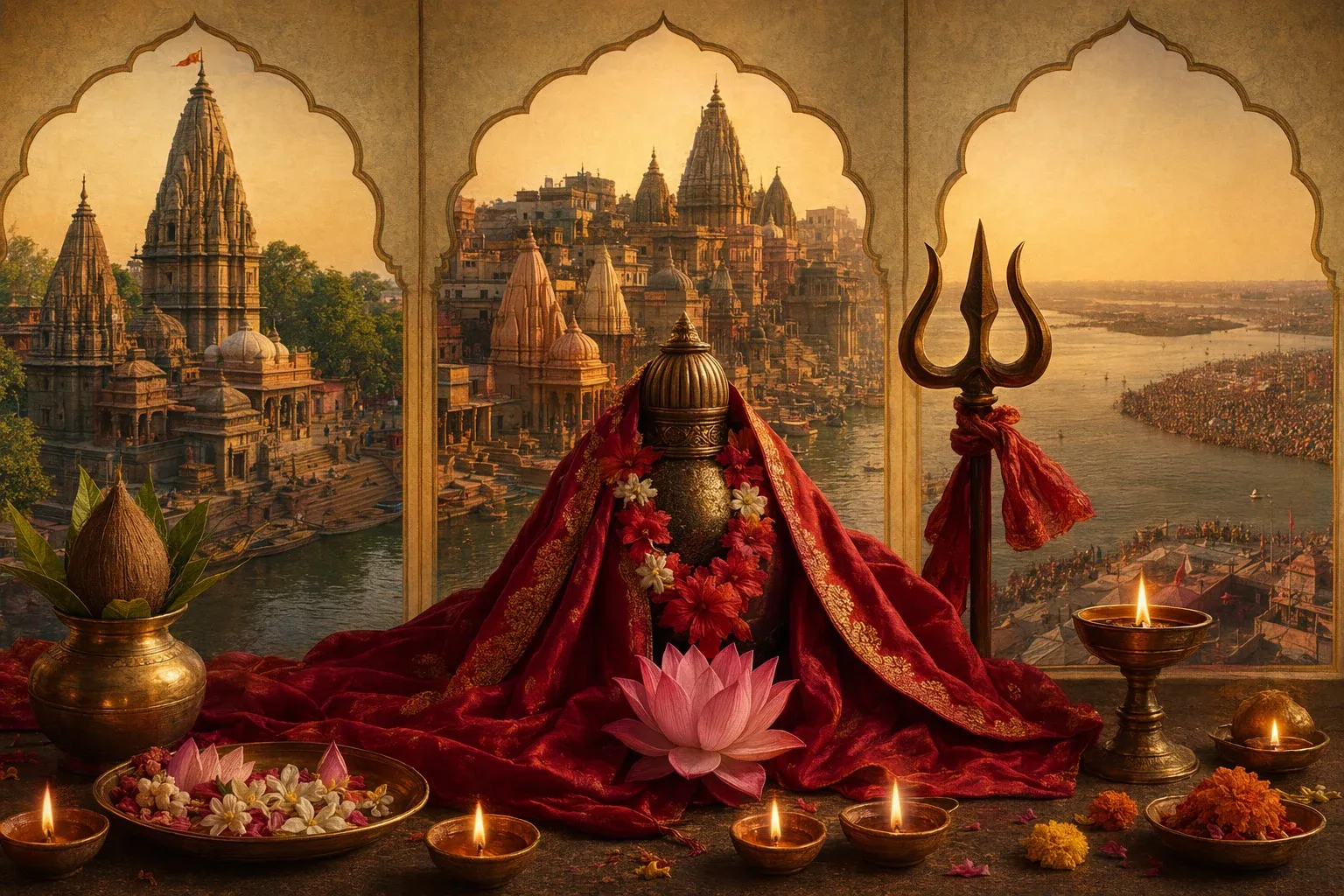
Ujjain, Kashi, and Prayagraj are not ordinary place names in Indian sacred geography. Each city carries many layers of devotion: temples, rivers, stories, festivals, local memory, and journeys made by generations of pilgrims. When readers ask about Shakti Peeth traditions in these cities, the best answer is not just a list. It is a way to understand how the worship of Devi can live inside a much larger sacred landscape.
A Shakti Peeth is usually understood as a sacred seat of the Goddess, connected in many traditions with the story of Sati and Shiva. The details vary across lists, regions, and local temple traditions. That variation is normal in Indian pilgrimage culture. A careful beginner guide should therefore use respectful language: commonly associated, remembered in some traditions, or locally revered, instead of pretending that every list is identical.
Why these three cities matter
Ujjain, Kashi, and Prayagraj are already famous tirthas, or places of sacred crossing. Ujjain is strongly associated with Mahakaleshwar, the Kumbh tradition, and many forms of Devi worship. Kashi, or Varanasi, is one of the most loved Shiva cities in India, yet it also has important Goddess traditions. Prayagraj is remembered for the sangam, ancestral rites, Kumbh, learning, and local Devi worship.
This matters because Shakti worship does not always appear separately from other forms of devotion. A pilgrim may visit a Shiva temple, a Devi shrine, a riverbank, and a local sacred site in the same journey. The city itself becomes a map of many traditions. For young readers, this is the simplest lesson: a Shakti Peeth reference tells us about Devi memory, but the full meaning of the place often includes much more.
Ujjain and the Harsiddhi tradition
In Ujjain, many devotees connect Shakti worship with Harsiddhi Mata. Harsiddhi is one of the best-known Goddess temples in the city and is often discussed when people ask about a Shakti Peeth in Ujjain. The temple’s name itself suggests fulfilment or accomplishment, and its worship sits naturally within Ujjain’s wider sacred identity.
Ujjain is also famous for Mahakaleshwar Jyotirlinga, so visitors sometimes meet Shiva and Shakti traditions together in one pilgrimage circuit. This does not mean that the categories are the same. A Jyotirlinga belongs to Shiva devotion, while a Shakti Peeth belongs to Goddess tradition. In a city like Ujjain, both can be part of the same devotional landscape without losing their own meanings.
A beginner should therefore avoid asking only, "How many Shakti Peethas are in Ujjain?" A better question is: which Goddess tradition is being referred to, which temple is locally revered, and which list or family tradition is the speaker following? That question gives a more respectful answer than a rushed number.
Kashi, Varanasi, and Vishalakshi memory
Kashi is most often remembered as a city of Shiva, especially through Kashi Vishwanath. But Kashi is also a city of the Mother Goddess. Many Shakti Peeth discussions mention Vishalakshi, commonly associated with the Varanasi sacred landscape. The name Vishalakshi means the wide-eyed or large-eyed Goddess, a form that many devotees approach with affection and reverence.
Kashi also teaches an important point about sacred cities: one place can hold many forms of worship without contradiction. The ghats, lanes, temples, and pilgrimage routes create a dense field of memory. A visitor may come for Shiva, but also meet Annapurna, Vishalakshi, Ganga, and many other forms of divine presence.
For readers comparing lists, the exact wording may differ. Some sources speak in terms of Kashi, some of Varanasi, and some connect the tradition with a particular shrine or sacred area. Instead of treating this as confusion, see it as the way living traditions preserve memory through place names, temple names, and local usage.
Prayagraj and the local Devi landscape
Prayagraj is best known for the Triveni Sangam, where the Ganga, Yamuna, and the invisible Saraswati are traditionally remembered together. Because of that, many people first think of Prayagraj as a river-pilgrimage city. But the sacred life of Prayagraj also includes temples, local Goddess worship, and Shakti-related traditions.
Readers may come across names such as Alopi Devi or Lalita Devi while learning about the Devi landscape of Prayagraj. As with other sacred cities, one should read these traditions carefully and respectfully. Some lists and local accounts may emphasise different names or associations. The important point is that Prayagraj is not only a bathing place or festival centre; it is also part of a broader world of Goddess devotion.
This is especially useful for students. If you only memorise a list, Prayagraj becomes one more name. If you understand the city, you see why Shakti memory, river sanctity, ancestral rites, and pilgrimage can all meet in one place.
How to compare lists without getting confused
Shakti Peeth lists are not always exactly the same. Some traditions count 51, some 52, and some preserve other regional or devotional lists. Names of the Goddess, Bhairava associations, body-part memories, and exact locations may vary. That does not mean the tradition is meaningless. It means sacred geography has been preserved through many communities and languages.
A good beginner method is simple. First, identify the city or region. Second, identify the Devi name used locally. Third, compare it with a trusted Shakti Peeth list while remembering that regional variation exists. Fourth, avoid making a claim sound more certain than the tradition itself allows.
This method is kinder to the subject. It also prevents arguments where none are needed. Pilgrimage traditions are not only about data; they are also about worship, memory, and how communities carry stories forward.
A simple way to remember the three cities
Remember Ujjain through Harsiddhi and the larger Mahakal city. Remember Kashi through Vishalakshi within the great sacred landscape of Varanasi. Remember Prayagraj through its river confluence, local Devi traditions, and pilgrimage memory. These short reminders do not replace detailed study, but they help beginners keep the cities clear.
The deeper point is that Shakti Peeth traditions show how India remembers sacred space. A Goddess shrine is not just a dot on a map. It belongs to stories, temple practice, regional language, festival life, and the faith of people who continue to visit. Ujjain, Kashi, and Prayagraj each show this in a different way.
So if someone asks which Shakti Peeth is in Ujjain, Kashi, or Prayagraj, answer with care. Name the commonly remembered Devi tradition, explain the city context, and leave room for variation across lists. That approach is more accurate, more respectful, and more useful than a single overconfident line.