
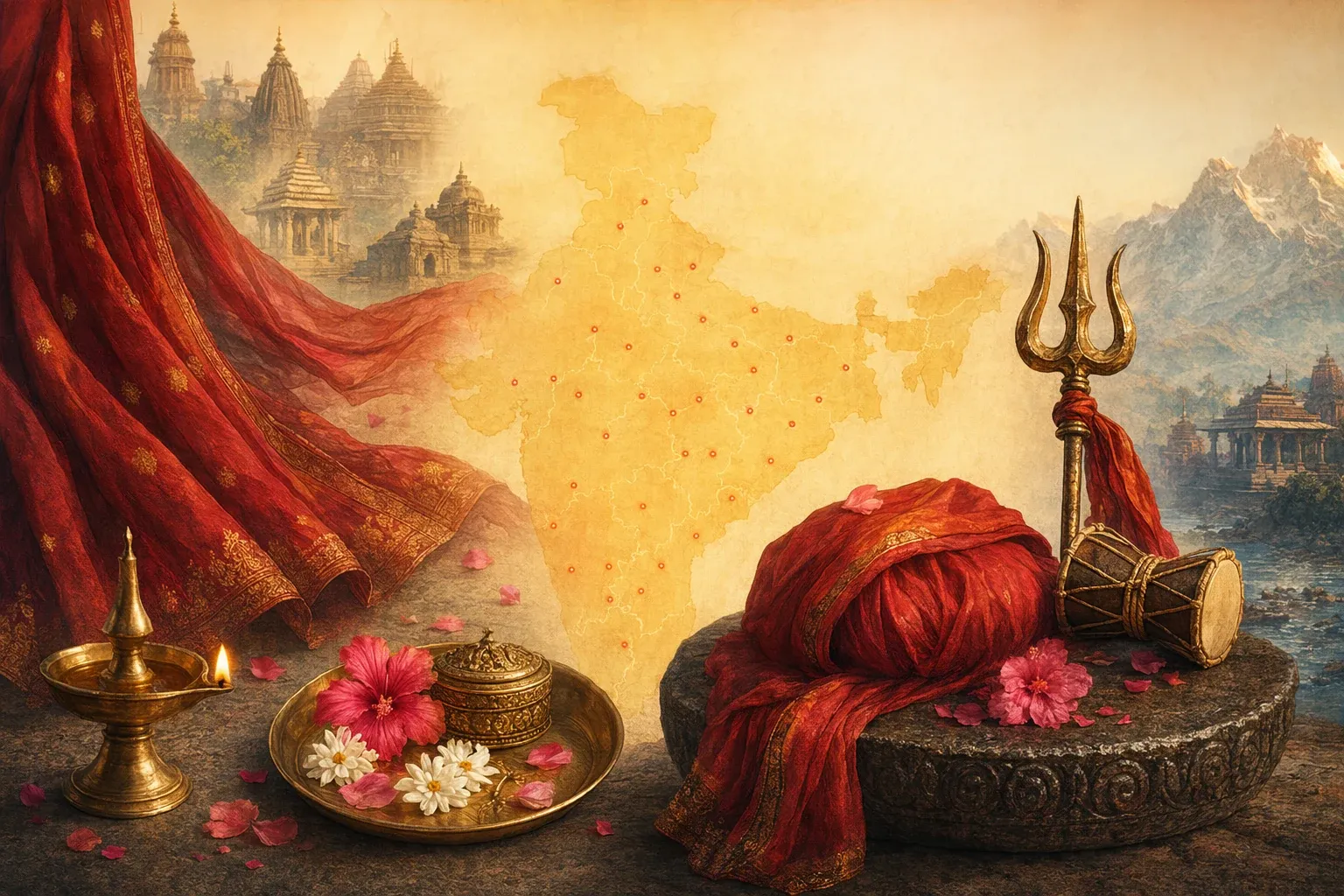
A Shakti Peeth is a sacred place connected with Devi worship, the Sati-Shiva story, and the living idea that Shakti is present across sacred geography. For beginners, the most helpful way to understand it is not as a simple tourist list, but as a devotional map where story, temple memory, local tradition, and pilgrimage come together.
Simple answer
A Shakti Peeth is a sacred place connected with Devi worship, the Sati-Shiva story, and the idea of divine feminine presence across sacred geography.
A Shakti Peeth is traditionally understood as a sacred seat of the Goddess. Many accounts connect these places with the story of Sati, Shiva’s grief, Vishnu’s intervention, and the spread of Devi’s presence across the land.
Readers may search for this topic using phrases such as shakti peeth meaning, what is 51 shakti peeth, why 51 shakti peeth, shakti peeth history. Those phrases are useful, but the real goal is to understand the meaning with context.
Why it matters
For a beginner, the main idea is sacred geography: devotion is not only in one temple or one city, but remembered through many places, languages, landscapes, and local forms of the Mother Goddess.
Lists and details vary. Some traditions speak of 51, some 52, and some 108 sacred seats. Names, body-part associations, Bhairav names, and exact locations can differ, so careful language is better than overconfident certainty.
The best-known story says that Sati, daughter of Daksha and wife of Shiva, gave up her body after being dishonoured at Daksha’s yajna. Shiva’s grief shook the cosmos, and Vishnu is said to have used the Sudarshana Chakra so that Sati’s body was separated and the sacred places emerged.
Different retellings give different details, but the heart of the story is not shock value. It is about devotion, grief, cosmic balance, and the spreading of the Goddess’s presence across many regions.
The number 51 is common in popular lists, but 52 and 108 also appear in different traditions. That is why a careful reader treats the count as a devotional map, not as a single spreadsheet with only one accepted version.
What beginners should notice
- A Shakti Peeth is a sacred seat connected with Devi worship.
- The Sati-Shiva story is a devotional explanation, not a sensational travel hook.
- Lists can vary across traditions, so humility is necessary.
- Pilgrimage should respect local temple rules and living communities.
Simple meaning of Shakti Peeth
The best-known story says that Sati, daughter of Daksha and wife of Shiva, gave up her body after being dishonoured at Daksha’s yajna. Shiva’s grief shook the cosmos, and Vishnu is said to have used the Sudarshana Chakra so that Sati’s body was separated and the sacred places emerged.
The safest beginner rule is to distinguish tradition from geography. A place can be sacred because of story, temple practice, local memory, pilgrimage, or all of these together.
When details differ between lists, it is better to say “in many traditions” or “commonly associated with” rather than forcing certainty where living traditions are diverse.
The Sati-Shiva story in brief
Different retellings give different details, but the heart of the story is not shock value. It is about devotion, grief, cosmic balance, and the spreading of the Goddess’s presence across many regions.
The safest beginner rule is to distinguish tradition from geography. A place can be sacred because of story, temple practice, local memory, pilgrimage, or all of these together.
When details differ between lists, it is better to say “in many traditions” or “commonly associated with” rather than forcing certainty where living traditions are diverse.
Why 51, 52, or 108 counts appear
The number 51 is common in popular lists, but 52 and 108 also appear in different traditions. That is why a careful reader treats the count as a devotional map, not as a single spreadsheet with only one accepted version.
The safest beginner rule is to distinguish tradition from geography. A place can be sacred because of story, temple practice, local memory, pilgrimage, or all of these together.
When details differ between lists, it is better to say “in many traditions” or “commonly associated with” rather than forcing certainty where living traditions are diverse.
How devotees understand the sacred geography
This part helps answer the reader’s main question about What Is a Shakti Peeth? Meaning, Origin Story, and Why 51 Places Are Sacred. A beginner should connect the phrase “How devotees understand the sacred geography” with meaning, lived practice, and respectful context.
The safest beginner rule is to distinguish tradition from geography. A place can be sacred because of story, temple practice, local memory, pilgrimage, or all of these together.
When details differ between lists, it is better to say “in many traditions” or “commonly associated with” rather than forcing certainty where living traditions are diverse.
Quick FAQ for beginners
This part helps answer the reader’s main question about What Is a Shakti Peeth? Meaning, Origin Story, and Why 51 Places Are Sacred. A beginner should connect the phrase “Quick FAQ for beginners” with meaning, lived practice, and respectful context.
The safest beginner rule is to distinguish tradition from geography. A place can be sacred because of story, temple practice, local memory, pilgrimage, or all of these together.
When details differ between lists, it is better to say “in many traditions” or “commonly associated with” rather than forcing certainty where living traditions are diverse.
Related reading
To understand Hindu deity symbols in a wider way, read our guide to Hindu god and goddess symbols.
For Shiva background connected with many sacred stories, see our Shiva Purana beginner guide.
Common misunderstandings
- Do not turn the Sati story into shock content.
- Do not pretend every Shakti Peeth list is identical.
- Do not use pilgrimage only as a checklist for photos.
- Do not ignore local temple customs while chasing famous names.
Simple answers to common questions
what shakti peeth
A Shakti Peeth is a sacred place connected with Devi worship, the Sati-Shiva story, and the idea of divine feminine presence across sacred geography.
why shakti peeth
For a beginner, the main idea is sacred geography: devotion is not only in one temple or one city, but remembered through many places, languages, landscapes, and local forms of the Mother Goddess.
why 51 shakti peeth
For a beginner, the main idea is sacred geography: devotion is not only in one temple or one city, but remembered through many places, languages, landscapes, and local forms of the Mother Goddess.
how 51 shakti peeth
Many popular traditions speak of 51 Shakti Peeths, but other counts such as 52 or 108 also appear. Treat the number with respect and note the tradition being followed.
what is shakti peeth
A Shakti Peeth is a sacred place connected with Devi worship, the Sati-Shiva story, and the idea of divine feminine presence across sacred geography.