
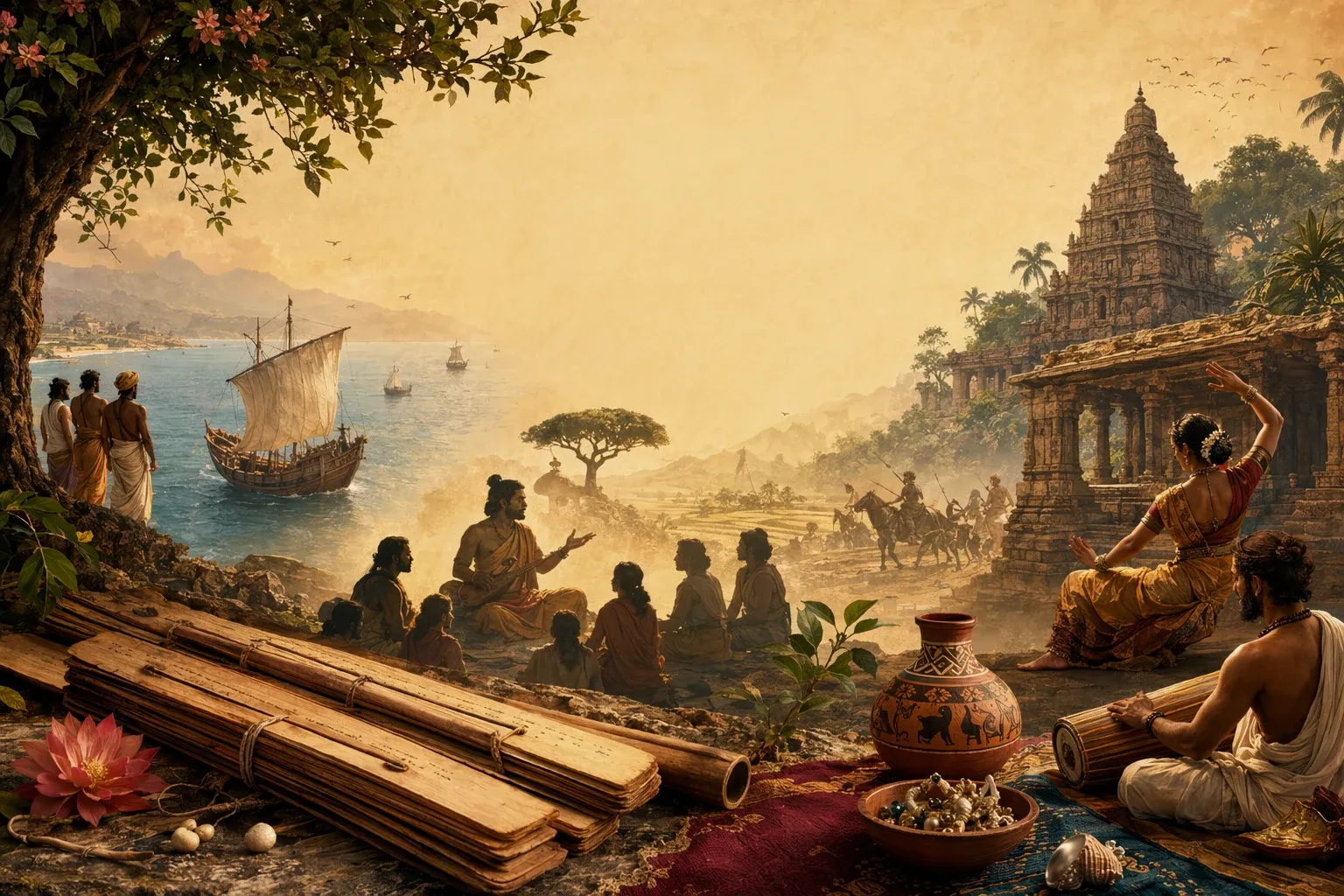
Sangam literature matters because it gives us one of the richest early literary windows into South India. It preserves ancient Tamil poems that are elegant, compressed, emotionally intelligent, and historically valuable. Through them we encounter lovers, warriors, kings, bards, mothers, merchants, farmers, fishermen, cities, ports, hills, forests, fields, and seashores. The poems are not only beautiful; they help us understand how people imagined love, honour, generosity, grief, landscape, and social duty.
For Tamil heritage, Sangam literature is foundational. It shows the depth of Tamil as a classical language and demonstrates that early Tamil society produced sophisticated poetics, ethical reflection, and literary organisation. For Indian culture more broadly, it expands the picture of ancient India beyond Sanskrit texts and northern political centres. It reminds us that the subcontinent has always contained many literary worlds.
A classical voice in Tamil
The importance of Sangam literature begins with language. These poems show Tamil in a highly developed literary form. Their diction, imagery, metres, and conventions reveal a culture that valued poetic precision. A short poem could carry layered meaning through landscape, speaker, situation, and emotional suggestion.
This matters because classical status is not only about age. It is about depth, continuity, and influence. Sangam poetry provides early evidence of Tamil’s literary power and has shaped later Tamil identity, scholarship, and artistic imagination. It remains a source of pride because it shows a language thinking deeply through its own forms.
A map of ancient society
Sangam poems are not history books in the modern sense, but they contain valuable social memory. They mention rulers, clans, warfare, patronage, trade, agriculture, cattle, ports, roads, bards, merchants, and urban life. Poems from Purananuru and the Ten Idylls are especially useful for glimpsing public life, generosity, battle, and kingship.
These details must be read carefully. Poetry uses convention and praise, so it cannot be treated as a plain report. Still, when many poems evoke patterns of life, they become important evidence. They help historians ask better questions about economy, ecology, political power, and cultural values in early South India.
Akam and puram as a literary achievement
The distinction between akam and puram is one of the great achievements of classical Tamil poetics. Akam concerns the interior world of love, longing, union, waiting, and separation. Puram concerns public life: war, fame, generosity, death, ethics, and social honour. This arrangement allowed poets to handle private and public life with remarkable subtlety.
Akam poetry avoids naming specific lovers and instead uses landscapes and situations to express emotion. Puram poetry can name kings, battles, and public acts. Together they show a society deeply aware that human life has both inner and outer dimensions. This insight remains fresh today.
Landscapes as culture
Sangam literature is famous for linking landscapes with emotions and situations. Mountains, forests, fields, seashores, and arid roads are not decorative settings. They are part of the poem’s meaning. The five landscapes, often called tinai, connect ecology, livelihood, season, deity, time, and emotional mood.
This makes Sangam poetry important for ecological imagination. It recognises that human feeling is shaped by place. A lover’s waiting by the sea differs from a dangerous journey through dry land. A secret mountain meeting differs from domestic tension in cultivated fields. The poems preserve a way of seeing land and emotion together.
Women’s voices and emotional nuance
Sangam love poems often include the voices of women, female friends, and mothers. These voices are not ornamental. They express desire, restraint, anxiety, intelligence, and social negotiation. A friend may protect the heroine’s reputation. A mother may sense hidden love. A woman may speak of longing with dignity and precision.
This emotional nuance is one reason the poems feel alive. They do not reduce love to romance alone. They show the pressures around love: family, gossip, distance, time, trust, and social expectation. The result is a literature of deep psychological insight.
Ethics, generosity, and impermanence
Sangam literature is also important for its ethical imagination. Puram poems praise generosity, courage, honour, and hospitality, while also remembering death and impermanence. A ruler is not great merely because he has power. He is great when he gives, protects, and earns worthy fame. A warrior is praised for courage, but grief is not hidden.
Some poems speak with striking philosophical force about the briefness of life. They remind readers that wealth and power pass away, while noble conduct can live in memory. This moral seriousness connects Sangam poetry with later Tamil ethical works such as Tirukkural, even though the forms differ.
A wider Indian literary history
Indian literary history is sometimes simplified into a few famous languages and texts. Sangam literature resists that simplification. It shows that early India contained multiple centres of literary excellence. Tamil poets developed their own conventions, genres, and aesthetic theories while also participating in wider cultural exchanges over time.
For students of India, this matters. It encourages a more balanced understanding of the past. The story of Indian literature is not one river but a network of rivers, each with its own source, flow, and meeting points. Sangam literature is one of the major currents.
Influence on identity and the arts
Sangam literature continues to influence Tamil identity, scholarship, public memory, music, theatre, cinema, and modern poetry. Names such as Madurai, Kaveripattinam, Chera, Chola, Pandya, kurinji, and Purananuru carry cultural resonance. The poems are quoted in discussions of language pride, regional history, ethics, and heritage.
This influence should be handled with care. Ancient poems should not be reduced to slogans. Their richness lies in complexity. They can inspire pride while also inviting patient study. Bhaktilipi’s overview of Sangam literature poems and themes offers a closer look at love, war, ethics, and daily life.
A beginner’s doorway
For newcomers, Sangam literature may seem distant because the poems require notes and context. But the effort is worthwhile. Start with translated selections from Kuruntokai for love poetry and Purananuru for public themes. Then explore the Ten Idylls and the broader list of major Sangam books and collections. Read slowly, and allow the images to work.
The importance of Sangam literature lies in its combination of beauty and evidence. It is a literary treasure, a cultural archive, a record of poetic intelligence, and a living source of Tamil heritage. It teaches us that ancient poetry can be brief without being simple, local without being narrow, and old without losing its human force.