
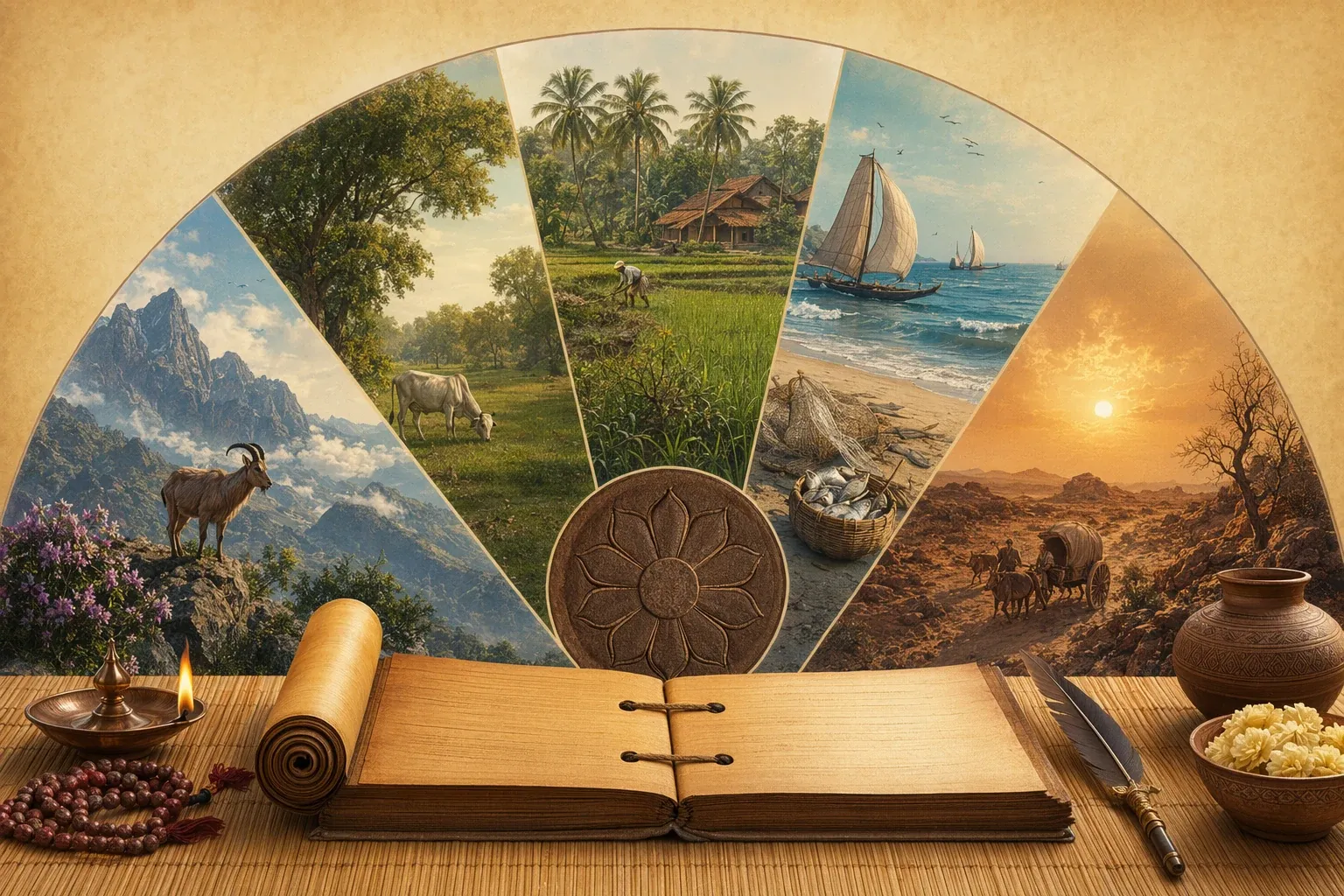
The five Sangam landscapes are kurinji, mullai, marutham, neithal, and palai. In Tamil poetics, they are more than scenery. They are part of a system called tinai, where landscape, emotion, time, season, plants, animals, people, and social situation are linked together.
This is one of the most beautiful ideas in Sangam literature. A poem does not always say, “The lovers are meeting secretly,” or “The woman is waiting anxiously.” Instead, it may show a mountain path, a forest evening, a wet field, a sea wind, or a dry road. The trained reader understands the emotional world through place.
What does tinai mean?
Tinai can be understood as a poetic category or landscape mode. It joins outer nature with inner feeling. In akam poetry, the inner world of love, each landscape is associated with a typical emotional situation. This does not mean every poem is mechanical. It means poets shared a rich symbolic language.
For beginners, think of tinai as a map of emotion. The poem’s place is not random background. The place helps carry meaning. A mountain, forest, farm, coast, or wasteland can tell us where the lovers stand in their relationship.
Kurinji: mountains and secret union
Kurinji is the mountain landscape. It is often linked with lovers’ union, secrecy, night, hill paths, waterfalls, wildflowers, and the excitement of meeting away from public eyes. The mood can feel fresh, intense, and hidden.
A kurinji poem may show hunters, mountain people, cool air, and difficult paths. These details are not just decorative. They create a world where love is adventurous, private, and full of risk. The mountain becomes a language for desire and meeting.
Mullai: forest and patient waiting
Mullai is associated with forests, pastoral life, evening, cattle, and waiting. The emotional situation often involves patience: a woman waits for her beloved to return, trusting that delay does not mean betrayal. The mood is slower than kurinji, softer, and more inward.
In mullai poems, nature may feel sheltering rather than dramatic. The waiting is not empty. It carries faith, endurance, and quiet pain. The landscape teaches readers that love includes time, not only excitement.
Marutham: fields and domestic tension
Marutham is the agricultural landscape of fields, rivers, settled villages, and daily life. It is often linked with quarrel, infidelity, teasing, complaint, and the social complications of love. Because the setting is settled, relationships are more visible to others.
A marutham poem may involve a wife, a lover, a friend, or a teasing voice that exposes hypocrisy. The field landscape suggests ordinary life, but the emotions are sharp. Love here is not only romantic; it is tangled with habit, reputation, hurt, and negotiation.
Neithal: seashore and anxious longing
Neithal is the coastal landscape. It brings the sea, boats, waves, salt wind, fisherfolk, waiting, departure, and uncertainty. The emotional mood often involves longing for someone who has gone away or may not return quickly.
The sea is powerful because it is restless. It can give livelihood, but it also separates people. A neithal poem may make the reader feel distance through sound: waves, birds, boats, and wind. The coast becomes a place where love listens for return.
Palai: dry land and dangerous separation
Palai is the dry, harsh landscape. Interestingly, it is not always a permanent desert. It can represent land made harsh by heat and season. In love poetry, palai often carries the mood of long separation, difficult journeys, danger, thirst, bandits, and endurance.
A palai poem can feel tense because travel itself becomes emotional. The beloved may be away on a hard road. The waiting person imagines risk. Love is stretched across heat, fear, and distance. The landscape becomes a test.
Why the five landscapes matter
The five landscapes show how sophisticated Sangam poetry is. Instead of separating nature and feeling, the poems make them speak together. This approach is different from simply adding a scenic description to a poem. In tinai, place is structure.
The system also preserves cultural knowledge. We see occupations, plants, animals, seasons, routes, social roles, and ways of life. Poetry becomes a memory map of ancient Tamilakam, not in the form of a textbook, but through lived scenes.
A beginner’s reading method
When you read a Sangam love poem, first look for the setting. Is it mountain, forest, field, coast, or dry road? Then ask what emotional situation fits that place. Who is speaking: the woman, the man, a friend, a mother, or another voice? What is left unsaid?
This method will make even a short poem feel larger. You will begin to notice that Sangam poets trusted readers. They did not explain every meaning. They placed clues carefully and expected sensitive listening.
For the broader background, see Bhaktilipi’s guide to Sangam literature as a whole. Once tinai is clear, many poems become easier and more moving.
Simple takeaway
The five Sangam landscapes are kurinji, mullai, marutham, neithal, and palai. Each one links a natural setting with a mood in love poetry. Tinai is the art of reading emotion through place, and it is one of the great gifts of Classical Tamil literature.
Why tinai is still memorable
Tinai remains memorable because it gives readers a humane way to look at nature. Hills, forests, fields, coasts, and dry roads are not empty scenery; they become companions to human feeling. This makes Sangam poetry feel ecological without sounding modern or forced. The poems remind us that people understand love, absence, trust, and fear through the places where they live.