
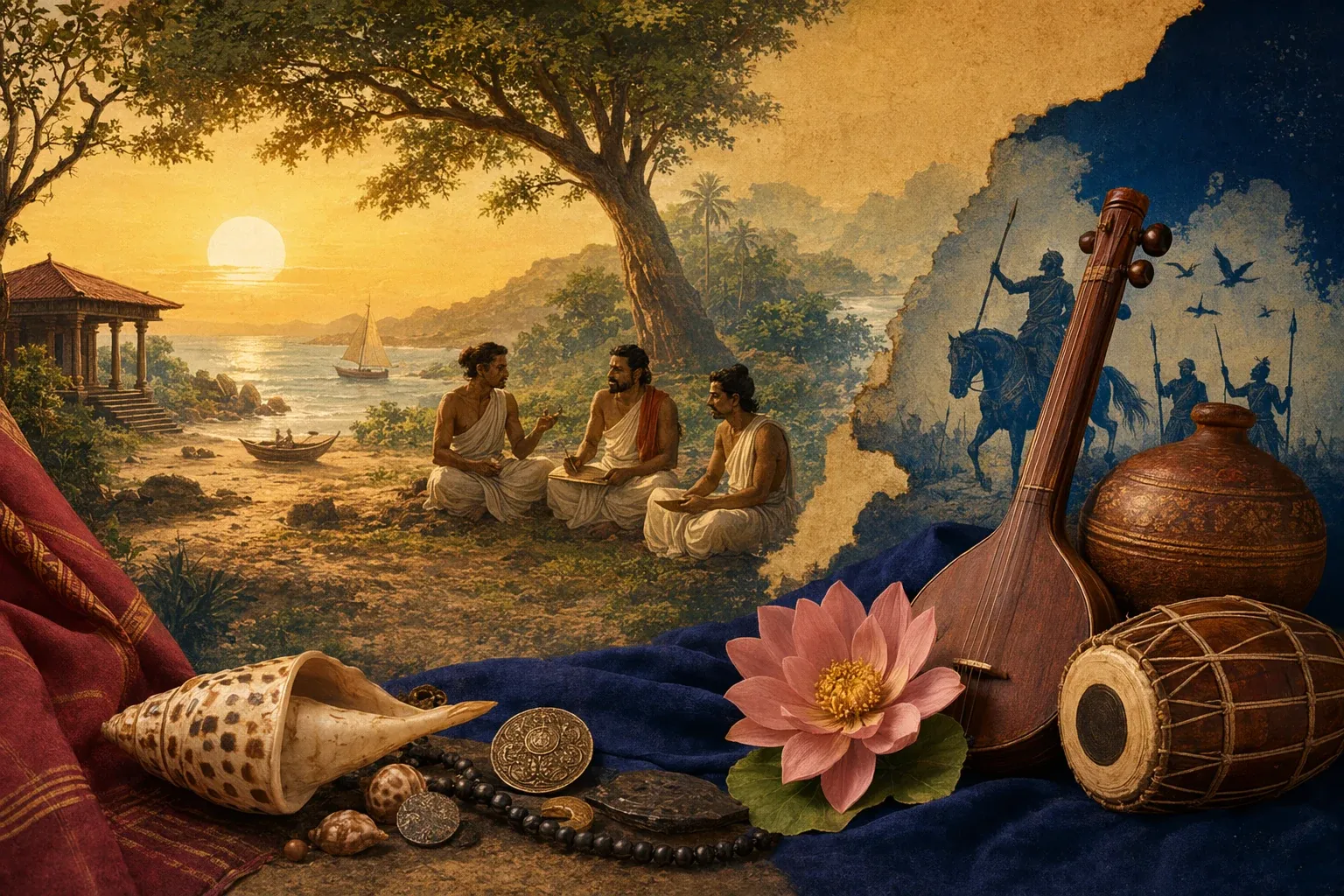
Sangam literature means the early classical Tamil poetic tradition associated with ancient Tamilakam. It is not one single book by one author. It is a large body of poems, preserved mainly in anthologies, that speaks about love, courage, kings, generosity, war, ethics, landscapes, trade, grief, waiting, and everyday human life.
For a beginner, the easiest way to understand Sangam literature is this: it is one of India’s oldest windows into Tamil language, poetry, and society. The poems are ancient, but they do not feel dead. They talk about people waiting for loved ones, praising brave warriors, watching the sea, depending on rain, honouring generosity, and living inside a world shaped by land, emotion, duty, and memory.
The simple meaning of Sangam literature
The word Sangam is usually connected with the idea of learned poetic assemblies in Tamil tradition. In a simple study sense, Sangam literature refers to the early Tamil poems and collections linked with this classical phase of Tamil literary history. These poems were composed by many poets, not by a single author, and they were later preserved, arranged, copied, studied, and interpreted across generations.
This is why Sangam literature is important both as literature and as cultural memory. As literature, it gives us beautiful poems with careful images, emotions, and social detail. As cultural memory, it shows how Tamil society remembered poets, patrons, landscapes, love, heroism, and moral values. As historical material, it gives clues about early South Indian life, though those clues must be read carefully rather than treated like a modern textbook report.
Where does Sangam literature come from?
Sangam literature is associated with ancient Tamilakam, the Tamil-speaking cultural region of early South India. Scholars usually place the core Sangam corpus roughly around the early centuries before and after the Common Era, though exact dating is debated. That caution is healthy. The point is not to force one perfect date, but to understand that these poems belong to an early and highly developed Tamil literary world.
The major collections often mentioned by students are the Ettuthokai, or Eight Anthologies, and the Pattuppattu, or Ten Idylls. The Tolkappiyam, an ancient Tamil grammar and poetics text, is also important for understanding literary conventions, especially the way poems connect emotions, landscapes, people, and situations.
Akam and puram: inner life and public life
One of the most useful keys to Sangam poetry is the distinction between akam and puram. Akam means the inner world. These poems speak about love, union, separation, waiting, longing, trust, and emotional experience. They often avoid naming specific individuals because the emotional situation matters more than public identity.
Puram means the outer or public world. These poems speak about kings, battles, honour, generosity, death, fame, ethics, warriors, bards, and public action. If akam poetry asks what a heart feels, puram poetry asks how a person acts in society. Together they show that Sangam literature is not narrow. It includes private emotion and public responsibility, tenderness and courage, nature and politics.
The five landscapes make the poetry feel alive
Sangam poetry is famous for linking human feelings with landscapes. The five well-known landscapes are kurinji, mullai, marutham, neithal, and palai. These are not only scenery. Each landscape carries a mood, way of life, emotional setting, and cluster of images.
Kurinji is connected with mountains and often with lovers’ union. Mullai suggests forest or pastoral spaces and patient waiting. Marutham is linked with fertile agricultural land and domestic situations. Neithal belongs to the seashore, where longing and uncertainty often appear. Palai represents arid hardship and difficult journeys. Through these landscapes, nature becomes part of the poem’s emotional language.
This is one reason young readers can enjoy Sangam literature. The poems do not separate human life from ecology. A hill, field, forest, coast, or dry road is not just background. It helps explain the feeling of the poem.
What do the poems tell us about ancient life?
Sangam poems can show us many things about early Tamil society: rulers and chieftains, poets and bards, warriors and lovers, farmers and traders, towns and ports, gifts and honour, grief and public reputation. But we should be careful. A poem is not a census record. It is not written like a government file. It uses image, exaggeration, convention, and emotion.
Still, repeated details across poems can help historians ask better questions. References to trade, landscapes, social roles, war, generosity, and patronage are valuable when read alongside archaeology, inscriptions, language study, and later commentaries. The best approach is respectful and careful: appreciate the poetry first, then use it as one kind of evidence, not the only evidence.
Why Sangam literature matters for Indian heritage
Sangam literature matters because it reminds us that Indian civilisation has always been multilingual and many-layered. Sanskrit, Tamil, Prakrit, Pali, and many regional languages all shaped India’s cultural story. Sangam poems show the depth of Tamil imagination and the richness of South Indian heritage within the larger Indian world.
It also matters because it makes ancient people feel human. When we read about waiting, love, grief, pride, generosity, and courage, we realise that the past was not just dates and dynasties. It was full of people with emotions, duties, fears, hopes, and relationships. That makes history less dry and literature more alive.
How students should remember it
If you are studying Sangam literature for school, remember five points. First, it is early classical Tamil literature. Second, it is preserved in major collections such as the Eight Anthologies and Ten Idylls. Third, it uses the important categories of akam and puram. Fourth, it connects poetry with landscapes like kurinji, mullai, marutham, neithal, and palai. Fifth, it helps us understand ancient Tamilakam through literature, not through modern-style reports.
That is enough for a strong beginner answer. After that, you can slowly learn names of texts, poets, themes, and examples.
What is Sangam literature in simple words?
Sangam literature is the early classical Tamil poetic tradition. It includes poems about love, war, kings, generosity, landscapes, society, and everyday life in ancient Tamilakam.
Why is Sangam literature important?
It is important because it preserves early Tamil poetry and gives valuable cultural and historical clues about ancient South India. It also shows how deeply Tamil literature connects emotion, nature, ethics, and public life.
What are akam and puram?
Akam refers to inner life, especially love and personal emotion. Puram refers to public life, including heroism, kingship, war, generosity, honour, and social duty.
Is Sangam literature useful for history?
Yes, but carefully. The poems are literary works, not modern records. They become useful historical clues when read with language study, archaeology, inscriptions, and other evidence.
For wider context, you may also enjoy Bhaktilipi’s guides to scripts and languages in ancient Indian inscriptions, South Indian inscriptions, and Sanskrit for beginners.
Related reading
For broader context on Bhaktilipi, continue with When Was Sangam Literature Composed? Age, Period, and Historical Context and The Evolution of Sadou Asom Lekhika Samaroh Samiti: Women's Voices Shape Literature.