
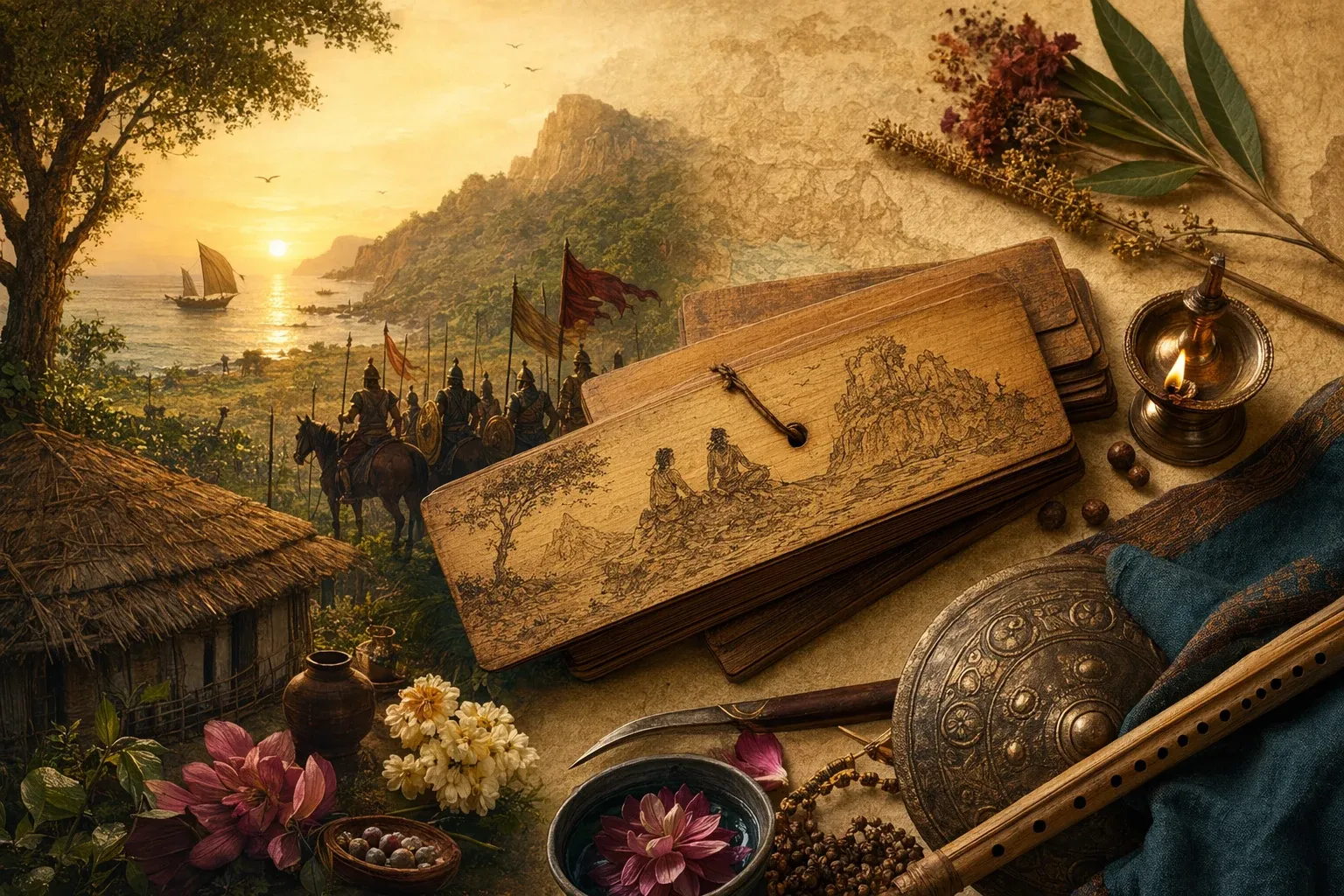
Sangam literature is famous for saying much in a small space. A poem may be only a few lines long, yet it can contain a landscape, a season, a secret meeting, a mother’s anxiety, a warrior’s death, a king’s generosity, or a thought about the fragile nature of life. Its power comes from compression. The poems do not explain everything; they trust image, voice, and convention.
The two most useful words for beginners are akam and puram. Akam means the interior domain: love, longing, union, waiting, separation, patience, anxiety, and the emotional life that is not publicly announced. Puram means the public domain: war, heroism, death, fame, generosity, ethics, kings, and the responsibilities of social life. These categories are not cages, but they help us understand how Sangam poems organise experience.
Love in landscapes
Akam poems often connect emotional situations with landscapes. The mountain region, or kurinji, is associated with lovers’ union and secret meetings. The forest or pastoral landscape, mullai, suggests patient waiting. The agricultural landscape, marutam, can be linked with domestic love, quarrel, or infidelity. The seashore, neital, often carries longing and anxious waiting. The arid landscape, palai, is associated with separation, hardship, and dangerous journeys.
This system does not make the poems mechanical. Instead, it gives them emotional shorthand. When a poem describes a lonely seashore bird, waves, salt wind, and a woman waiting, the reader understands more than scenery. Nature becomes a language for feeling. The landscape is not background; it is part of the emotional event.
Voices of women and friends
One of the remarkable features of Sangam love poetry is the range of voices. The speaker may be the heroine, her friend, the hero, the mother, or another figure within the social world of love. The friend often mediates between desire and social caution. The mother may sense that her daughter has changed. The heroine may speak directly or indirectly, revealing longing without dramatic confession.
These poems are delicate because love is shown within social boundaries. Secret love, waiting for marriage, separation caused by travel, and the tension between private feeling and public reputation all appear. The emotional intelligence is striking. A young woman’s silence, a friend’s warning, or a mother’s suspicion can carry the weight of an entire story.
War, fame, and grief
Puram poems bring a different energy. They speak of kings, warriors, cattle raids, battles, drums, spears, bardic praise, and the desire for lasting fame. Yet they are not simple celebrations of violence. Many poems recognise the cost of war. Mothers, wives, bards, and poets can speak with grief, pride, irony, or moral force.
A fallen warrior may be praised for courage, but the poem may also show the wound left behind. A king may be honoured for generosity, but the praise often implies ethical expectation: a ruler should give, protect, and act with dignity. Fame is not only personal glory; it is tied to social memory. A life becomes meaningful when remembered for courage, hospitality, and honour.
Generosity as public virtue
Sangam poetry places great value on generosity. Poets praise rulers and patrons who give without hesitation. This giving is not merely charity; it is part of the moral fabric of public life. A king’s greatness is measured by open-handedness, protection of people, and the ability to sustain artists, warriors, and guests.
Bards are important figures in this world. They travel, observe, praise, advise, and sometimes challenge. Their poetry preserves reputation. A generous ruler lives in verse; a miser risks shame. The relationship between poet and patron is therefore practical and ethical. Literature becomes a social force.
Everyday life in vivid detail
Although Sangam literature is ancient, its details can feel immediate. Poems mention fishermen, farmers, hunters, salt-makers, traders, mothers, friends, guards, messengers, dancers, musicians, and travellers. They evoke cities, ports, roads, forests, fields, mountains, and seashores. They notice flowers, animals, drums, lamps, chariots, boats, ornaments, and food.
These details matter because they prevent the poems from becoming abstract. Love happens in a village, near a field, on a path, by the sea. War changes households. Trade brings goods and strangers. A city has markets, festivals, wealth, and moral risks. The poems preserve fragments of lived experience, even when shaped by convention.
Ethics without preaching
Sangam poems often contain ethical insight, but they rarely feel like sermons. A poet may reflect on impermanence through an image of fading life. A praise poem may imply that power without generosity is empty. A love poem may show the pain caused by delay or carelessness. A battlefield poem may honour bravery while acknowledging grief.
Later Tamil works such as Tirukkural express ethics in compact couplets, but the Sangam anthologies already show a moral imagination. They ask what makes a life worthy: loyalty, courage, restraint, truthfulness, hospitality, emotional sensitivity, and awareness of mortality. These values arise from scenes rather than lectures.
Nature as emotional intelligence
The natural world in Sangam poetry is never generic. Specific flowers, birds, animals, seasons, and terrains carry emotional meaning. The kurinji flower, the heron by the shore, the hot palai road, the cool forest wait, the fertile fields of marutam: each participates in human feeling. This gives the poems ecological depth.
Modern readers sometimes separate nature writing from love poetry or political poetry. Sangam literature refuses that separation. A landscape can reveal desire, danger, patience, and social condition. This is one reason the poems still feel fresh. They understand that human life is rooted in place.
Reading selected collections
Beginners can start with Kuruntokai, Natrinai, Akananuru, and Ainkurunuru for love themes. Purananuru is essential for public themes of war, ethics, death, and generosity. Pattuppattu offers longer poems with rich descriptions of cities, roads, landscapes, and patrons. A basic guide to books of Sangam literature can help place these collections in order.
The poems are best read slowly. Do not worry if a first reading feels incomplete. Read the note, return to the image, and ask who is speaking. Is the poem public or interior? Which landscape appears? What social situation is implied? With practice, the poems open.
Why the themes still matter
Sangam literature remains important because its themes are still recognisable. People still wait for loved ones, worry about reputation, mourn the dead, praise generosity, distrust empty power, and find emotion in landscape. The poems come from an ancient Tamil world, but their human insight travels across time.
Their greatness lies in balance: love without sentimentality, war without simple triumph, ethics without heavy preaching, and everyday life without dullness. Sangam poems show that a culture can preserve profound thought in brief lyric form. They invite us to listen carefully, because in a few lines there may be a whole world.