Sangam literature is written mainly in Classical Tamil, often called Old Tamil by scholars. That simple answer is important, but it is only the beginning. These poems belong to an early layer of Tamil literary culture, where language, landscape, love, war, kingship, ethics, memory, and music come together in a compact poetic style.
If you are new to the subject, it helps to first read Bhaktilipi’s introduction to what Sangam literature means and the companion guide on when Sangam literature was composed. This article focuses only on the language question: what Tamil means here, how old it is, and why translation can never carry every shade of the original.
Classical Tamil, not a different language
Classical Tamil is not a foreign language separate from Tamil. It is an early, highly literary form of Tamil with older grammar, vocabulary, sound patterns, and poetic conventions. A modern Tamil speaker may recognise many words and cultural references, yet still need notes, commentaries, or a teacher to understand the poems fully.
That gap is normal. English readers face a similar experience with Shakespeare or Chaucer, and Sanskrit readers face it with older Vedic and classical texts. Languages change across centuries. Pronunciation shifts, grammar becomes simpler or more layered in different places, and words gather new meanings. Sangam Tamil stands close to the roots of Tamil literary expression, so it feels both familiar and distant.
What makes Sangam Tamil special
Sangam poems are famous for saying a great deal in very few lines. The language often avoids long explanations. Instead, it uses a flower, bird, season, hill path, seashore, drum, chariot, or waiting woman to reveal emotion and social setting. A short poem may suggest love, separation, public honour, poverty, generosity, grief, or courage without naming every feeling directly.
This style depends on shared cultural codes. For example, a mountain landscape may point toward secret union in love poetry, while a battlefield image may suggest public fame and heroic memory. The language is therefore not just vocabulary. It is a system of poetic signs that readers were expected to understand.
Was Sanskrit used in Sangam literature?
Sangam literature is mainly Tamil. That matters because it shows the strength of a regional literary tradition with its own grammar, themes, and artistic discipline. At the same time, ancient South India was never sealed away from other regions. Trade, religion, migration, dynastic contact, and learned exchange brought many languages into conversation over time.
Some later Tamil texts show stronger Sanskrit influence, and later commentaries may use terms from wider Indian learning. But the core Sangam corpus is valued precisely because it preserves an early Tamil voice. Its power comes from Tamil poetic craft, Tamil landscapes, Tamil social worlds, and Tamil ways of linking inner feeling with outer place.
Script and language are not the same thing
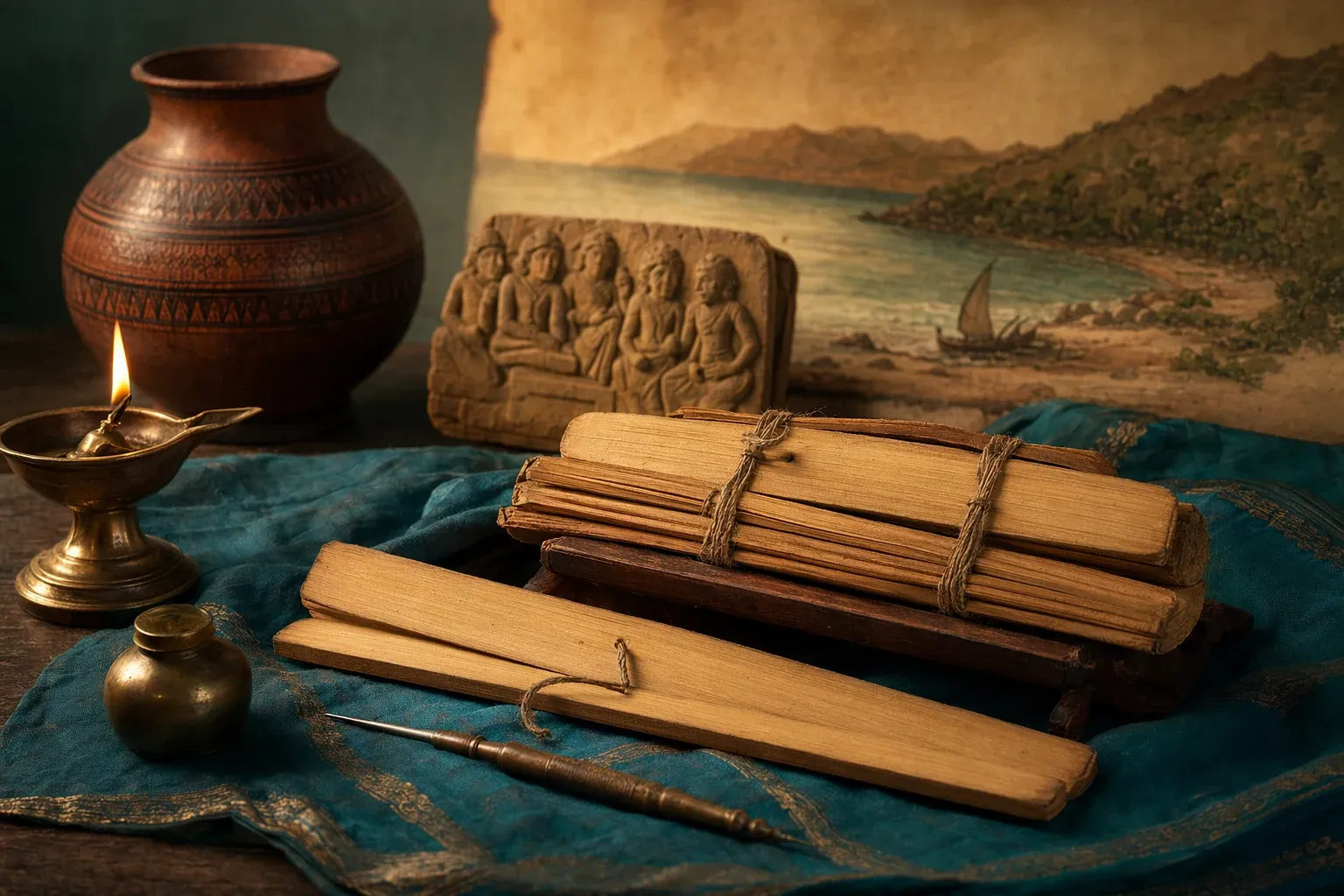
Beginners sometimes confuse the language of a text with the script used to write or preserve it. A language is the spoken and literary system: Tamil in this case. A script is the set of written signs used to record it. Early Tamil inscriptions are associated with Tamil-Brahmi, while manuscripts and later printed editions passed through different stages of writing, copying, editing, and commentary.
So when we ask, “Which language is Sangam literature written in?” the answer is Classical Tamil. When we ask how the texts reached us, the answer becomes more complicated: oral memory, palm-leaf manuscript traditions, medieval commentary, modern editing, printing, and academic study all played a role.
Why translations feel different
A good English translation can help beginners enter the poems, but it cannot carry every layer. Tamil words may hold landscape, emotion, social position, and poetic convention at once. A translator must choose whether to sound literal, lyrical, explanatory, or simple. Each choice reveals something and hides something.
For example, a poem about a woman waiting near the seashore may not simply be “about the sea.” The coast can signal a particular emotional situation, a type of waiting, a rhythm of trade and departure, and a mood shaped by wind, salt, boats, and uncertainty. In Tamil, those associations can be compact. In English, they may need a note.
Why the language answer matters
Saying that Sangam literature is written in Classical Tamil gives Tamil its rightful place in world literary history. These poems are not merely historical data for kings and wars. They are crafted works of language, with beauty, restraint, wit, tenderness, and sharp observation.
The language also reminds us that Indian literature is not only one stream. Sanskrit, Pali, Prakrit, Tamil, Kannada, Telugu, Bengali, Assamese, Malayalam, Marathi, and many other languages have carried serious thought and artistic power. Sangam poetry is one of the clearest examples of an early Indian regional literary tradition standing with confidence.
A beginner’s way to read it
Start with a reliable translation, but keep the Tamil identity of the poems in mind. Notice repeated landscape words. Notice how few lines are needed to create a scene. Notice whether the poem speaks in a private voice or a public voice. If you know Tamil, compare a small passage with the original and see where the English version expands or softens it.
Above all, do not treat Classical Tamil as a museum label. The poems survived because readers, singers, teachers, editors, and communities continued to care. Their language is old, but the emotions are still recognisable: longing, pride, generosity, shame, patience, loyalty, and the desire to be remembered well.
Simple takeaway
Sangam literature is written mainly in Classical Tamil, an early literary form of Tamil with its own grammar, imagery, and poetic codes. Understanding that answer helps beginners respect both the age of the poems and the living Tamil tradition that continues to read them.