
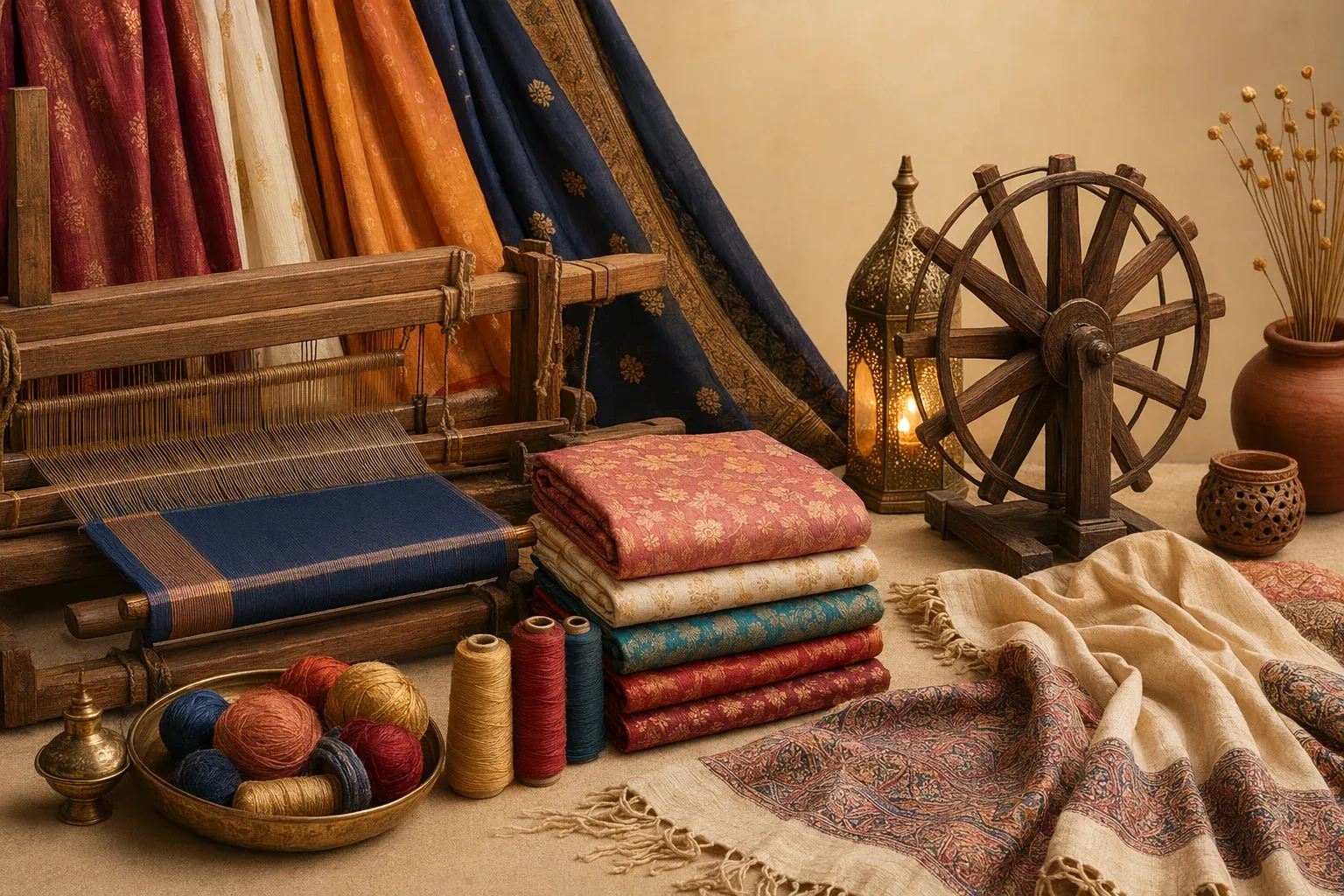
Many Indian cities and regions are famous for textiles, but the honest beginner answer is not “one city equals one fabric.” Textile identities grow from weaving communities, trade routes, courts, temples, climate, raw materials, local taste, and long histories of exchange.
Simple meaning
A useful textile map names both place and technique. Varanasi is famous for brocades and Banarasi saris; Kanchipuram for silk saris; Kutch and parts of Gujarat for Ajrakh, Bandhani, embroidery, and craft clusters; Jaipur, Bagru, and Sanganer for block printing; Lucknow for Chikankari; Chanderi for light woven fabrics; Kashmir for shawls and Kashida; Assam for Muga and Eri silk traditions.
These examples are starting points, not borders. Many textile traditions spread across districts, villages, communities, and markets rather than staying inside one city limit.
The wider textile context
Indian textiles are not only fabric in the shopping sense. They connect agriculture, trade, climate, community knowledge, ritual use, family memory, regional identity, and everyday design. A cotton gamcha, a Banarasi brocade, a Kanchipuram silk sari, an Ajrakh print, a Kantha stitch, and a handloom stole all belong to different worlds, but each shows how cloth can carry culture.
That is why beginners should learn textiles through four questions: What is the material? How was it made? Where does the design come from? How is it used by people? These questions keep the topic practical, not just decorative.
North India
Varanasi is known for Banarasi brocade and saris. Lucknow is known for Chikankari embroidery. Kashmir is known for shawls, pashmina discussions, and Kashida embroidery. Punjab connects with Phulkari and everyday textile culture.
West India
Gujarat and Rajasthan include Bandhani, Ajrakh, mirror work, embroidery, Dabu, Bagru, Sanganeri, and many weaving and printing clusters. Kutch is especially important for craft diversity.
South India
Kanchipuram is famous for silk saris. Telangana and Andhra regions connect with Ikat and Kalamkari-related textile worlds. Karnataka, Tamil Nadu, and Kerala also have important weaving and dress traditions.
East and North-East India
Bengal has Jamdani, Kantha, Baluchari, and other textile traditions. Odisha has Ikat and appliqué-linked craft worlds. Assam is famous for Muga, Eri, and weaving traditions connected to daily and ceremonial life.
Examples to remember
- Varanasi: Banarasi brocade and wedding saris.
- Kanchipuram: silk saris with strong borders.
- Lucknow: Chikankari embroidery.
- Kutch: Ajrakh, Bandhani, embroidery, and craft clusters.
- Assam: Muga and Eri silk traditions.
How to look closely
When you see a textile, slow down for a minute. Notice the fibre, weight, texture, border, repeat, colour, motif, stitch, drape, and finishing. A beginner does not need to know every name immediately; careful looking is the first skill.
- Check whether the pattern is woven, printed, dyed, or embroidered.
- Look for regional names instead of relying only on broad labels.
- Ask whether the piece is handmade, hand-finished, machine-made, or inspired by a handmade tradition.
- Separate daily-use cloth, ceremonial cloth, fashion fabric, and home decor fabric.
- If a seller or caption gives a cultural claim, see whether it names maker, place, or technique clearly.
Care, source, and everyday use
A textile becomes more meaningful when you know how to care for it. Store special pieces away from harsh sunlight, avoid rough washing when dyes or embroidery are delicate, air fabrics before packing them for long periods, and repair small damage early. Care is not separate from culture; it is how a cloth survives long enough to become memory.
If you are buying, ask for source details in a calm and practical way. A good answer may name a town, weaving cluster, artisan group, cooperative, brand partnership, fibre, dye, or technique. A weak answer usually stays vague: “Indian print”, “heritage style”, “handmade look”, or “ethnic design” without explaining what was actually made by hand.
For students and young readers, the best learning path is simple: start with one textile you have at home, identify its material and technique, ask an elder or seller what they know about it, then compare that story with reliable craft references. This turns culture from a distant subject into something you can touch, question, and protect.
Respectful learning and use
The respectful way to learn Indian textiles is to keep maker, place, and purpose in the frame. When possible, name the region, technique, artisan group, material, and use. Avoid treating every pattern as a generic “ethnic” design, and avoid turning sacred or community-specific motifs into random decoration.
This matters because textiles are often made by people whose names do not appear in glossy photos. Better learning can turn appreciation into support: buying fewer but better pieces, crediting crafts, caring for fabric, and teaching others the right names.
Common mistakes to avoid
- Treating a map as exact when craft geography is often regional.
- Ignoring villages and artisan clusters in favour of only big cities.
- Assuming a textile name always means it was made in the famous place.
- Forgetting that migration and markets can shift where textiles are produced.
Why it still matters
Textiles stay close to life. They touch the body, enter homes, appear in rituals, mark festivals, carry family memory, and move through markets. For young readers, they are one of the easiest ways to understand Indian culture because they are visible, useful, and full of stories.
At the same time, textile heritage needs more than admiration. It needs honest naming, fair sourcing, patient care, and respect for the communities that kept these skills alive. When we learn cloth properly, we also learn how culture survives through everyday work.
Helpful next reads
For related context, read traditional clothing in Punjab and local handicrafts and cultural context. These public Bhaktilipi guides connect textiles with broader questions of culture, craft, and responsible appreciation.
Final takeaway
Indian textiles are easier to understand when you treat them as living culture, not only beautiful surface. Learn the material, technique, region, maker, and use. That simple habit makes every sari, shawl, print, stitch, or home textile more meaningful.