
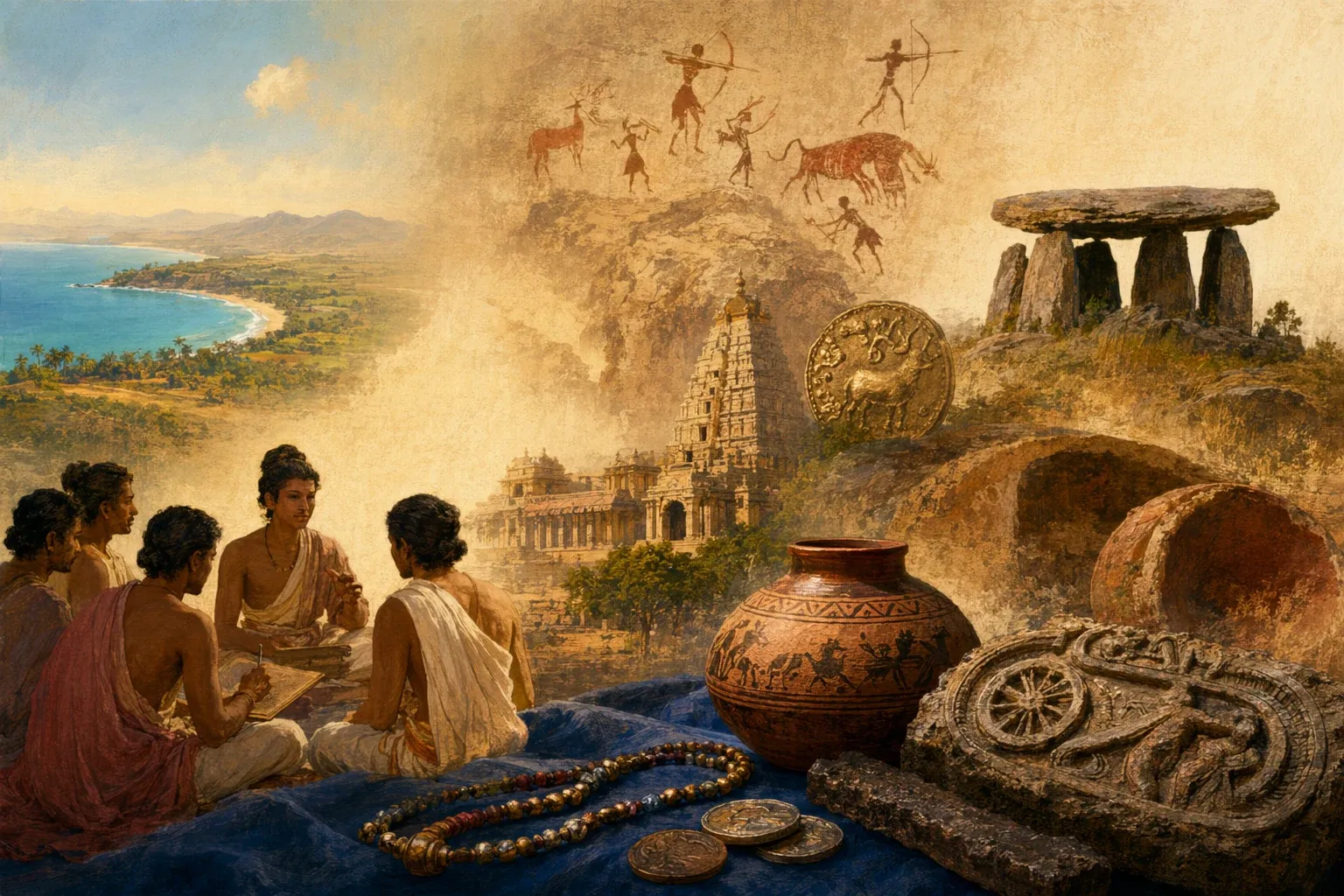
Sangam literature is usually connected with the early historic period of South India, often discussed around the centuries before and after the Common Era. But a careful answer must also say that poems, oral memory, compilation and later manuscript transmission do not always share one neat date.
So the best beginner answer is cautious: learn the broad period, understand why dating is difficult, and avoid turning a complex literary tradition into one overconfident year.
The simple meaning
A beginner-safe answer is that many Sangam poems are connected with the early centuries before and after the Common Era, while the collections as we know them were preserved and studied through later tradition.
If you are new to the topic, think of Sangam literature as a poetic archive of early Tamil imagination. It preserves voices that speak about love, separation, generosity, courage, kings, landscapes, towns, ports, grief, and moral choices. That is why it feels both ancient and surprisingly close to everyday human life.
Tradition, interpretation, and historical context
Tradition gives Sangam literature a sacred place in Tamil cultural memory. It remembers poets, assemblies, patrons, and the dignity of Tamil as a classical language. This layer deserves respect because communities do not preserve literature for centuries unless it matters deeply to them.
Interpretation asks what the poems mean. Some poems show inner emotions like love, waiting, longing, and trust. Others show public life: honour, war, generosity, kingship, death, fame, and social duty. The poems are short, but their emotional world is wide.
Historical context asks what the evidence can support. Scholars study language, poetic conventions, anthologies, references to rulers and trade, archaeology, inscriptions, and later commentaries. This does not reduce the beauty of the poems; it protects them from careless exaggeration.
Examples to remember
- early Tamilakam society
- Chera, Chola, and Pandya references
- trade and coastal life
- poetic conventions that may preserve older memory
- later compilation and commentary traditions
The broad Sangam age
The best beginning is a clear, calm answer. A careful timeline article that gives a beginner-safe date range, explains why exact dating is debated, and connects the literature to early historic South India instead of making exaggerated claims. A beginner should come away knowing what the topic means, why it belongs to Tamil literary heritage, and why it matters beyond exam revision.
A short answer is useful, but a good explanation should add one more layer: what kind of people, places, and feelings are visible through the poems. That is where Sangam literature becomes more than a definition.
Why dating Sangam poems is difficult
Tradition remembers Sangam literature through the idea of learned poetic assemblies, respected poets, patrons, and the pride of Tamil. Interpretation asks what the poems teach about emotion, ethics, power, society, and beauty. Historical context checks language, dating, anthologies, archaeology, trade references, and social clues without making careless claims.
For example, the same poem may be read as literature, cultural memory, and historical clue. Literature looks at image and emotion. Cultural memory asks why people valued it. History asks what it can safely tell us about a time and place.
Clues scholars use for dating
A useful way to study the topic is to connect text with life. Sangam poems are not only decorative verses. They can show how people imagined love, honour, generosity, grief, kingship, friendship, landscape, livelihood, and public reputation.
This is especially helpful for students. Instead of memorising a random list, connect each title or idea with a function: anthology, poem, landscape, theme, poet, patron, or historical clue. The subject becomes easier and more meaningful.
Tamilakam society, trade, kings and cities
We should also be careful with labels. Ancient does not mean simple, and poetic does not mean historically useless. A poem is not a census record, but repeated details about places, goods, rulers, occupations, emotions, and customs can still help historians ask better questions.
A careful reader should avoid two extremes. One extreme treats every traditional detail as automatically proven. The other treats tradition as useless. The better path is respectful curiosity: listen first, then examine evidence honestly.
A simple timeline with an uncertainty note
The goal is balanced understanding. Keep the simple definition in mind, remember a few examples, and avoid turning a living literary tradition into either dry memorisation or exaggerated internet certainty.
The modern value is simple: Sangam literature teaches us to see culture through language, ecology, emotion, and society together. It shows that poetry can carry memory without becoming a boring record.
Common mistakes to avoid
- Do not treat Sangam literature as one single book by one author.
- Do not present every traditional story as a proven historical fact; respect tradition and explain evidence separately.
- Do not reduce the poems to exam lists only. Their imagery, emotion, and social detail are the real treasure.
- Do not confuse original Tamil composition with modern translations or student summaries.
- Do not use random download pages or old public blog pages as sources for claims.
Questions people ask
How old is Sangam literature?
A careful beginner answer places many Sangam poems in the broad early historic period of South India, especially the early centuries before and after the Common Era, while noting that exact dating and compilation history are debated.
When was Sangam literature composed?
When was Sangam literature composed and in which language?
What is Sangam literature in history?
Sangam literature means the early classical Tamil poetic tradition preserved in major anthologies and related texts. It includes poems on love, war, kings, ethics, landscapes, trade, and everyday life in ancient Tamilakam.
How do historians date early Tamil texts?
The original language is early/classical Tamil. Modern English, Hindi, Telugu, Malayalam, and other versions are translations or explanations, useful for beginners but not the original language of composition.
Why it matters today
Sangam literature matters today because it gives young Indians a wider map of heritage. It reminds us that Indian culture includes Sanskrit, Tamil, Prakrit, Pali, regional languages, oral traditions, temple cultures, courtly worlds, folk memories, and many ways of thinking about life.
It also teaches humility. A poem from long ago can still speak about waiting for someone, grieving a warrior, praising generosity, watching the sea, fearing separation, or admiring courage. The language is ancient, but the emotions are human.
Dates matter, but honesty matters more. Sangam literature should be introduced as ancient and deeply important without pretending every poem can be fixed to one exact year.
Related guides
For nearby public context on South Indian heritage, you may also read South Indian inscriptions and Halmidi inscription. These links are meant as wider background, not as replacements for studying Sangam literature itself.