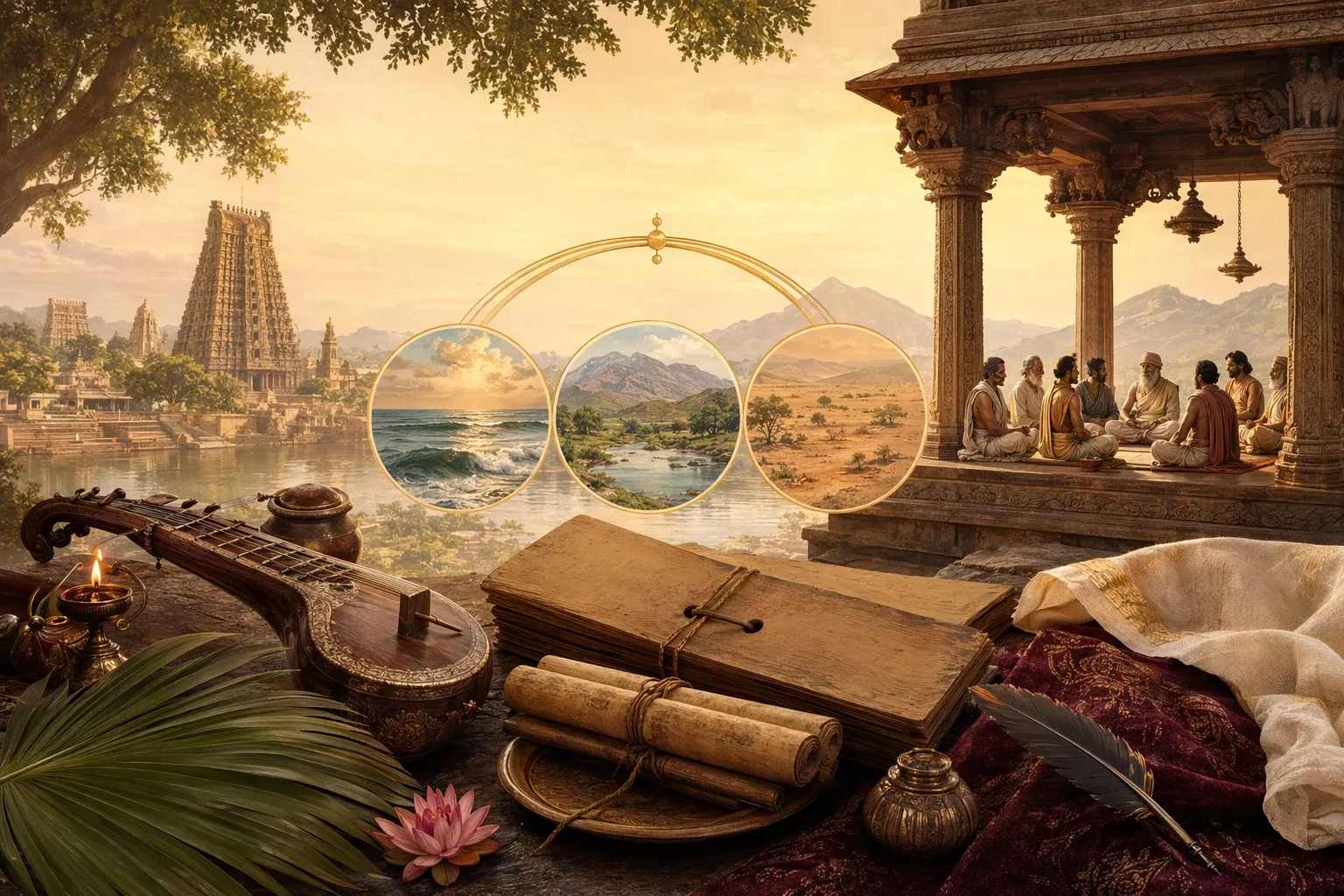
It is called Sangam literature because Tamil tradition connects these poems with learned assemblies of poets and scholars known as Sangams. The word “Sangam” can be understood as an assembly, gathering, or academy. In Tamil cultural memory, these assemblies became a powerful way to describe the dignity and antiquity of early Tamil poetry.
The idea is beautiful, but it must be explained carefully. Beginners should not imagine a modern college campus with attendance registers, fixed classrooms, and printed certificates. The Sangam story belongs to literary memory, later tradition, and cultural imagination, while the poems themselves are studied through language, themes, manuscript history, and historical clues.
What does Sangam mean?
In this context, Sangam means a gathering of learned people, especially poets. The name suggests that poetry was not treated as casual entertainment alone. It belonged to a respected world of composition, listening, judgement, memory, and refinement. A poem had to fit artistic rules, emotional truth, and social expectation.
This is one reason the title “Sangam literature” carries such pride. It tells readers that early Tamil poems were part of a serious literary culture. They were not random folk fragments. They show discipline, subtle imagery, compact structure, and a shared understanding of themes such as love, war, honour, generosity, grief, and ethical conduct.
The tradition of three Sangams
Tamil tradition speaks of three Sangams. They are often described as great assemblies held across vast periods, with the last Sangam associated with Madurai. The first two are placed in a remote, almost legendary past, while the third is connected more closely with the surviving body of classical Tamil poetry.
For beginners, the safest way to understand this is to treat the three Sangams as a traditional framework of memory. They express the belief that Tamil poetry has deep roots, ancient institutions, and long continuity. Whether every detail can be proven like a modern government record is a different question.
Why historians are careful
Historians and literary scholars are careful because ancient traditions often mix memory, symbolism, pride, and fact. The three Sangams are described in later sources, and some parts of the story are difficult to verify. That does not mean the tradition is worthless. It means we should not force it into either blind acceptance or total dismissal.
A balanced reader can say: Tamil tradition remembers great poetic assemblies, and the surviving poems show that early Tamil literary culture was highly developed. At the same time, details about the first two Sangams belong more to cultural memory than to firm historical reconstruction.
Madurai and literary authority
Madurai holds a special place in the Sangam imagination. It is remembered as a centre of Tamil learning, poetry, and Pandya patronage. Even when historians debate details, the association of Madurai with Tamil literary authority remains culturally important.
This association also helps explain why Sangam literature is not only about poems on a page. It is tied to place, patronage, courtly culture, learned judgement, and the idea that language deserves public honour. A poem could travel through oral performance, courtly praise, anthology making, and later commentary before reaching modern readers.
What survives today?
The surviving corpus includes important anthologies and longer poems. Readers often meet names such as Ettuthogai, the Eight Anthologies, and Pattuppattu, the Ten Idylls. These works preserve poems about inner emotional life and public action. Tamil literary study often uses the categories akam and puram to discuss these two broad worlds.
Akam poetry deals with love, longing, union, waiting, secrecy, and emotional landscapes. Puram poetry deals with war, generosity, death, honour, kings, bards, and public reputation. The Sangam name covers this artistic universe, not just the legend of assemblies.
Why the name still matters
The name “Sangam literature” gives cultural shape to a large and diverse body of poetry. It tells us that these works were remembered as refined, ancient, and worthy of study. It also gives Tamil readers a shared term for a classical inheritance that continues to shape identity, education, and literary pride.
For non-Tamil beginners, the name is a doorway. It invites us to see Indian literary history as multilingual. Classical Tamil stands beside other Indian literary traditions with its own voice, not as a footnote. To understand that wider context, you may also read Bhaktilipi’s introduction to what Sangam literature is.
A careful way to explain it in class
If you are answering this question in school or in a beginner discussion, say this: Sangam literature is named after the traditional Tamil idea of poet assemblies called Sangams. Tradition speaks of three Sangams, with the last linked to Madurai and to the surviving classical poems. Scholars respect the tradition but also study the poems through language, history, and manuscript evidence.
That answer avoids two mistakes. It does not treat the three Sangams as a simple modern fact without context. It also does not insult the tradition by calling it meaningless. It keeps cultural memory and historical caution together.
Simple takeaway
Sangam literature gets its name from the Tamil tradition of learned poet assemblies. The three Sangams express a powerful memory of ancient Tamil literary excellence. The surviving poems prove that early Tamil culture had a refined poetic world, even when some details of the assembly tradition must be handled with care.
Why the term is useful for beginners
The term also gives students a practical label for a large set of poems that would otherwise feel scattered. When a teacher says Sangam literature, the class can discuss early Tamil love poetry, public poems, anthologies, poet memory, and Madurai tradition under one umbrella. The name is therefore both cultural and educational: it helps organise study while still pointing back to Tamil memory.