
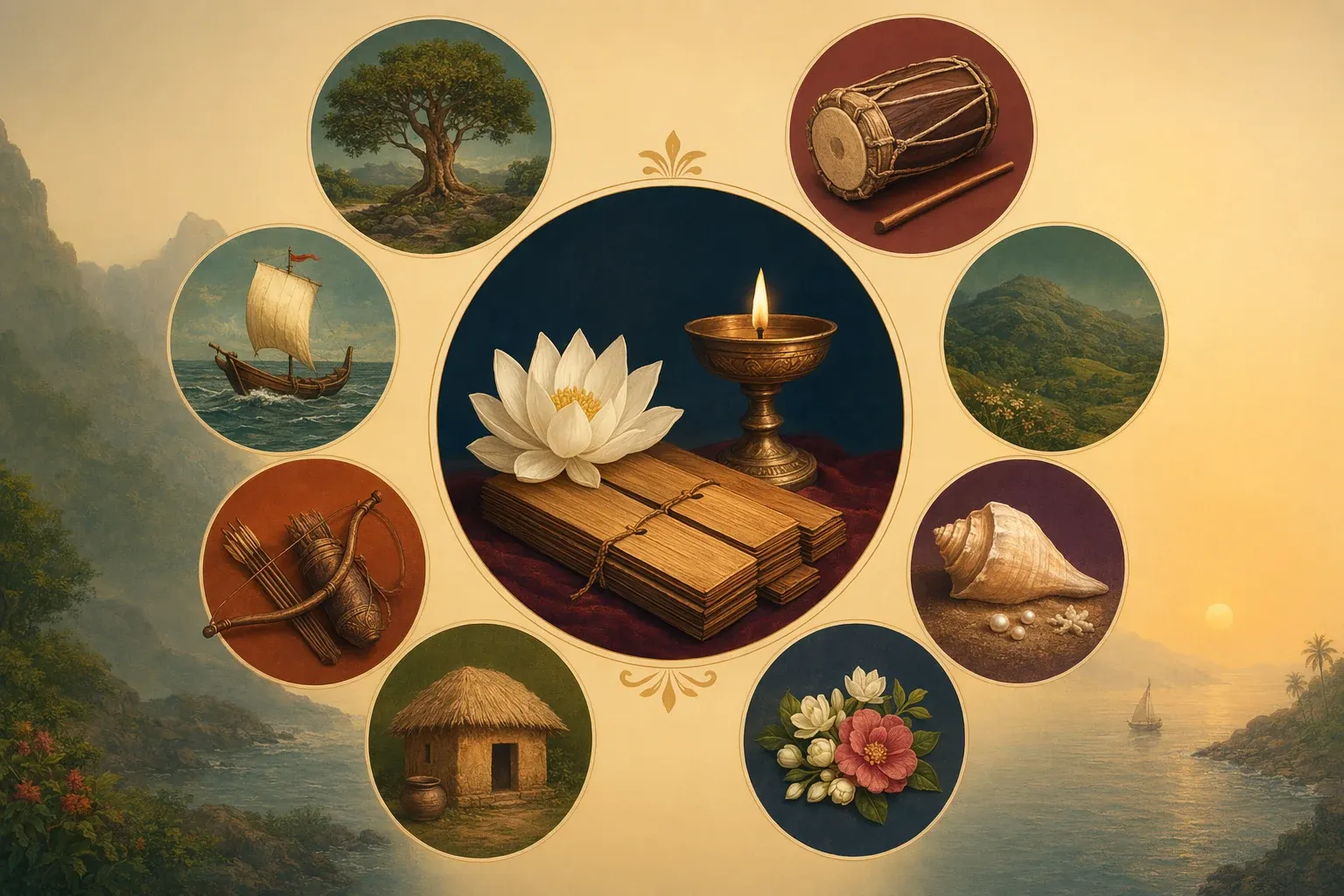
Ettuthogai means “Eight Anthologies.” It is one of the most important groupings in Sangam literature and preserves many short Tamil poems from the classical period. For beginners, Ettuthogai can seem intimidating because the names are unfamiliar. Once you see the pattern, it becomes much easier: these are eight collections that gather poems on love, public life, landscape, kingship, devotion, war, generosity, and emotion.
Before going into the list, it helps to know the bigger picture. Sangam literature includes many poems composed in Classical Tamil. Bhaktilipi’s overview of what Sangam literature means explains the basic frame, while the guide on the Sangam period gives historical context. Ettuthogai is one major doorway into that world.
What are the eight anthologies?
The eight anthologies are traditionally listed as Natrinai, Kuruntokai, Ainkurunuru, Pathitrupathu, Paripadal, Kalithogai, Akananuru, and Purananuru. Different spellings appear in English because Tamil sounds are transliterated in more than one way. Do not worry if one book writes Kuruntokai and another writes Kurunthogai. They refer to the same collection.
The names may look difficult at first, but each collection has its own character. Some lean toward love poetry, some toward public themes, some toward a specific poetic metre or arrangement, and some toward praise, landscape, or ethical memory.
Natrinai and Kuruntokai
Natrinai and Kuruntokai are especially important for akam poetry, the inner world of love and feeling. These poems often speak through lovers, friends, mothers, and messengers. They do not usually explain everything directly. A hill path, a night journey, a waiting woman, a friend’s warning, or a seasonal sign may reveal the emotional situation.
Kuruntokai is known for short, concentrated poems. A beginner may enjoy it because many poems are brief, but brief does not mean simple. A few lines can carry longing, secrecy, hesitation, and social pressure. Natrinai also offers rich emotional scenes and shows how landscape and feeling are joined in Tamil poetics.
Ainkurunuru and Kalithogai
Ainkurunuru is arranged around the five landscapes of Tamil love poetry: kurinji, mullai, marutham, neithal, and palai. Each landscape is linked with a mood, setting, time, and emotional situation. This makes Ainkurunuru especially useful for understanding how Sangam poets turned geography into feeling.
Kalithogai is known for poems in the kali metre. It can feel more elaborate, musical, and dramatic. The collection gives readers another taste of how form shapes meaning. The rhythm and structure are not decoration; they affect how a poem moves and how emotion is heard.
Akananuru and Purananuru
Akananuru means “four hundred poems of the interior,” and it is a major collection for akam themes. It explores love, separation, union, patience, secrecy, and the delicate relationship between personal desire and social boundaries. It is one of the best places to see how sophisticated Tamil love poetry can be.
Purananuru, by contrast, is a central collection for puram themes, the public world. It includes poems on kings, battle, death, honour, generosity, poverty, bards, and moral reputation. Some poems praise rulers, while others speak with astonishing emotional directness about loss and impermanence.
Pathitrupathu and Paripadal
Pathitrupathu is associated especially with praise poems connected to Chera rulers. It helps readers see how poetry, kingship, public memory, and patronage worked together. Such poems are valuable not only as literature but also as evidence for political imagination and social ideals.
Paripadal has a distinctive place because it includes devotional and musical elements, with poems connected to deities and rivers. It shows that Sangam literature is not limited to love and war alone. Its world includes worship, music, landscape, and sacred feeling too.
Why Ettuthogai matters
Ettuthogai matters because it preserves variety. If you read only one or two famous poems, you may think Sangam literature has a single tone. The Eight Anthologies show the opposite. They include quiet love poems, sharp public poems, praise, lament, devotion, social observation, and technical poetic skill.
They also show that ancient Tamil poetry was organised with care. The poems were not left as a loose pile. Later tradition grouped, preserved, named, and interpreted them. That process helped them survive long enough for modern readers to study them.
How beginners should approach the list
Do not try to memorise all eight names on the first day. Start by remembering two pairs: akam is the inner world, and puram is the public world. Then place Akananuru and Natrinai closer to love themes, and Purananuru closer to public themes. After that, add Ainkurunuru for the five landscapes, Pathitrupathu for Chera praise, and Paripadal for music and devotion.
Read a few translated poems slowly. Ask who is speaking, what landscape appears, what emotion is implied, and what social value is being tested. That habit will teach more than memorising a list without reading.
Simple takeaway
Ettuthogai, the Eight Anthologies, is a core part of Sangam literature. Its collections preserve many voices and moods of Classical Tamil poetry, from intimate love to public honour. For beginners, the best way to learn the list is to connect each anthology with its literary personality.
A note on names and spelling
English spellings of these anthologies can vary because Tamil words are being carried into another alphabet. A beginner should not panic when one source uses a slightly different spelling from another. Focus first on the collection’s role: whether it is closer to love poetry, public praise, landscape arrangement, music, devotion, or royal memory. Once that map is clear, the names become friendlier and easier to remember.