
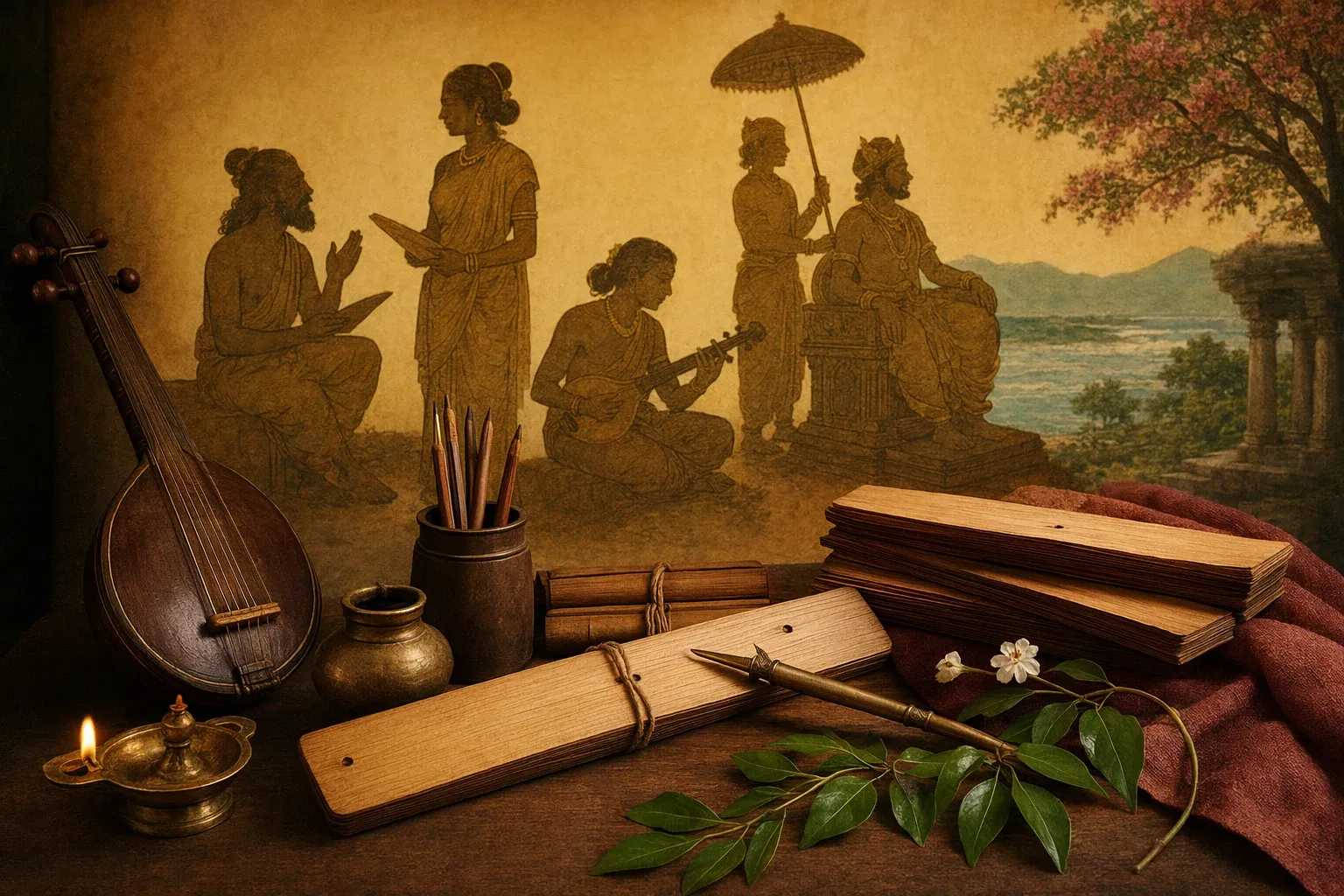
Sangam literature was not written by one author. It is a large body of poems connected with many Tamil poets, singers, court bards, women writers, learned teachers, kings, and local chieftains. That is why the question “Who wrote Sangam literature?” needs a wider answer than a single name.
A useful starting point is to remember that Sangam poetry is a collection tradition. Individual poems were attributed to different poets, then preserved in anthologies. Some poets are famous; some are known through only a few verses; some names may reflect poetic memory more than modern biography. Together, they create one of the richest early literary landscapes in India.
Many poets, not one founder
Unlike a work such as the Ramayana, which is traditionally linked with Valmiki, or the Arthashastra, associated with Kautilya, Sangam literature is not centred on one founding author. It is closer to a literary archive: many short poems, arranged later into collections, with voices from different regions, courts, communities, and emotional worlds.
This matters because the poems do not all sound the same. Some speak with the delicacy of love poetry. Some praise kings. Some mourn warriors. Some criticise greed. Some celebrate generosity. Some describe hunger, travel, waiting, war drums, wet fields, mountain paths, or the loneliness of separation. The variety of poets helps explain the variety of moods.
Famous names beginners may meet
Several names appear often in introductions to Sangam poetry. Kapilar is remembered as a major poet, especially connected with friendship, ethics, patronage, and moving descriptions of people and place. Paranar is another respected name, often associated with public poems and historical memory. Nakkirar is linked with learned poetic authority in Tamil tradition.
Avvaiyar is especially beloved because the name is connected with wise female poetic voices in Tamil memory. There may have been more than one poet remembered by that name across different periods, but in beginner study, Avvaiyar represents the presence of women’s intelligence, moral clarity, and literary power in Tamil tradition.
These names should be treated with respect and care. We should not flatten them into modern celebrity profiles. Their importance lies in poems, attributions, later memory, and the way Tamil culture continued to honour them.
Were there women poets?
Yes. One of the most important things for beginners to know is that Sangam literature includes women’s voices. Some poems are attributed to women poets; many love poems speak through female characters, friends, mothers, and messengers. The result is a literary world where women are not simply decorations in a story. They think, wait, judge, desire, fear, advise, and speak.
This does not mean ancient society was equal in a modern sense. It means the literary record is more complex than a simple male-only picture. Women appear as poets, as speakers inside poems, and as figures whose emotional intelligence shapes the meaning of love poetry.
Patrons, kings, and chieftains
Poets needed audiences and patrons. Sangam poems often mention rulers from the Chera, Chola, and Pandya worlds, along with many smaller chiefs. Public poems could praise generosity, courage, victory, and honour. A patron who fed poets, protected people, gave gifts, or died bravely could be remembered in verse.
This relationship was not only flattery. A skilled poet could also preserve moral expectations. A ruler was expected to be generous, brave, and worthy of praise. Poetry helped create reputation, but it also carried judgement. A stingy or unjust ruler risked shame. In that sense, poets were part of the public conscience of their time.
Bards and oral performance
Many Sangam poems likely lived through performance before and alongside written preservation. Bards, singers, and reciters carried poems between courts and communities. Instruments, voice, memory, and occasion shaped how poetry was heard. A poem praising a generous chief was not merely read silently; it could be performed in a social setting where honour mattered.
This is why the “writer” question is not only about someone holding a pen. Ancient literature often moved through speech, song, memory, and later writing. The poet composed, the performer carried, the patron supported, the community remembered, and later editors arranged the material.
Why attribution can be difficult
Modern readers like clear biographies: birth date, hometown, complete works, and personal details. Sangam literature rarely gives that kind of certainty. Some poet names appear in colophons and traditional records. Some details may be shaped by later interpretation. Scholars compare language, style, history, and manuscript evidence to understand the tradition carefully.
This uncertainty should not make the poems feel weak. It should make us read them with humility. The poems are old, layered, and preserved across a long chain of memory. Their survival itself is remarkable.
How to read the poets responsibly
Read a few poems by named poets, but also pay attention to speakers inside the poems. Ask: Is this a lover speaking? A friend? A bard? A mother? A warrior’s community? A poet praising a patron? The voice of the poem may not be the same as the personal diary of the poet.
For broader grounding, pair this article with Bhaktilipi’s guides on the meaning of Sangam literature and its historical period. Those guides help separate legend, literary memory, and historical evidence.
Simple takeaway
Sangam literature was written and preserved by many Tamil poetic voices, not one author. Its world includes famous poets, women poets, bards, rulers, chieftains, patrons, performers, and later compilers. That shared authorship is part of its beauty: it lets us hear ancient Tamil society through many tones rather than one single voice.