
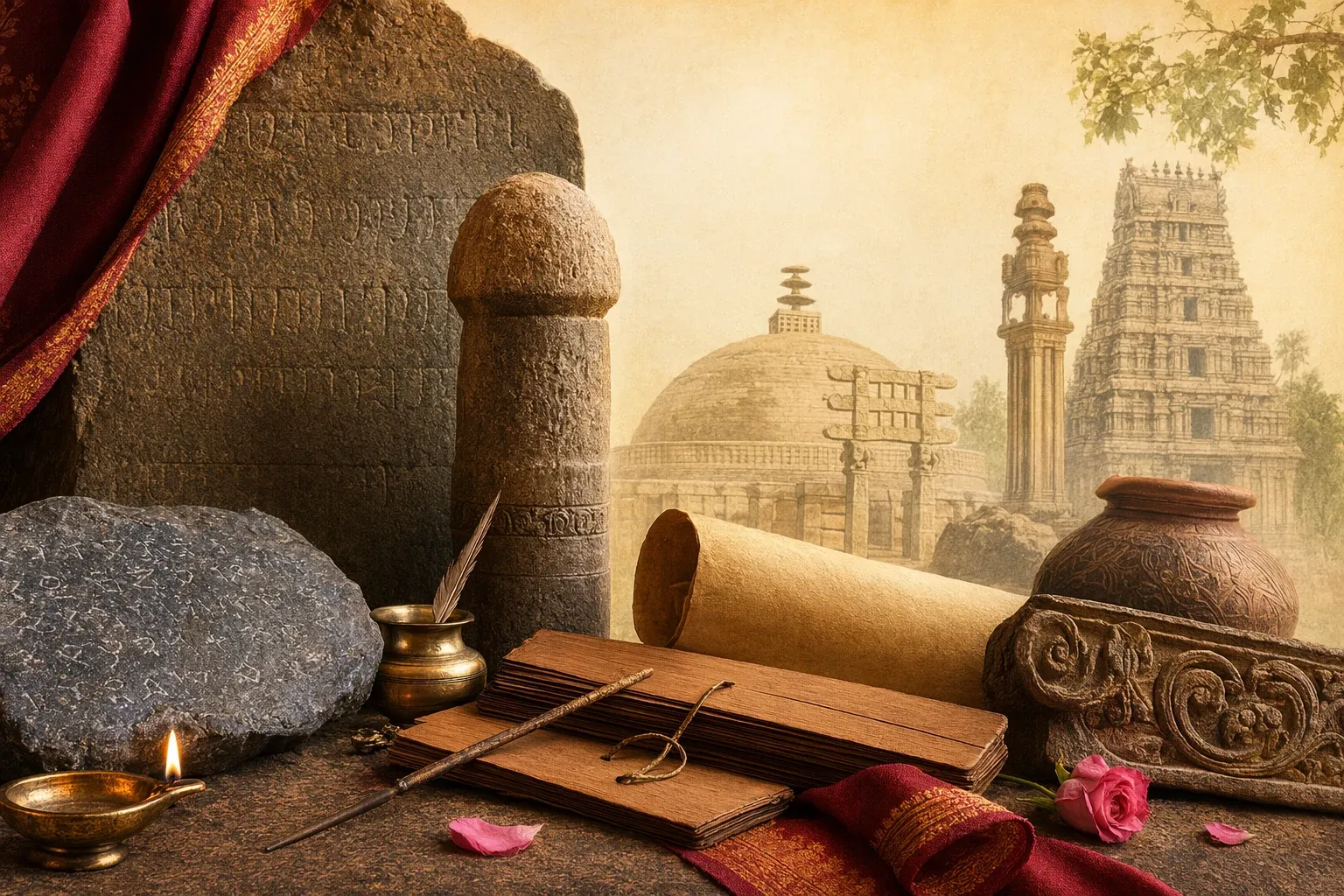
Ancient Indian inscriptions teach us two things at once: the script used to write letters and the language those letters record. Confusing these two is one of the most common beginner mistakes.
A script is the writing system. A language is what is being expressed. The same language can sometimes be written in more than one script, and the same script can be used for different languages over time.
The simple meaning
A script is the writing system, like Brahmi or Kharosthi. A language is what is being written, such as Prakrit, Sanskrit, Tamil, or a regional language. Mixing these up creates many online myths.
Think of inscriptions as messages that were meant to survive ordinary paper, memory, and gossip. They were often placed where people could see them, preserve them, or use them as proof. That is why epigraphs matter so much for reconstructing India’s past.
Tradition, interpretation, and historical context
Tradition tells us how communities remembered a king, temple, donor, teacher, pilgrimage place, sacred gift, or regional story. Many inscriptions belong to living religious and cultural spaces, so they deserve respectful attention, not casual handling.
Interpretation asks what the record is trying to communicate. A royal order may project authority. A donation record may honour merit and public generosity. A temple inscription may show devotion and also reveal economics, labour, land, language, and local power.
Historical context asks what can be verified. Historians check script, language, material, dating, location, formula, comparison with other records, and possible damage. This careful method protects us from both blind exaggeration and lazy dismissal.
Examples to remember
- Brahmi script
- Kharosthi script
- Prakrit inscriptions
- Sanskrit inscriptions
- Tamil and other regional-language records
- later regional scripts
Script vs language
The first task is to make the idea clear without making it childish. A myth-clearing article that teaches beginners the difference between script and language, then introduces Brahmi, Kharosthi, Prakrit, Sanskrit, Tamil and regional scripts without making exaggerated age claims. This matters because inscriptions are not just old writing. They are public records made for memory, authority, devotion, law, or community recognition.
A useful beginner answer should start with clarity, then add nuance. A one-line answer may be good for revision, but a real article should also explain why the record mattered to the people who created it.
Major early scripts in inscription study
Material changes meaning. A rock edict feels public and permanent. A copper plate can preserve a legal grant. A temple wall can record local devotion and administration. A coin or seal may carry short but powerful information about authority, language, and identity.
A stone, pillar, cave, copper plate, coin, seal, or temple wall is not just a background surface. It shapes how the message travelled, who could see it, how official it felt, and how long it could survive.
Prakrit, Sanskrit, Tamil and regional evidence
The content of inscriptions can be surprisingly practical. They may mention rulers, donors, taxes, land boundaries, festivals, lamps, villages, guilds, victories, repairs, teachers, temples, monasteries, or witnesses. That is why they help historians move beyond vague stories.
This is where inscriptions become exciting. They can reveal names of donors, villages, queens, merchants, monks, priests, artisans, officials, and communities that may not appear in famous literary narratives. Small records can carry big historical value.
Age claims need evidence
At the same time, inscriptions must be read carefully. Some praise kings in grand language. Some are damaged. Some dates are debated. Some records were copied, reused, moved, or misunderstood. Good history compares inscription evidence with archaeology, texts, coins, and local context.
A respectful reader should also accept uncertainty. If a date is debated, say so. If a translation is unsure, say so. If a claim depends on one damaged line, do not turn it into a loud internet fact.
How palaeography helps with dating
For today’s reader, the main lesson is patient attention. Do not treat an inscription as a mysterious code or a random quote. Ask where it was found, who recorded it, what it says, what it leaves out, and why someone wanted those words to last.
The best ending for an inscription topic is practical: learn the main meaning, remember two or three examples, and keep asking evidence-based questions. That habit is more valuable than memorising a list without context.
Common mistakes to avoid
- Do not treat every old mark as a fully readable inscription without evidence.
- Do not confuse script with language; Brahmi is a script, while Prakrit, Sanskrit, Tamil, and other tongues are languages.
- Do not use one inscription to prove a huge claim without comparing other evidence.
- Do not ignore sacred or local context when inscriptions are part of temples, monuments, or living communities.
- Do not depend on random downloads, uncited images, or fake translations when reliable references are available.
Questions people ask
What are the primary scripts found in ancient Indian inscriptions?
A script is the writing system, while a language is what is being written. Ancient Indian inscriptions include scripts such as Brahmi and Kharosthi and languages such as Prakrit, Sanskrit, Tamil, and regional languages.
Which languages appear in ancient Indian inscriptions?
A script is the writing system, while a language is what is being written. Ancient Indian inscriptions include scripts such as Brahmi and Kharosthi and languages such as Prakrit, Sanskrit, Tamil, and regional languages.
How are script and language different?
Common types include rock, pillar, cave, temple-wall, copper plate, coin, seal, and memorial inscriptions. They can also be grouped by purpose, such as royal orders, donations, land grants, victories, religious records, and memorials.
Is Prakrit older than Tamil?
A script is the writing system, while a language is what is being written. Ancient Indian inscriptions include scripts such as Brahmi and Kharosthi and languages such as Prakrit, Sanskrit, Tamil, and regional languages.
Is Sanskrit 10,000 years old?
A script is the writing system, while a language is what is being written. Ancient Indian inscriptions include scripts such as Brahmi and Kharosthi and languages such as Prakrit, Sanskrit, Tamil, and regional languages.
Why it matters today
Indian inscriptions matter today because they teach evidence-based curiosity. They show that history is not only a chain of legends or textbook dates. It is also built from public records, local names, materials, languages, and careful reading.
They also remind young readers that culture is documented in many forms. A temple wall, copper plate, rock face, coin, or seal can preserve social life just as powerfully as a famous book. When we learn to read them responsibly, we become better at respecting both heritage and truth.
When you separate script from language, inscription study suddenly becomes clearer. You stop chasing internet age claims and start looking at real evidence.
Related guides
For nearby context, read Halmidi inscription and Minor Rock Edicts. These public guides connect this inscription topic with related Indian-history examples without pulling the article away from its main focus.