
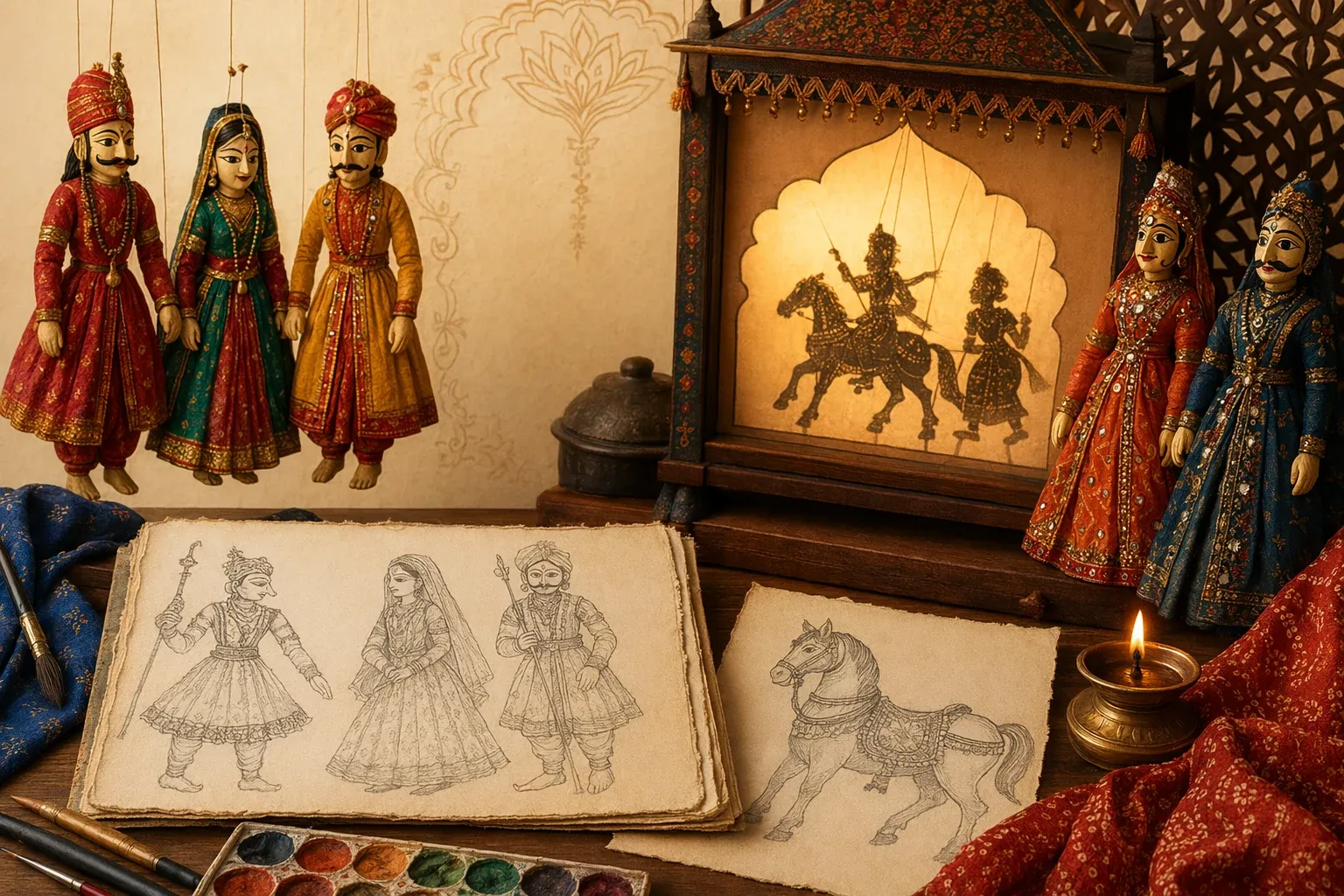
Indian puppetry art is more than a cute drawing of a puppet on a stage. It is performance design. A puppet has to look striking from a distance, move clearly, match a story, suit a region, and work with music, light, costume, and voice. When students search for Indian puppetry images or try an Indian puppetry drawing, the goal should not be to copy a random colourful figure. The better goal is to notice how form, material, costume, character, and performance style work together.
A puppet is made to be seen in action. A string puppet may need a light body, a strong head, and cloth that moves beautifully when the performer pulls the strings. A shadow puppet may need a flat leather body, cut-out details, and joints that create expressive silhouettes on a lit screen. A rod puppet may need strength and balance because it is controlled from below. A glove puppet needs a head and arms that respond quickly to the performer’s hand. These practical needs shape the art.
Puppetry art as performance design
When you look at Indian puppetry, ask four questions: How is it moved? What is it made of? Which story world does it belong to? What regional style does it reflect? These questions turn a drawing exercise into cultural learning. A puppet from Rajasthan, Kerala, Odisha, Andhra Pradesh, Karnataka, West Bengal, or Bihar may differ in face shape, costume, colour, jewellery, material, and movement. The drawing should show some of those differences instead of making every puppet look the same.
Indian puppetry often connects with other arts. Puppets may borrow costume and make-up from theatre and dance forms. Pavakathakali of Kerala reflects Kathakali’s dramatic headgear and facial style. Gombeyatta of Karnataka can show the influence of Yakshagana. Shadow puppets from southern India may resemble regional painting and leather craft. Rod puppets from Bengal may carry the visual energy of Jatra theatre. These links make puppetry a useful subject for art students because it teaches design through culture.
Common visual features to notice
Start with the face. Many puppets use bold eyes, sharp brows, strong noses, moustaches, crowns, or stylised expressions. The face has to communicate quickly to an audience. A hero, demon, queen, clown, sage, animal, or god may have a different visual code. The proportions may not look realistic, and that is not a mistake. Puppets often exaggerate the head, eyes, costume, or hands so the character reads clearly in performance.
Next look at costume. Indian puppets often use bright textiles, patterned skirts, jewellery, headgear, turbans, crowns, and decorative borders. In a string puppet, a flowing skirt can hide the absence of legs and also create beautiful movement. In a theatre-inspired puppet, costume may show the character’s rank or role. In a shadow puppet, the costume is not cloth but cut and painted design. The audience sees shape, perforation, and colour through the screen.
Materials matter too. Wooden puppets, leather puppets, cloth bodies, papier-mache parts, painted surfaces, bamboo supports, rods, strings, and metal details all create different visual effects. A polished wooden face feels different from a translucent leather silhouette. A puppet designed for a stage performance has different needs from a classroom craft puppet. If you draw a puppet, showing the strings, rods, hand opening, or screen can make the drawing more accurate.
How to draw Indian puppetry without stereotypes
The easiest mistake is to draw a generic “Indian puppet” with random jewellery, a moustache, and bright colours. That may look decorative, but it does not teach much. Choose one broad type first: string, shadow, rod, or glove. Then choose one regional example. For instance, you might draw a Kathputli-inspired string puppet with a turban, expressive eyes, and flowing Rajasthani costume. Or you might draw a Tholu Bommalata-inspired shadow puppet as a flat leather figure with jointed arms, patterned cut-outs, and a screen behind it.
Keep your drawing respectful. Avoid making faces silly unless you are drawing a comic character from a specific performance context. Do not mix sacred symbols carelessly. If you draw a deity character, treat the image with care and avoid turning it into a joke. If you are unsure, draw a narrator, dancer, animal, musician, or generic royal character instead of a sacred figure.
Label your drawing. A good student drawing can include small notes such as “strings attached to head and hands,” “leather shadow puppet,” “jointed arm,” “painted face,” “regional costume,” or “screen and lamp.” Labels show that you understand the art, not just the outline.
Student-safe drawing ideas
- Kathputli study: Draw a Rajasthani string puppet with visible strings, a bright skirt, a turban or head covering, and a small stage curtain.
- Shadow puppet study: Draw a flat leather puppet silhouette with decorative cut-outs, one jointed arm, and a lamp-screen setup.
- Rod puppet study: Draw a larger puppet with rods below the body and one rod connected to an arm, showing how the performer might control it.
- Glove puppet study: Draw a hand-puppet cross-section with the performer’s fingers controlling the head and arms.
- Comparison page: Divide a sheet into four boxes for string, shadow, rod, and glove puppets, with one example and one movement note for each.
These activities are safe because they focus on technique and visual observation. They do not ask students to copy a living artist’s exact puppet or reproduce a sacred icon without context. If you use a reference image, write where it came from.
Using Indian puppetry images responsibly
Images are useful for learning, but they should be used with credit. If you include an image in a school project, note the artist, institution, collection, page title, and link when available. Museum and cultural institution pages are good starting points because they often provide context. The IGNCA slide collection page, for example, explains how slides can show costume, face make-up, technical details, and regional variations. The Center for Puppetry Arts exhibit page offers a museum view of Indian puppetry styles and epic themes.
Do not remove watermarks, crop out captions, or repost an artist’s photograph as if it is free clip art. Do not use AI-generated or copied images as proof of a real tradition unless you clearly label them as illustrations. For cultural learning, a credited photo of a real puppet or performance is more valuable than a polished but inaccurate image.
If you are making your own drawing from a reference, do not trace and publish it without permission. For classroom practice, you can study shapes and then create your own labelled educational drawing. If your work is posted online, credit the reference and mention that your drawing is student work inspired by a particular tradition.
Visual checklist for regional details
Before finishing a drawing or image note, check these details. What type of puppet is it? Which state or region is associated with it? Is the body flat or three-dimensional? Are there strings, rods, a glove opening, or a shadow screen? What material is suggested: wood, leather, cloth, paper, or mixed materials? What is the costume saying about the character? Are there musical instruments, stage props, lamps, curtains, or a narrator? Does the puppet look like it can actually move?
This checklist helps students avoid two extremes. One extreme is a vague decorative drawing with no cultural detail. The other is an overloaded drawing with every possible Indian motif added at once. A strong drawing chooses a clear tradition, shows a few accurate features, and leaves space for the viewer to understand the performance.
How colours and materials tell the story
Colour is not just decoration. Bright textiles can help a puppet stand out in low light. Strong outlines help the audience read a character quickly. Dark silhouettes in shadow puppetry create drama, while translucent painted leather can produce glowing colour. Gold borders, crowns, jewellery, and patterned cloth may mark royal or divine characters. Earthy tones, simple clothing, or comic exaggeration may show village characters, clowns, animals, or attendants.
Materials also affect movement. A heavy puppet cannot move like a light paper figure. A leather shadow puppet needs pierced details and flexible joints. A wooden string puppet needs balance so it can dance without collapsing. A glove puppet needs a firm head but a flexible body. When students include these details, their drawings become more thoughtful and accurate.
FAQs
What does Indian puppetry art look like?
It varies by region and technique, but common features include bold faces, painted surfaces, colourful costumes, jewellery, headgear, strings, rods, leather silhouettes, stage props, and stylised character shapes.
How can students draw Indian puppetry?
Choose one type of puppet, pick a regional example, observe its movement and material, draw the main visual features, and add small labels explaining strings, rods, leather, costume, or stage setup.
What should I avoid in an Indian puppetry drawing?
Avoid generic stereotypes, careless sacred imagery, uncredited copying, and random decoration. Try to show a real technique or regional feature instead.
Can I use online images for a school project?
Yes, for study and presentation, but credit the source clearly. Use museum, cultural institution, or artist pages when possible, and do not repost or crop images in a misleading way.
Why do many puppets have exaggerated eyes or costumes?
Puppets are designed for performance. Exaggerated eyes, costumes, and shapes help the audience recognise characters and emotions quickly from a distance.